Choose the unloading method from the peak pallet rate: divide the filler's peak speed by the bottles on one pallet. A line filling twelve thousand bottles an hour from loads of two thousand four hundred bottles consumes five pallets an hour, one every twelve minutes, and no hand crew sustains that. Slow, occasional arrivals can be unloaded by hand; a steady moderate rate suits a semi-automatic layer unit; a high rate of one stable bottle and pallet format justifies a fully automatic depalletizer.
The scope here runs from a loaded pallet standing at the unloading station to the moment empty bottles reach the unscrambler infeed or the take-away conveyor. Container loading arithmetic sits in our guide to CBM and pallets per container.
What to read off the pallet load
A pallet of empty bottles is assembled at the glass plant: a base, bottles in a set pattern, pads separating the layers, sometimes a top cap, and film or banding securing the stack. Five figures are fixed at that moment and the receiving plan needs all of them: footprint, bottles per layer, layer count, finished height including the cap, and gross weight.
Footprint drives both freight and equipment. Two industrial sizes dominate: 1200 by 800 mm, the EUR and EPAL pool pallet, and 1200 by 1000 mm, common in export trades. Nominal dimensions for both follow the ISO 3394 family. A dock that takes both cannot run fixed guide rails or a fixed fork entry height, so write the pallet standard into the order instead of inheriting it from the previous supplier.
Bottles per pallet (layers multiplied by bottles per layer) is the figure that turns line speed into pallet rate. Gross weight per pallet is the other number the plan depends on.
Ask the supplier for two documents before shipment. One is a pallet load drawing giving layer pattern, bottles per layer, layer count, pad type and pallet specification. The other is a written pallet standard with a condition requirement. "It will be palletised" is not an answer to either request, and the gap tends to appear as a leaning stack on arrival.
Arrival formats and what each demands of the receiving site
Whoever writes the packing specification at origin picks the format, and nothing done at destination can change it afterwards.
- Palletised. The normal choice for repeat orders. Loads are stable, counts are exact, any standard forklift handles them and receiving is quick. The trade-off is the pallet: a one-way pallet adds material and some volume to each shipment, while a pooled pallet brings an account and a return duty.
- Slip-sheeted. A thin sheet stands in for the pallet, freeing payload and height. That helps with tall bottles where the pallet is what lifts the load above the container door. The forklift then needs a push-pull attachment, and a sweep-type unloading head will not work on a slip sheet. Buying a standard machine and later switching to slip sheets creates a mismatch training cannot solve.
- Floor loaded. Loose bottles or cases stacked on the container floor fill the box completely and give the lowest freight per bottle, but unloading is almost pure labour. It works for a single high-volume bottle feeding a dedicated line from a tipped or conveyed bin. For mixed or seasonal orders, or a site with no dedicated infeed, unloading usually eats more than the freight saving, and that labour stays invisible until someone counts hours per thousand bottles.
Sizing the station from the peak pallet rate
Annual volume is the wrong planning figure. A site averaging one pallet every twelve minutes may need one every four minutes in its busiest month, and the filler cannot slow down to suit the unloading crew.
Check four constraints in this order:
- Pallet rate, from bottles per pallet and line speed.
- Floor area for waiting full pallets, a pallet magazine, the empty pallet stack, the buffer ahead of the unscrambler and the path each empty pallet takes back to the stack.
- Door and lift height. A tall load sitting on a 150 mm pallet may fail to pass the container door, or the headroom above the machine.
- Load condition. Loads from one container do not all arrive alike. After a humid route the film may be slack, pads damp and columns leaning by a few degrees. Planning for the ideal load covers only the easy half of the day.
The usual way to expose the fourth problem early is to test a complete pallet load against the real route's transit conditions with a published programme such as the ISTA family, ahead of any commercial shipment.
Matching the unloading route to the order
Use the table as a worksheet: find the row that describes your order and move its last column into the purchase order. The volume descriptions are planning bands for comparison only. Where one route overtakes another depends on your pallet rate, labour rate and machine uptime, so confirm it against an equipment quotation.
| Order profile | Unloading route | What the load must be like | Confirm in writing before shipment |
|---|---|---|---|
| Palletised, single bottle, a few containers a year | By hand. A lift table, a turntable and one or two operators keep a slow line supplied, and the labour is intermittent. | Sound pallets, flat deck, no nails protruding; film tied to the pallet base; tops capped or padded. | Pallet standard and footprint, bottles per layer, layer count, gross weight, load height, who supplies pallets. |
| Palletised, single bottle, a container or more each month | Semi-automatic unit lifting one layer at a time while an operator guides bottles to the infeed. It takes away most of the lifting, not most of the labour. | Height and layer count identical from pallet to pallet; wrap a destrapper can strip; pads stiff enough not to fold at the pick head. | Tolerance on load height and bottles per layer, pad material and thickness, manual or machine wrap removal. |
| Palletised, several sizes or mixed loads | Manual or semi-automatic, since changeover between formats tends to cost more than the machine saves unless sizes share a finish and a diameter band. | One format per pallet where possible, format labelled clearly on the load, never two formats within a layer. | A pallet drawing per format, a changeover procedure, time needed between formats. |
| Palletised, single bottle, high volume, dedicated line | Fully automatic depalletizer. The filler sets the pallet rate, changeovers are rare and the rate carries the equipment. | Pallet specification unchanged between orders, pallets that feed a magazine, consistent wrap standard. | Pallet specification with condition clause, wrap and pad standard, buffer sizing, magazine capacity, empty pallet removal. |
| Slip-sheeted or floor loaded, single bottle, high volume | Floor unloading into a bin or hopper feed. Slip sheets require a push-pull forklift and rule out a sweep head. | Cases or bottles stacked square, pads between layers, a defined top layer, working room for the unloading equipment. | Forklift attachment at the receiving site, tipping or conveying, how loose bottles get to the unscrambler. |
| Cased bottles on pallets, or returnable crates in a closed loop | Case or crate unloading. The handled unit is the case, so the machine is chosen for that container format, not for loose bottles. | Sound cases or crates, cell size suited to the bottle, a loop that can count, wash and reissue units. | One-way or returnable, number of units in circulation, who owns the containers. |
Two of these rows lead to separate decisions. Packing at origin, and its effect on breakage before a load is even stacked, is covered under case packers for glass bottles. Closed-loop programmes where the container travels back to the filler are covered under returnable bottle crates.
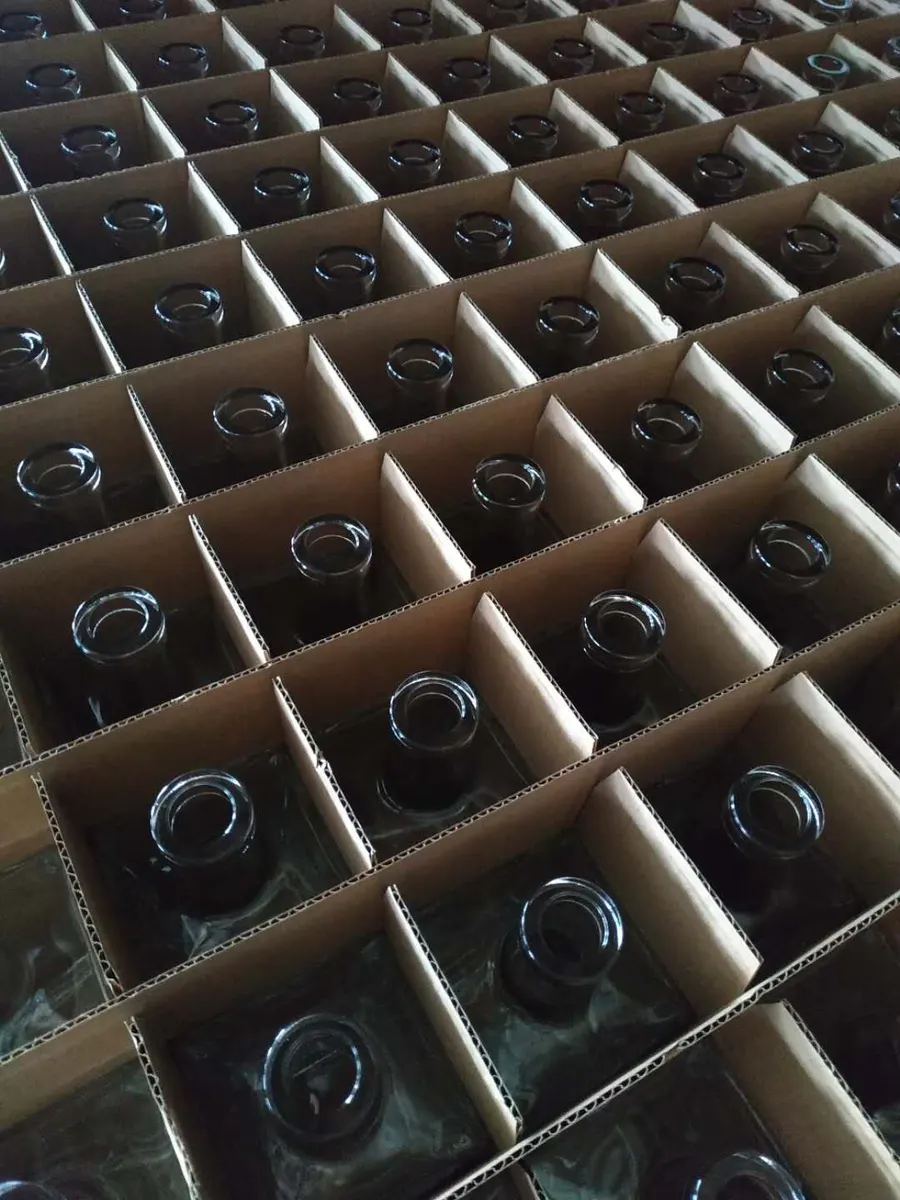
Pallet, wrap and layer pad requirements
Pallet condition
Everything is measured from the pallet. A layer-lifting machine expects the same top surface height on every load, and a hand crew needs a base that is safe to lean on. Typical defects are a cracked or absent top deck board, a bottom board gone at the fork entry, a raised nail, a wet or warped stringer, or a repair that makes one side higher.
On any of these the load tilts, the outer bottles sit below the inner ones at the pick, and the outer ring drops. Naming a pallet model is therefore not enough, because a standard model can turn up in poor condition. The acceptance clause should say sound, dry, level on the deck and free of protrusions.
Stretch wrap
Wrap holds layers to one another, which everyone applying it understands. Its second task is to anchor the lowest layer to the pallet so the stack cannot slide as one block under forklift braking or container handling. Film that begins at the bottles and never passes round the bottom board produces the classic leaning load: layers stay together while the whole stack shifts on its base.
Specify wrap so a destrapper can cope with it: a set number of turns, a set overlap, and no film routed beneath a top cap so that the cap ends up bound to the layers under it.
Layer pads
Pads get the least scrutiny and cause the most pick-head jams. Too thin, and the pad folds instead of drawing clear. Damp from a humid container, it sticks to bottle bases. Undersized, it leaves outer bottles overhanging its edge, and they tip as the layer rises. Put material, thickness, edge size and damp behaviour into the pack specification, and keep the pads from a first shipment as the reference for the next.
Causes of breakage at the unloading station
Breakage here follows a short list of causes. Identifying which one is present does more than making the machine gentler.
| Symptom | Cause | Where it is fixed |
|---|---|---|
| Leaning columns | Transport, not the machine | At origin: wrap anchored to the pallet, a square pallet, and a pattern whose interlocking does not fight the pick head |
| Chipped finish or neck | A gripper sized for another finish diameter, a transfer that pushes on the neck instead of the body, or operators lifting by the neck | Gripper and transfer design, handling practice. The finish is the thinnest part of a bottle and cannot serve as a handle. |
| Bottles toppling as the layer leaves the pallet | A partial row, or a count that differs from the pitch the machine assumes. The head lifts a gap and neighbouring bottles rotate. | Fix the layer count and remove partial rows, which costs less than guard rails added later |
| Chips or checks found later at the filler or by the customer | A drop at discharge onto a hard table or into a hopper, landing on base or heel | Lowest release height the layout permits, a soft landing surface, take-away speed matched to release speed |
| Glass-to-glass pressure on the transfer plate | Unloading head outrunning the take-away | Speed matching between the two |
The discharge drop is the quietest of these because the damage shows up downstream. Curing it takes a bracket and a few centimetres of headroom. Pressure between glass surfaces is the single condition every glass supplier asks line designers to avoid.
Buffer and handoff to the unscrambler
The buffer ahead of the unscrambler decides whether the station works. If it is too small, each pallet change, jam and wrap removal starves the line. If it is too large, the plant has paid for floor space and a stock of empty bottles that ties up capital without adding one pallet an hour.
Size it by adding the longest unavoidable interruption to an average jam. With a ninety-second pallet change and three minutes to clear a typical jam, five minutes of line consumption covers both. An oversized buffer also conceals a changeover problem that should be solved.
With manual pallet changes, that buffer justifies a lift table or turntable so a single operator works at a comfortable height. With automatic changes it justifies a pallet magazine and an empty pallet stacker, and the layout needs a fixed path for full pallets in and empties out.
Two interfaces remain. Between discharge and take-away, the slower side sets the rate and the faster side builds back pressure. Between the empty bottle feed and the unscrambler infeed, a bin or hopper may deliver only what the unscrambler absorbs, which is where loose-bottle formats tend to give back their advantage. Work backwards from line speed, never forwards from the machine.
Pallet return and pooling
Pallets are a second material flow, and their cost is the item most often missing from comparisons. Three models exist.
- One-way. Bought with the shipment and kept at the receiving plant for warehouse reuse or disposal. Nothing goes back, but money is spent on every shipment and pallets pile up in the yard.
- Pooled. Under an exchange system such as EUR and EPAL, pallets are returned or swapped and a balance runs between the parties. It is efficient when both ends lie within one pool area and costly when pallets must recross an ocean to square the account.
- Owned fleet. Pallets or returnable crates shuttle between two known points. Cost per trip is lowest on a short, stable route, and exposure is highest if the route or loop length changes.
Turnaround needs administration. At minimum: a pallet account counted at every shipment, a named person signing on receipt, monthly reconciliation with the supplier's count, and agreed handling of losses and of pallets returned damaged. For pooled pallets, settle the exchange rate and who answers for a pallet the pool rejects ahead of the first container. Purchase modes for palletised glass are set out on our hub page about buying empty glass containers in bulk.
Trade terms, unloading labour and pallet ownership
The trade term fixes where risk sits on arrival, who pays for unloading and who owns the pallet afterwards.
| Term | Effect on unloading and pallets |
|---|---|
| EXW | Goods and pallet belong to the buyer from the supplier's dock. Loading, pallet and unloading all fall to the buyer. |
| FOB and other F-group terms | Delivery is on board and risk passes at the ship. The pallet normally leaves the country with the cargo, so pooled accounts are hardest to balance and one-way pallets are often the practical choice. |
| CIF and CIP | The supplier arranges and pays carriage to the named place. Check what that place means: carriage to the destination port covers neither unloading at the buyer's plant nor pallet removal. |
| DDP | Delivery extends to the buyer's premises, so unloading and pallet handling are part of the purchase. The delivery point and the equipment available there become contract matters. |
Under any term, two clauses head off disputes over a damaged load. One names the unloading equipment and its provider, including whether a forklift with the correct attachment exists at the delivery point. The other sets a damage-reporting window and a joint inspection at unloading, with pallet, wrap and broken bottles kept as evidence.
If incoming lots are inspected by sampling, name the scheme and acceptance level in the order, following the widely used ISO 2859-1 and AQL approach. A claim then rests on an agreed method and not on the receiver's opinion.
Cost items to compare per thousand bottles
Comparisons argued on labour alone usually reach the wrong answer. Express five items per thousand bottles unloaded so that options share one basis:
- Labour in operator minutes per pallet, counting wrap removal, pad handling, pallet removal and jam recovery along with moving bottles.
- Equipment spread across the pallets it will really handle in a year, with maintenance and spares.
- Floor space for the station, buffer, magazine, empty stack and forklift route, since it is lost to other uses.
- Pallets and their return, which recur with every shipment.
- Lost bottles at landed cost, not ex-works value: a bottle broken at the station has already been shipped the whole route, and clearing it adds further cost.
Two more factors tend to settle the outcome. A station that cannot keep the filler supplied is paid for in idle filler time, normally a larger sum than any realistic labour saving, so automation is usually justified by uptime, not headcount. And a comparison built on twelve months of average volume understates every option sized for the peak month.
What to send us for an unloading plan
As a sourcing desk we write the pallet, wrap and pad requirements into the packing specification agreed with the glass plant, so the receiving side has to be known first. We need three things:
- Arrival format: palletised, slip-sheeted or floor loaded; pallet standard and condition; bottles per layer and layer count; gross weight and finished load height.
- Batch: annual volume, peak pallets per shift, and how many bottle sizes and pallet formats the station handles.
- Line speed at the filler in bottles per hour, with bottle capacity, container and finish.
Mention the trade term and delivery-point equipment if either is unusual. From that we can set out the unloading route, pallet and wrap specification with a dock-checkable condition clause, pad specification, buffer size, magazine and empty pallet arrangement, a return or pooling model fitting the trade term, and a cost comparison per thousand bottles at peak. A line designer, a forklift supplier and a pallet pool can then all work from one receiving plan.
Questions buyers ask about bottle depalletizers
Which pallet standard should empty bottles arrive on?
Either common footprint works, provided the order names it. Consistency matters more than the choice, because unloading equipment is set for one deck height and one footprint. Reject a load whose pallet fails the written condition requirement sooner than risk the layer sitting on it.
Do bottles have to come on pallets?
No, though the alternatives reshape the receiving plan. Slip sheets remove the pallet and its return cost but need push-pull handling at destination. Floor loading only pays for a single high-volume bottle feeding a dedicated infeed from a bin. A mixed or seasonal order on the floor combines a real freight saving with unloading that is hard to predict and hard to staff.
Can a single depalletizer handle several bottle sizes or pallet formats?
Often, but the cost lies in changeover. A new bottle diameter means resetting layer pitch and guides; a new pallet footprint means adjusting the datum and often the magazine; a new finish diameter can call for another gripper. Sizes within one diameter band and finish change over in minutes, and one machine is normally right. Otherwise weigh changeover time against changes per week. For mixed orders on shared pallets, a manual or semi-automatic station usually wins even when total volume is high.
Who pays for pallet return?
That follows from the trade term and the pallet model. Under DDP the return obligation can rest with the supplier if the contract states it. Whatever the term, the pallet account described above costs little to write and a great deal to argue about afterwards.