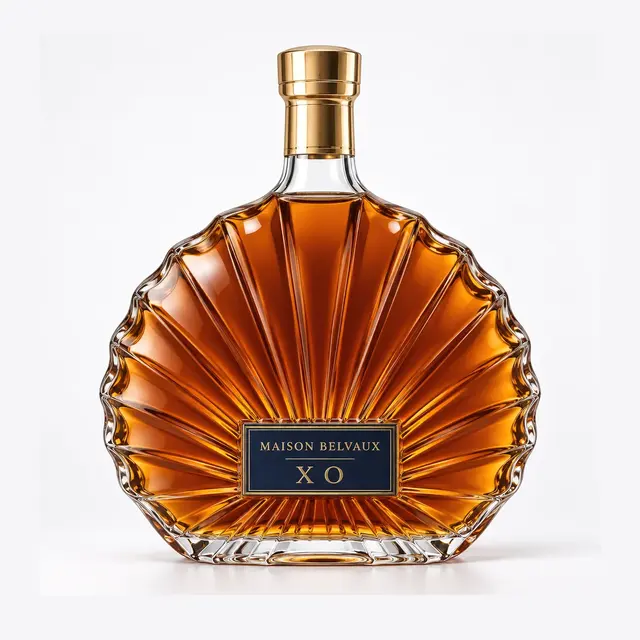

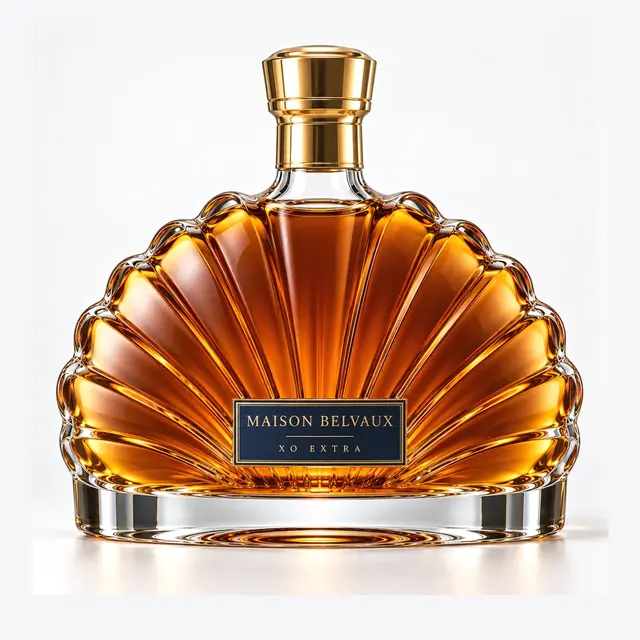
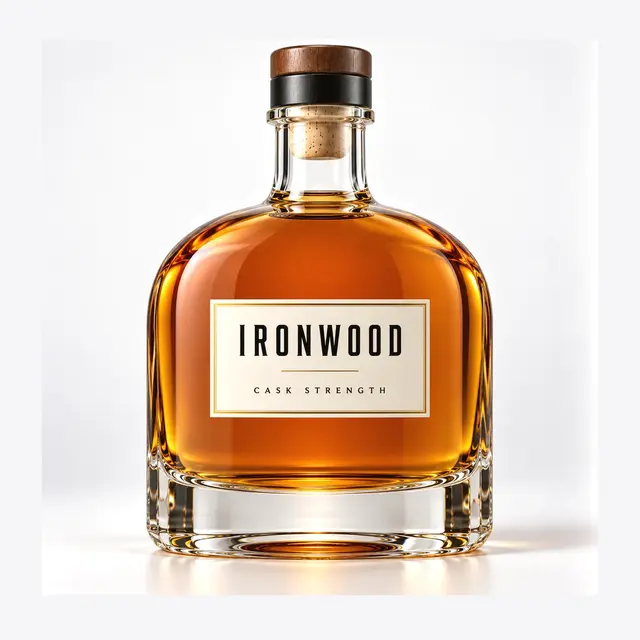
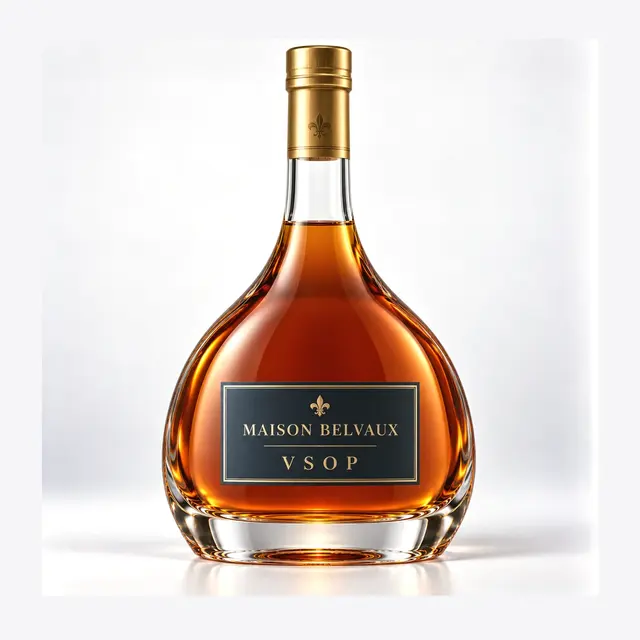


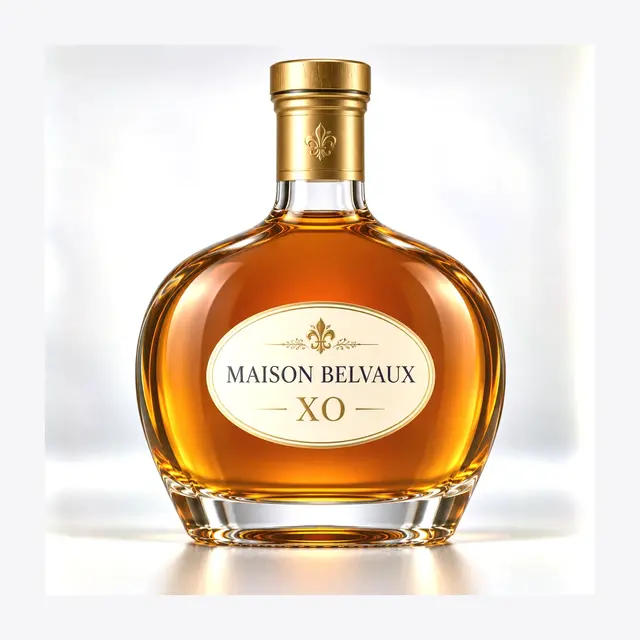
Weight, relief and the XO signal
Three cues do most of the work in this category, and they are all physical. The first is mass: a deep, thick base that gives the bottle an unmistakable heft when lifted. The second is relief — sunburst fans, fluting, medallions and crests worked into the mould rather than printed on. The third is optical: faceted or stepped surfaces that catch light the way cut crystal does.
All three are mould-level decisions, which is why brandy briefs have to be specific earlier than briefs in other categories. Relief cannot be added after tooling. Base weight cannot be adjusted without changing the mould and re-validating the annealing profile. A brand that starts with "we will decide the details at artwork stage" ends up with a plain bottle and a print budget trying to do a mould’s job.
The counterweight is cost. Heavy glass is more glass, slower to form and slower to anneal, and it hits container weight limits before it hits volume limits. It is worth being honest at the brief stage about which tier you are actually selling into, because the heaviest option is not automatically the most commercial one.
The shapes in this range
Brandy moulds divide by how much of the presentation budget sits in the glass itself.
Relief and medallion bottles
Sunburst fans, fan-shell panels and embossed crests moulded into the body. The most distinctive option and the least reproducible by a competitor, because the shape itself carries the identity rather than a label that can be copied.
Decanter silhouettes
Flared, faceted or pyramid bodies that read as tableware rather than packaging. These suit gifting programmes where the bottle is expected to stay on display after it is empty.
Heavy-base flats and rectangles
XO-level weight in a shape that still boxes efficiently. A good compromise where the coffret and the freight both have to be costed carefully.
Entry-tier OEM rounds
VS and VSOP programmes that need the category read without the presentation-tier glass budget. Simpler bodies, lighter bases, decoration doing more of the work.
Gift coffrets change the glass brief
A large share of brandy volume ships in a rigid box, and that changes which bottle is right. The box has to be tooled around the final bottle envelope — including the closure and any decoration that adds thickness — so the bottle has to be locked before the coffret is designed, not alongside it.
Shape efficiency matters more than it looks. A flat or rectangular bottle needs a shallower box, which means less board per unit, more units per master carton and more cartons per pallet position. On a container-scale programme that compounds into a real number. A dramatic decanter silhouette can be the right brand decision and still be the expensive one — worth seeing both costed before choosing.
Decoration on a relief bottle
Relief and printing compete for the same surface. A heavily moulded bottle has less flat area for a label, and printing across a relief transition rarely registers cleanly. The usual resolution is a small front label or a neck medallion plus screen printing confined to a flat panel, with the moulded relief carrying the rest.
Metallic effects — gold or bronze screen printing, coated caps, hot-stamped detail — are common at this tier and are worth trialling on the actual mould early. Metallic inks sit differently on a faceted surface than on a cylinder, and the sample is the only reliable proof.
From brief to container
Send the tier you are selling into (VS, VSOP, XO), the destination market, whether a coffret is part of the programme, and an annual volume estimate. We come back with a technical drawing confirming capacity, neck finish and critical dimensions, plus samples before anything is committed to production.
Because relief and base weight vary so much across this range, minimum quantities and lead times are quoted per mould rather than published. Inspection documentation ships with the lot: annealing per ASTM C148, internal pressure per ISO 7458, thermal shock per ISO 7459.
Common questions
Can relief detail be added to an existing mould?
Sometimes, within limits — shallow engraving on a flat panel is more feasible than reworking the body geometry. Anything that changes wall thickness distribution has to be re-validated for annealing and strength. Send the mould reference and the artwork and we will get the factory to tell you what is possible on that specific tooling rather than in general.
Is heavier glass actually stronger?
Not reliably. Strength comes from wall thickness distribution and from a correct annealing profile, not from total mass — a heavy bottle with uneven walls and residual stress is weaker than a lighter, well-annealed one. Heavy glass is a brand decision; the ASTM C148 annealing record is the strength evidence.
Which capacity should an XO programme use?
700ml is standard for EU and UK, 750ml for the US, and several moulds run both. Gift programmes in some Asian markets also use larger presentation formats. Confirm the fill size against your destination market before the coffret is tooled, since the box cannot absorb a capacity change.
Can you supply the coffret as well as the bottle?
We coordinate secondary packaging alongside the glass rather than treating it as a separate purchase, which avoids the common failure where a box tooled from a drawing does not fit the bottle as decorated. Tell us at brief stage if a coffret is in scope.