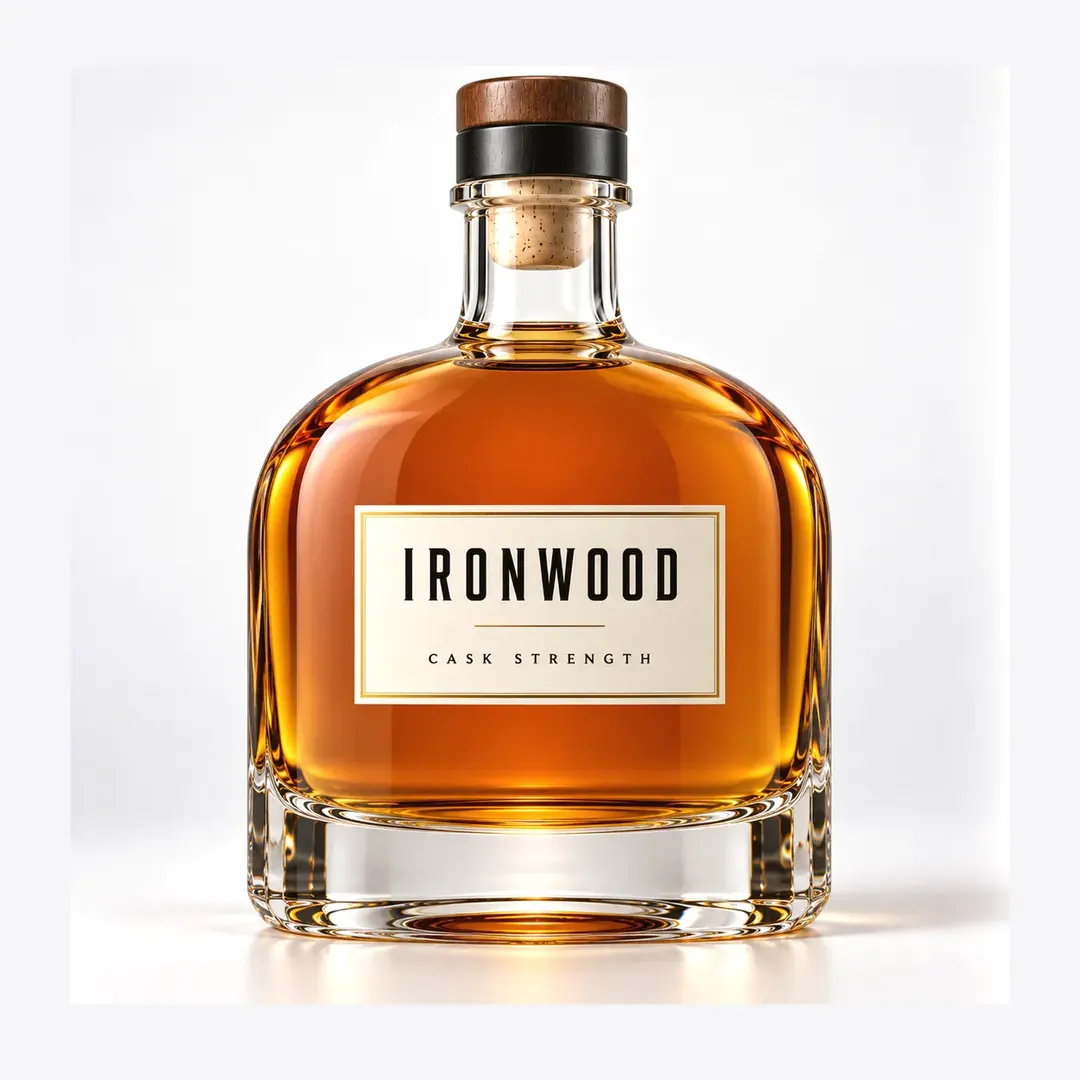
Model CF-13 announces its intentions at the bottom. The photograph shows a clear flint glass bottle with a flat, softly oval body, gently rounded shoulders, a short neck with a rolled ring lip for bar-top closures — and then, dominating the lower third of the silhouette, a massively thick base with a visible ring of decorative ridge detailing pressed into the glass. This is weight used as a design language. For brandy, cognac-style spirits, premium rum, and gift-market whisky programs that need a container to feel expensive before the cork is pulled, the CF-13 is built around exactly that sensation.
The Base Is the Brand Asset
In premium spirits packaging, the base is where value is physically stored. The CF-13’s heavy glass gather does four jobs simultaneously. It drops the centre of gravity so the bottle stands planted on a back-bar. It magnifies the liquid above it — a deep base acts as a lens, bending light up through the spirit and giving amber liquids in particular a glowing, layered depth that thin glass cannot produce. It transforms hand feel: the first thing a consumer does with a premium bottle is lift it, and weight is the most reliable proxy for quality the hand knows. And it photographs beautifully, which matters more every year as spirits are increasingly bought from screens.
The decorative ridge ring visible around the base perimeter adds a fifth function: light play. Those moulded ridges catch and scatter highlights along the bottle’s lowest edge, creating a bright line that reads as “cut glass” at a distance — an association with crystal decanters that elevates perceived price without crystal’s cost, weight penalties, or lead-content regulatory complications.
Exact base thickness and total glass weight cannot be read from a photograph; confirm both on the factory drawing, and weigh a physical sample. In this category, grams are positioning.
Flat Body, Flat Economics
Above that statement base, the CF-13’s body is a practical flat oval. The format gives decorators two generous planar panels for labels, screen print, or etched artwork, while keeping the bottle slim in the dimension that costs money — shelf and carton depth. Flat bottles pack tighter per carton layer than rounds, so the freight cost of all that extra base glass is partially recovered in container-loading efficiency. For duty-free and gift channels, the slim profile slides into presentation cartons and tubes that round bottles of equal capacity cannot enter.
The smooth shoulder transition from body to neck also deserves a mention: gradual curves distribute impact stress more evenly than sharp geometry, which matters on a heavy bottle where the mass above the shoulder is substantial.
Closure and Presentation Pairing
The rolled ring lip at the neck of the CF-13 is the classic bar-top finish, and on a bottle with this much base presence the closure should carry equal theatre: wooden-topped corks, heavyweight synthetic T-stoppers, and metallic-shelled bar-tops all pair naturally. The opening ritual — the grip of a wooden stopper, the pull, the sound — is part of what gift-market buyers are purchasing, and a heavy bottle underlines it.
As always, the photograph cannot show bore diameter or lip height. Confirm the neck finish code on the mould drawing and send that drawing to your stopper supplier; a mismatched bar-top closure on a premium bottle is an expensive embarrassment that a two-minute drawing check prevents.
Which Programs Buy Heavy-Base Bottles
Experience says the CF-13 will attract three buyer profiles. Brandy and cognac-style producers, for whom heavy glass is a category convention their consumers actively expect. Premium and super-premium rum brands borrowing whisky and cognac cues to justify price ladders. And corporate-gift and celebration-edition programs — weddings, anniversaries, Lunar New Year and holiday gift sets — where the bottle must communicate occasion before any label is read. All three share a willingness to pay for glass weight because their margins depend on perceived value.
Decoration on a Bottle That Already Speaks
A bottle with this much base character needs decoration that complements rather than competes. The two flat panels accept screen printing with perfect registration, and many buyers in this segment choose a single elegant printed mark — a crest, a monogram, a vintage year — letting the glass itself carry the premium message. Acid-etched frosting applied as a framed window on one panel pairs exceptionally well with a heavy base, the matte surface contrasting with the brilliant glass below. Metallic hot-stamping and fired decals both perform cleanly on the planar panels, and spray-coated color versions (deep amber, smoked grey, opaque black) convert the same mould into seasonal or limited editions without tooling cost.
For gift programs, consider how the bottle will be photographed: the ridged base ring produces a strong highlight line in studio lighting, which e-commerce teams can exploit with simple backlit setups.
QC Behind the Weight
Heavy-base bottles concentrate more glass — and therefore more cooling stress — at the base, which makes annealing discipline more critical, not less. Our production is verified against documented standards: annealing stress controlled per ASTM C148, internal pressure resistance tested to ISO 7458, and thermal shock endurance validated to ISO 7459. Batch reports accompany every shipment; request them with your samples and let your QC team audit the data before the first container.
Confirm These Figures with the Factory
Before specifying the CF-13, confirm on the mould drawing: nominal and brimful capacity, overall height, body width and depth, total glass weight, base thickness, neck finish code, and the detail geometry of the base ridge ring. For order planning see our guide to glass bottle MOQs, and qualify any shortlisted factory with the supplier checklist before deposits move.
Request CF-13 Samples
If your brandy, premium rum, or gift-market spirits program needs a bottle whose weight does the selling, ask us for CF-13 samples and the mould drawing. We quote glass, closures, decoration, and export packing in one proposal. Contact our team with your target capacity and annual volume.
Frequently Asked Questions
What spirits categories is the CF-13 heavy-base bottle designed for?
The extra-heavy base and flat oval body suit brandy and cognac-style spirits, premium and aged rum, and gift-market whisky programs — any positioning where bottle weight and light refraction through the base support a higher price point. It is also popular for celebration and corporate gift editions.
How heavy is the base, and can the weight be increased?
Exact base thickness and total glass weight cannot be determined from a photograph — confirm both on the factory drawing and by weighing a physical sample. Increasing weight beyond the standard mould configuration requires mould modification, which the factory can quote separately with its cost and MOQ implications.
What is the purpose of the ridged detailing around the base?
The moulded ridge ring catches and scatters light along the bottle’s lowest edge, producing a cut-crystal visual effect in plain flint glass. It is both a decoration and a light-management feature that adds perceived value without the cost or regulatory issues of crystal.
What closures pair with the CF-13’s bar-top finish?
The rolled ring lip accepts bar-top closures: wooden-topped corks, synthetic T-stoppers, and metallic-shelled stoppers. Confirm the neck finish code and bore diameter on the mould drawing and supply that drawing to your stopper supplier before ordering closures.
Does the heavy base affect filling-line handling?
Heavy-base flat bottles run on standard lines but the extra mass rewards verification: confirm conveyor guide settings, star-wheel pockets, and accumulation-table behavior with a line trial using sample bottles. The lowered centre of gravity generally improves stability through rinsing, filling, and capping.
What is the MOQ for the CF-13, and are samples available?
MOQ depends on plain versus decorated supply and current furnace scheduling — the figure is confirmed in your quotation. Samples from stock are normally available within days; we recommend weighing them, testing your stoppers, and photographing the filled bottle under your retail lighting before committing to production.


