Custom development
Custom glass bottles, from sketch to container load.
An exclusive bottle starts as a drawing and ends as a shipment. A bespoke mould buys a silhouette nobody else can have — and commits you to tooling, a longer cycle and a higher minimum. So the first thing we do is say honestly whether you need one.
Before anything else
Do you need your own mould?
Most programmes don’t. Here is how we decide, so you can decide first.
Your own mould
Worth it when the bottle is the brand.
- You want a silhouette nobody else can buy — one people recognise across a dark bar.
- The programme is large and long-lived enough to carry tooling cost and a higher minimum.
- You can plan around a longer development cycle before launch.
A stock mould, decorated
Enough when what you need is a distinctive label on a good bottle.
- You are launching, testing a market or running private label.
- Embossing, print, coating and a distinctive closure can make a shared shape unmistakably yours.
- The launch date is fixed and there is no room for a tooling cycle.
Three routes
Shared, modified or a mold of your own.
Shared mould
The tooling exists. Other brands use it.
You pay nothing for the mould, and the minimum follows the plant’s schedule for that shape. What makes the bottle yours is decoration, closure and label. Most launches start here.
Modified mould
An existing shape with your change cut in.
An embossed mark, a new base plate, a different neck finish. You pay for the parts that change, not a whole set, and the drawing starts from a shape that already runs well.
Private mould
Cut to your drawing. Used only for you.
You pay for the full set and take the longest development cycle. Who owns the mold and where it is stored should be written down before it is cut, not argued about at the first reorder — see who owns the tooling.
Not sure which route fits? The stock vs custom guide walks through the trade in more detail, and the mold development guide covers what happens between drawing and first samples.
Cost and minimums
What sets the cost of a custom glass bottle.
There is no price list for a custom bottle, and a supplier who quotes one before seeing the shape is guessing. The number comes from six things. Each one moves the tooling cost, the unit price or the minimum order — and it helps to know which, because they trade against each other.
The mould itself
Moves: Tooling
A glass bottle mold is not one part. A production set has blank and blow moulds, neck rings, baffles and bottom plates, cut for every cavity the forming machine runs. Shape adds to it: a sharp shoulder, a deep punt, a heavy base or an off-round body all mean more machining and more trial runs before the bottle forms cleanly. A plain round is the cheapest mould to cut. A faceted decanter is not.
How many mould sets
Moves: Tooling and minimum
A forming machine runs several sections at once, and each needs its own set. More sets cost more up front and make every run faster, which is what brings the unit price down at volume. Fewer sets cost less up front, but the plant has to be willing to run the job slowly. Which one fits depends on your forecast, not on your first order.
Glass colour and weight
Moves: Unit price and minimum
Flint, amber and the standard greens run on scheduled furnace campaigns. A colour the plant is already running costs nothing extra; a special colour means waiting for a campaign, or paying for one. Glass cost follows weight, so a heavier bottle costs more per unit and more to ship.
Decoration
Moves: Unit price, sometimes tooling
Embossing is cut into the mould, so it is paid once. Screen printing, coating, frosting and hot stamping are paid per bottle, and every pass has its own setup. That setup is where decoration minimums come from. Two print colours are two passes.
Quantity
Moves: Unit price
Mould changes, line setup and inspection are fixed costs spread across the run. A small run carries more of them per bottle. That is the whole reason minimums exist, and it is why a quote for twice the volume is rarely twice the money.
Freight and packing
Moves: Landed cost
Glass is heavy, and once packed it is mostly air. Bottle height and weight decide cartons per pallet and pallets per container, and that can move the landed cost per bottle more than the glass price does. Ask for the loading plan with the quote.
We quote each of these per project rather than publish figures that would be wrong for your shape. For how tooling cost splits between stock, modified and fully custom moulds, see what a glass bottle mold costs.
How it runs
Five steps. One bottle, from a sketch to a loaded container.
STEP 01 / 05
Brief
Product, volume, closure direction, decoration intent and destination market.
You receive
An honest call on whether you need your own mould at all.
STEP 02 / 05
Drawing
A technical drawing confirming capacity, neck finish, weight and critical dimensions.
You receive
A drawing to sign off before any tooling is cut.
STEP 03 / 05
Mould
Cavity cutting at the plant whose mould library fits the shape.
You receive
Tooling cut to the drawing you signed, at a plant matched to the shape.
STEP 04 / 05
Samples
First articles gauged against the drawing before any production run.
You receive
Sample bottles measured against the drawing, for a trial on your line.
STEP 05 / 05
Production
Documented inspection per lot, container loading plan, export documents.
You receive
An inspection record for every lot, and the export paperwork with it.
Your side of it
What to have ready at each step.
- Step 01 · Brief
The fill, the capacity you plan to declare, the closure you want to use (or its supplier), the decoration idea, the markets you ship to and a yearly volume estimate. Sketches, photos of reference bottles or a competitor’s bottle all help.
- Step 02 · Drawing
Your label size, your filling line or co-packer’s limits on height, diameter and neck, and the closure supplier’s drawing. Check the drawing against all three before you sign it.
- Step 03 · Mould
Final vector artwork for any embossing, and the ownership and storage terms in writing. Changes after this point cost real money, so this is the last cheap moment to have second thoughts.
- Step 04 · Samples
A plan to test them: fill them, cap them, label them, run them on your line if you can, and send a few through a courier to see how they arrive.
- Step 05 · Production
Your packing requirements (cartons, dividers, pallet pattern), the Incoterm, your forwarder or port, and the documents your importer will ask for.
What you can hold us to
You sign off a drawing before any tooling is cut.
Capacity, neck finish, weight and critical dimensions are confirmed on paper first — the cheapest place to change your mind.
Samples are measured against that drawing, not eyeballed.
First articles are gauged before a production run is booked, and you get sample bottles for a trial on your own filling line.
Every lot ships with its inspection record.
Dimensional checks, visual defect classes and packing verification, documented per lot, with the export paperwork alongside.
MOQ
Keeping the first order small.
The MOQ on a custom bottle is set by the plant, and it follows from the costs above. What you can change is how much of your project needs a new run at all.
Start on a shared mould
Launch on a stock shape with your decoration, and move to a private mould once the product has sold through. The drawing, closure and label work carry over.
Keep decoration to few passes
One print colour, or embossing in place of print, keeps the per-bottle setup down.
Pick a colour the plant already runs
Flint, amber and the standard greens come round on regular campaigns. A special colour means waiting for one.
Ask when the shape next runs
If a shared shape is already scheduled, a smaller order can sometimes join that run instead of needing its own.
Give a forecast, not just an order
A plant quotes a first order differently when it can see the reorders behind it. A realistic yearly figure is more useful than a large first order you cannot sell.
Where a number would help — the minimum for a given shape, the tooling cost, the lead time — we ask for the brief and quote it, because the answer changes with the mould, the colour and the plant’s schedule. For the timing side, see how glass bottle lead times work.
Decoration & finishing
What can be done to the glass itself.
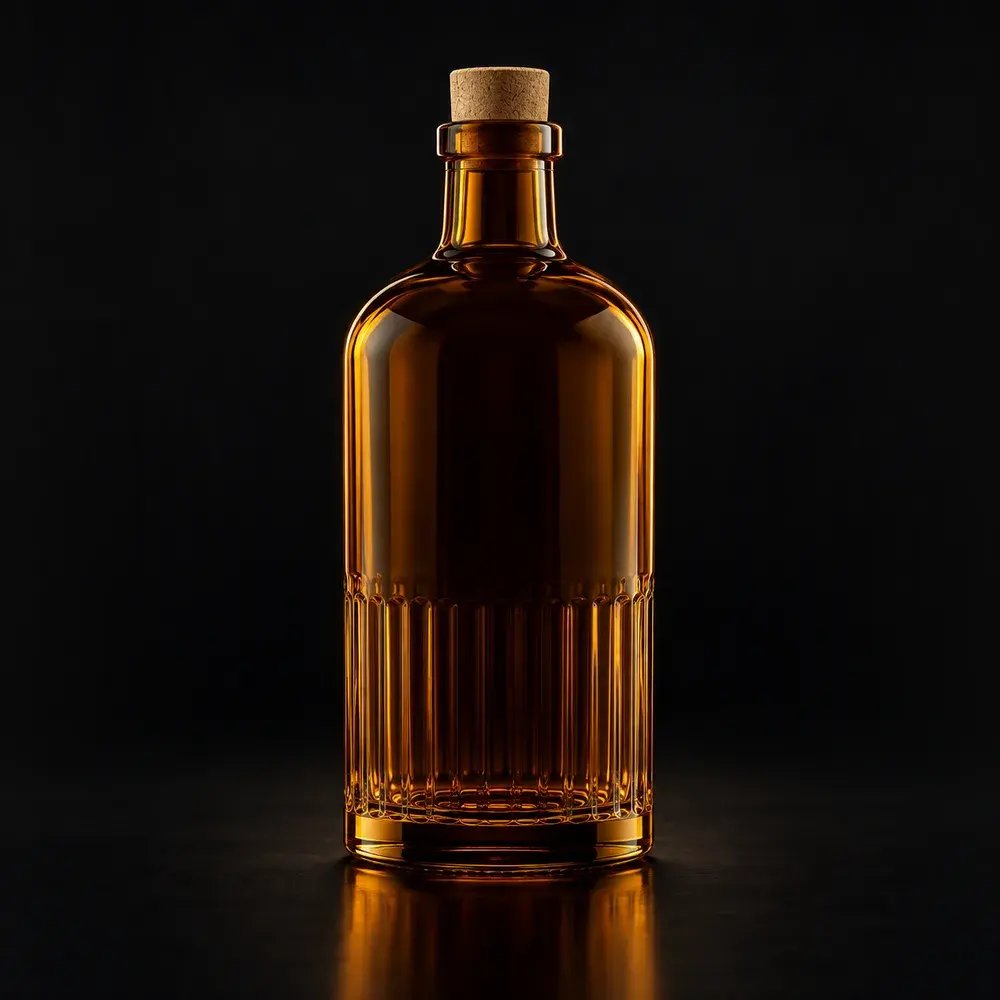
Custom mould development
From sketch to cavity: shape studies, drawing, mould cutting and first-article samples.
Embossing and relief
Brand marks, fluting and decorative panels cut into the glass itself rather than printed on it.
Spray coating and frosting
Acid etch, sandblast or spray-applied finishes, each with a different permanence and hand feel.
Screen printing and decoration
Multi-colour screen print, hot stamping and metallised finishes applied after annealing.
Send the brief. We come back with a drawing.
Container, closure, decoration, quantity and destination — whatever you already know. Quotes are answered in one to two business days.