
Not every brandy program needs a showcase bottle. If you are building an entry-level brandy line — a supermarket private label, a distributor’s house brand, a value expression that has to win on shelf price — what you need is a bottle that looks correct, runs reliably at high volume, and leaves margin in the product. That is the brief behind the BOJUE mold: a 700ml brandy bottle engineered for OEM programs where cost per thousand and supply continuity matter more than bespoke glass artistry. This page explains who this bottle is for, why the economics work, and how to run a volume program on it from first quote to repeat order.
Positioned for Value, Not for Prestige
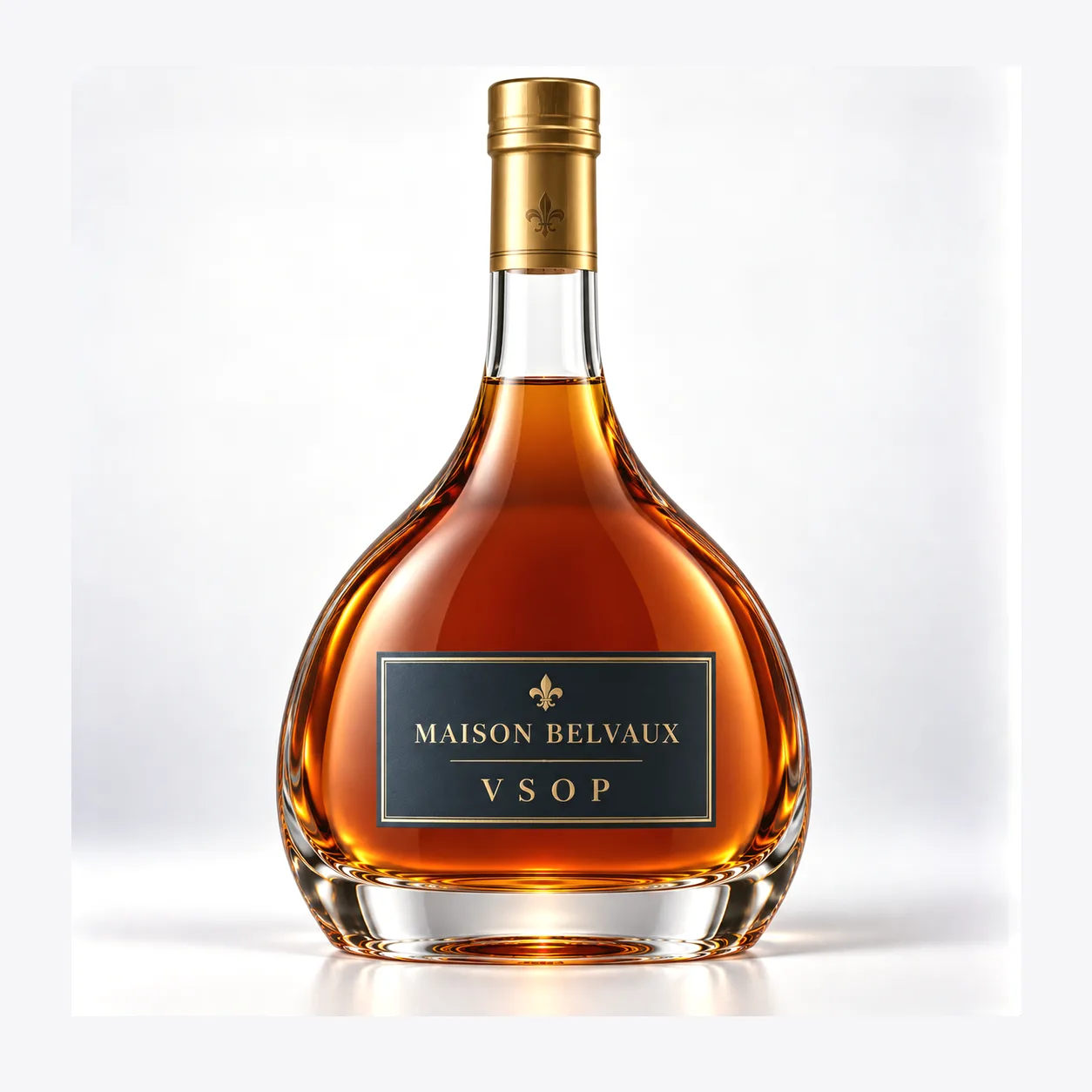
Brandy packaging spans an enormous range, from VSOP carafes with deep punts and heavy bases down to the straightforward bottles that carry everyday-pour brandy in supermarkets across Europe, Africa, and Asia. This mold sits deliberately at the value end of that range. It gives buyers a clean, category-correct brandy silhouette — the proportions consumers expect when they reach for an affordable bottle — without paying for decorative glass weight or complex mold features that an entry-level price point cannot recover.
That positioning matters for how you should think about this page versus others in our catalog. If your program targets the mid-tier — aged-stated expressions, gifting-led VSOP lines, bottles that must carry a forty-dollar shelf price — a heavier, more decorated mold in our range will serve you better. If, instead, your commercial model is volume: container-load orders, tight cost targets, retail buyers who negotiate in cents per case, then this is the mold built for your reality. Choosing the value-tier bottle is not a compromise; for entry-level programs it is the correct engineering decision, because every cent saved on glass is a cent that survives the retail buyer’s price negotiation.
The Economics of a High-Volume Brandy Bottle
Entry-level brandy lives and dies on landed cost. The bottle is typically the single largest packaging component in the cost stack, ahead of the label, the closure, and the carton — so bottle selection is where value-tier programs are won or lost. This mold contributes to the cost equation in four concrete ways.
- Shared-mold economics. You pay no bespoke tooling. The mold already exists, is proven in production, and is amortized across many programs. Your differentiation comes from decoration and closure, not from a tooling invoice.
- Production efficiency at volume. Molds that run repeatedly run better. Cycle stability, lower rejection rates, and predictable scheduling all improve on established molds — and those efficiencies show up in your per-unit price on large runs.
- Logistics density. A bottle designed for volume programs is designed to pack well. Exact case counts, pallet configurations, and container loading plans for this mold are confirmed with the factory at quotation, since final numbers depend on your closure choice and any decoration that changes the envelope.
- Reorder reliability. Entry-level lines are reorder businesses. A catalog mold with continuous production history is far easier to keep in supply than a bespoke mold that competes for line time. Ask the factory about scheduling for standing quarterly or semiannual runs.
For buyers building a landed-cost model, our explainer on glass bottle MOQ shows how order quantity and decoration choices interact with unit price — essential reading before you commit to a target cost with your retail customer.
Where This Bottle Sells: Markets and Channels
The 700ml capacity signals its primary markets immediately: this is the standard spirits size across the European Union, most of Asia, Africa, and duty-free channels — not the 750ml of the United States. Buyers speccing this mold typically ship into one of four channels.
Supermarket and discount retail private label. Chains building entry-level brandy SKUs under their own banners need correct category presentation at aggressive cost. This bottle, a paper label, and a standard closure is exactly that formula.
Distributor house brands. Importers and distributors in price-sensitive markets — West Africa, Southeast Asia, parts of Eastern Europe — run house brandies as volume lines. The 700ml format and a no-drama supply chain suit that model.
On-premise and pouring brands. Bar and club channels in many markets pour value brandy by the glass; the bottle behind the bar needs to look right and pour reliably, not impress a collector.
New-market brand launches. Launching a brandy brand in a new territory is a volume bet before it is a margin bet. An affordable, proven bottle keeps launch capital in liquid and marketing rather than in tooling.
Decoration Routes That Protect Your Margin
On a value-tier bottle, decoration strategy is margin strategy. The good news is that the most cost-effective decoration routes are also the fastest to execute. Conventional labeling — paper or film, applied on standard labeling lines — remains the default for entry-level brandy, and this bottle’s proportions give label designers clean, workable panels. Screen printing in a single color is a strong upgrade path: modest added cost, noticeably better shelf presence, and no label-application step for your co-packer. Frosting and spray coating are available on this mold for programs that want a premium cue at the top of the value tier, though most entry-level buyers reserve those routes for line extensions rather than the base SKU.
Closures follow the same logic: standard caps and bar-top closures in proven configurations keep both cost and supply risk low. The exact neck finish and closure compatibility for this mold are confirmed with the factory during sampling — raise any tamper-evidence or liner requirements (relevant for flavored brandy or brandy-based liqueurs) at RFQ stage. Confirm your final decoration and closure combination with the factory before ordering cartons or shipper displays, since decoration can change the packed envelope.
Quality Is Not the Place to Cut
Value-tier positioning describes price, not standards. A cheap bottle that fails on the line or in the container is the most expensive bottle you will ever buy. Our liquor bottle production follows the standard framework any B2B buyer should demand: annealing verified per ASTM C148 so residual stress stays within safe limits, internal pressure resistance tested per ISO 7458, and thermal shock resistance per ISO 7459 so bottles survive the temperature swings of container shipping and warehouse storage. Request the test documentation with your quotation and file it alongside our glass bottle supplier checklist — your retail customers’ auditors will ask for exactly this paper trail.
From RFQ to Reorder: Running a Volume Program
The fastest path from inquiry to production is a structured RFQ. Send your destination market, target annual volume, fill type (brandy, brandy liqueur, or adjacent dark spirit), and decoration direction through our contact page. We respond with pricing at your volume breaks, current MOQ confirmation, sampling timelines, and technical drawings. Samples precede any production commitment, and we recommend line trials with your co-packer before the first full run.
For buyers new to importing glass from China, our guide on importing glass bottles from China covers incoterms, export packaging, and freight planning for container-load bottle orders. Volume programs succeed on boring competence: consistent quality, confirmed schedules, and reorders that arrive when the warehouse needs them. That is precisely what this mold and this factory relationship are set up to deliver.
Frequently Asked Questions
Is 700ml compliant for brandy sold in the EU and other markets?
700ml is the standard spirits bottle size across the EU, most of Asia, Africa, and duty-free channels, which is why this mold is the default for programs shipping to those markets. The United States uses 750ml instead, so confirm capacity requirements for every destination market with the factory and your importer of record before finalizing artwork.
What makes this bottle suitable for entry-level brandy rather than premium lines?
The mold is engineered for value-tier economics: shared tooling with no bespoke mold cost, efficient high-volume production, and decoration routes centered on labeling and single-color screen printing. It delivers a category-correct brandy look at a cost structure that entry-level retail pricing can absorb. Mid-tier and aged-stated programs are better served by heavier molds in our range.
What is the MOQ for a high-volume OEM run?
MOQ depends on your decoration route and current line scheduling, so confirm the current figure with the factory at RFQ stage. As a shared catalog mold, minimums are standard production quantities rather than bespoke-mold volumes, and larger runs unlock better unit pricing. Our MOQ explainer page details how quantity and decoration interact.
Can I get samples for my co-packer’s line trials?
Yes, samples precede any production commitment and we recommend running them through your co-packer’s filling and labeling line before the first full order. Confirm current sample lead times and courier arrangements with the factory when you submit your RFQ.
Which decoration options fit a value-tier budget?
Conventional paper or film labeling is the default low-cost route, and single-color screen printing is the most cost-effective upgrade. Frosting and spray coating are available on this mold but are usually reserved for line extensions above the base SKU. Confirm the final decoration combination with the factory before ordering cartons, since it can change the packed envelope.
How are the bottles packed for container shipping?
Bottles are packed in export cartons and palletized for container loading, with configurations confirmed at quotation since final counts depend on your closure and decoration choices. For high-volume programs the factory can provide container loading plans so you can model landed cost accurately. Our guide to importing glass bottles from China covers the freight and packaging fundamentals.


