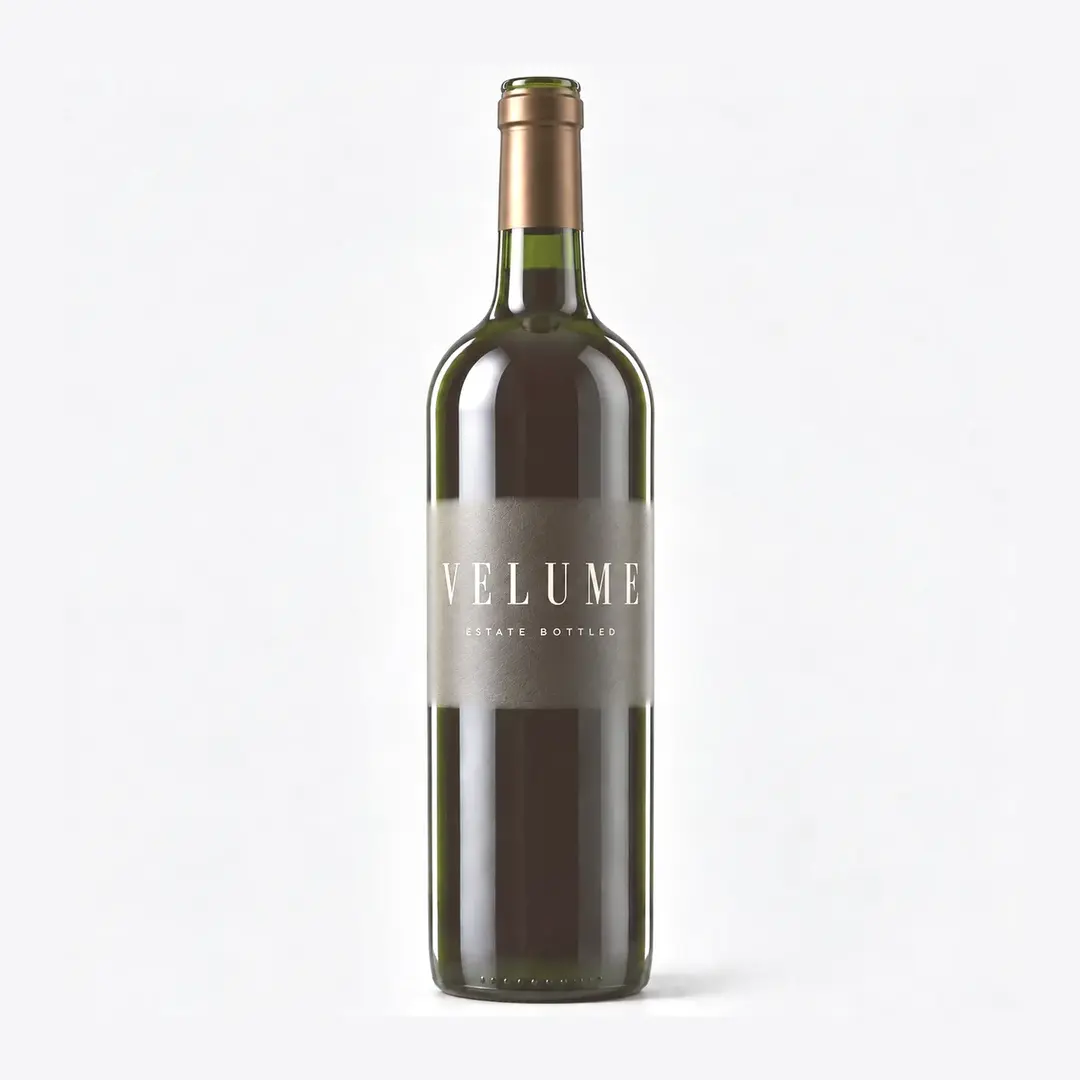
This 750ml Bordeaux green custom glass wine bottle is the mold we put in front of wineries and brand owners who intend to decorate the glass itself: acid-etched frosting for a reserve tier, multi-color screen printing that replaces paper labels entirely, or embossed crests and vintage marks worked into the bottle at forming. The base mold photographed here shows why it takes decoration so well. The antique-green glass is deep and even in tone, the body below the shoulder is a long, uninterrupted cylinder with no panel breaks or decorative ribs, the shoulder rolls over in one soft, continuous curve, and the cork finish carries a clean double ring that frames capsules neatly. It is, in short, a well-behaved canvas.
A Clean Canvas in Antique Green
Decoration lives or dies on surface quality, and the first thing a decorator asks about a mold is how much flat, unbroken real estate it offers. This mold’s body is a true cylinder from just below the shoulder to the heel tuck, which means screen artwork wraps without distortion, frost masks sit flush, and paper labels, where used, apply without bridging. The antique-green base tone gives printed inks a rich, dark ground: golds and creams read warm against it, whites pop for back-label legibility, and a single well-chosen color can carry a whole design.
The soft shoulder curve deserves a decorator’s attention too. It provides a natural upper boundary for a printed field, so artwork can run to the shoulder line and stop with a deliberate, finished look rather than fading awkwardly into the neck.
Decoration Routes: Frosting, Screen Print and Embossing
Three routes cover most custom programs on this bottle. Acid frosting transforms the whole surface or masked panels into a satin, light-diffusing finish that signals premium tiers instantly; it pairs well with a single printed color or a simple paper neck tag. Screen printing fires ceramic inks directly onto the glass for durable, dishwasher-proof branding that survives ice buckets and back-bar handling; multi-pass work allows several spot colors with registration checked per lot. Embossing works the design into the glass itself at the forming stage, ideal for estate crests, volume marks or a brand seal above the heel; it requires mold-level modification, so it is planned as a tooling project with its own sampling round.
Each route has different minimums and lead times, and combinations are common: a frosted reserve bottle with a two-color print and an embossed estate seal is entirely achievable on this base. Tell us the effect you are after and we will map the practical route, sequence and cost before artwork is committed.
Where the Mold Helps Your Artwork
Some design decisions become easier once the mold’s geometry is understood. The double ring on the finish gives capsules and printed neck bands a crisp termination point. The firm heel and defined contact ring keep printed lower-body elements clear of the scuff zone where cases and conveyors touch the glass. And the moderate punt keeps the base presentation tidy for bottles that will be displayed punt-out in gift boxes.
For embossing projects, the straight body offers generous, low-curvature zones where relief detail reproduces cleanly; fine script and deep relief are both possible, with final artwork adapted to the forming constraints during mold sampling. Exact printable height, frost-mask limits and embossing zones are confirmed on the technical drawing at quotation, so your design team works to real numbers rather than assumptions.
Closures, Capsules and Finishing Touches
The photographed bottle carries a cork finish suited to natural, colmated and technical corks, which remains the default for decorated premium bottles. Tin or polylaminate capsules in matched colors complete the look, and a screw-cap finish can be discussed with the factory for programs that want printed glass with Stelvin convenience. Fill height and corker settings should be validated on production samples; decorated samples from the actual print run are supplied for that line trial.
If your decorated bottle is part of a gift or export program, we coordinate decoration timing with capsule and carton supply so the whole presentation lands together rather than in three separate shipments.
Quality Control for Decorated Glass
Decorated bottles carry two quality files: the glass and the artwork. The base mold is annealed for stress relief, with lots sampled for thermal-shock endurance to ISO 7459 and internal pressure resistance to ISO 7458, plus surface-strength sampling after abrasion. On top of that, decorated runs add adhesion and abrasion checks on printed and frosted surfaces, color verification against the approved proof, and registration inspection on multi-color work. Lot certificates record both sets of results, and retained reference samples let us answer any field question against the actual production record.
Project Workflow, MOQ and Sampling
A typical custom project on this mold runs: brief and artwork review, technical drawing confirmation, decorated proof for approval, then production, inspection and export packing as cartons or shrink-wrapped bulk layers. Minimums vary by route; printed and frosted runs start lower than embossed tooling projects, and the current breakpoints are set out in our glass bottle MOQ guide. If this is your first decorated import, the full sequence from quotation to customs clearance is covered in our guide to importing glass bottles from China.
Send your artwork direction, annual volume and target launch date through our contact page, and we will return a decoration route recommendation, a sampling plan and a quotation that separates glass, decoration and logistics so your team can see exactly where the budget goes.
Frequently Asked Questions
What is the MOQ for a custom-decorated run of this Bordeaux bottle?
Minimums depend on the decoration route. Screen-printed and acid-frosted runs start at practical batch quantities, while embossing is a mold-level project with tooling cost and its own sampling round. Current breakpoints are in our glass bottle MOQ guide, or send your artwork and we will quote the minimum for your specific design.
Can you produce a decorated sample before full production?
Yes, and we insist on it. You receive a decorated proof from the actual process, whether frost, print or embossing, for approval of color, registration and finish before the bulk run. Your bottler can also use these samples to validate fill height and corker settings on the decorated surface.
Which decoration lasts longest on green glass: frosting, screen print or embossing?
All three are permanent when executed correctly. Ceramic screen-printed inks are fired onto the glass and resist ice buckets and washing; acid frosting is integral to the surface; embossing is part of the glass itself. The right choice depends on your design and budget, and we will recommend the route after reviewing your artwork.
Can the same mold carry both cork and screw-cap finishes for different tiers?
The photographed bottle carries a cork finish, which is the default for decorated premium bottles. A screw-cap finish can be discussed with the factory for tiers that want Stelvin convenience. Many brands run printed glass with cork on the reserve tier and capsules with screw cap on the entry tier.
How are decorated bottles packed to protect the artwork in transit?
Decorated runs ship with packing matched to the finish: printed and frosted bottles are packed to prevent surface-to-surface abrasion, using dividers and layer pads suited to the bottle’s contact ring, as export cartons or shrink-wrapped bulk layers. The packing plan is confirmed with your quotation.
How long does a custom decoration project take from artwork to delivery?
Timing depends on the route: print and frost projects move faster than embossing, which adds mold modification and sampling. Production and ocean booking follow proof approval. When you send your artwork and launch date, we return a project schedule covering proof, production, inspection and sailing so you can plan the release.


