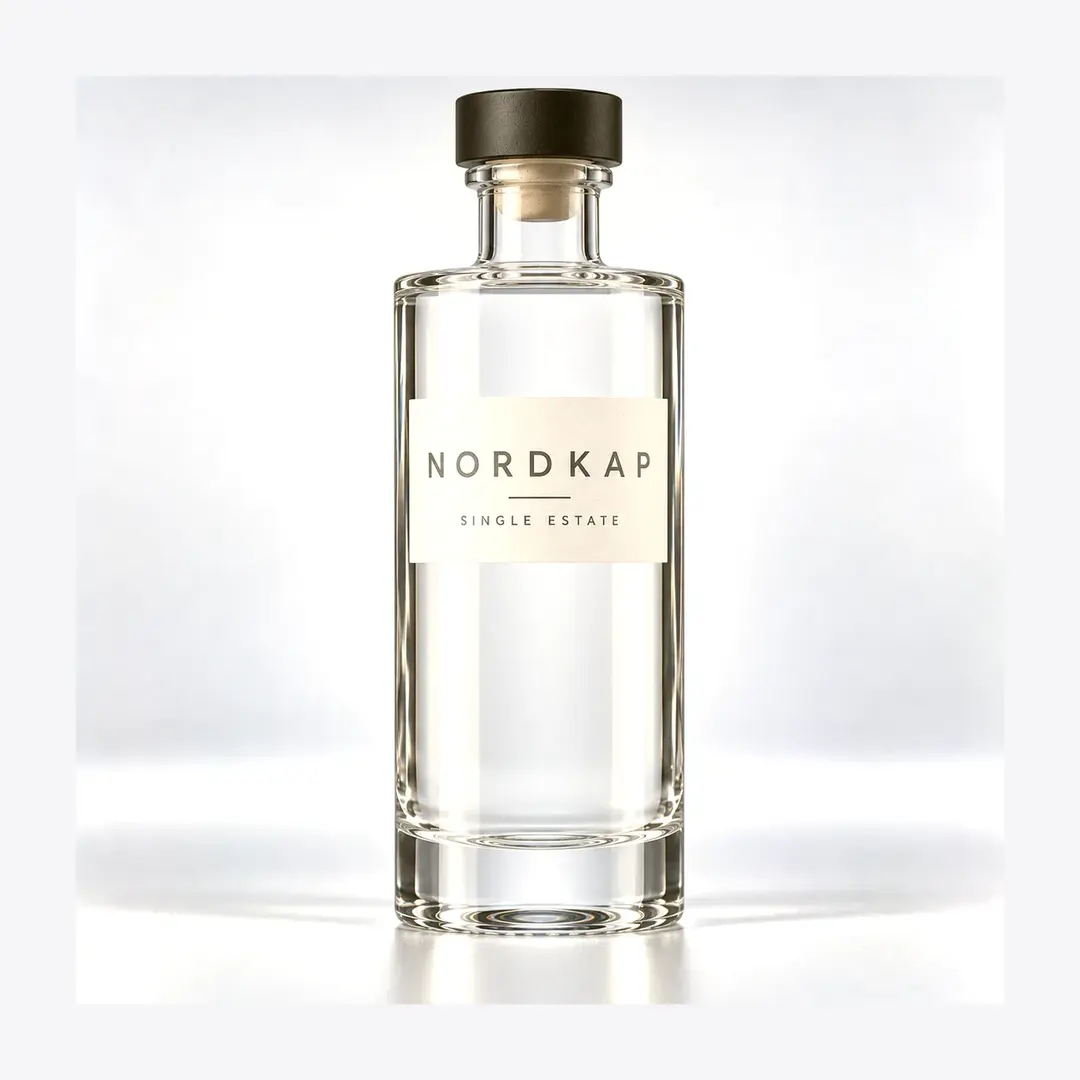
Model CF-13-1 is the most restrained bottle in this catalog series: a true cylinder in clear flint glass. The body runs straight from heel to shoulder with no waist, no panels, no fluting — just a slow radius into a long, straight neck and a compact bar-top lip. The base is thick enough to anchor the silhouette without turning it into a paperweight. This is the geometry Scandinavian vodka and modern white-spirit brands have used for two decades to say one thing: there is nothing between you and the liquid. The brief below is for brand owners and importers who want that minimalist register and need to understand what this mold does — and does not — offer. No capacity, dimensions, weight, or finish code is visible in the photograph; confirm all specifications with the factory before tooling decisions.
360 Degrees of Nothing to Hide
A cylinder makes a promise that shaped bottles soften: the product itself is the design. With no embossed panels or molded decoration to lean on, the liquid’s clarity, color, and viscosity carry the entire visual argument. For premium vodka — where “clean” is the whole positioning — that is exactly the point. The same logic suits white rum, blanco tequila, and unaged botanical spirits. It also raises the bar on liquid presentation: haze, sediment, or off-hues have nowhere to hide, so brands that choose this silhouette typically pair it with tight filtration specs. If your liquid is a feature, a cylinder is an amplifier; if it is not, a shaped or frosted bottle is the kinder choice.
The Long Straight Neck
The neck on CF-13-1 is proportionally long and unstepped, and it earns its height three ways. First, silhouette: a tall neck lifts the bottle’s profile on a crowded back bar, buying visibility without widening the footprint. Second, pour control: a straight bore gives bartenders a predictable stream with or without a pourer, and the neck length gives speed-pourer rubber fins a generous seat. Third, closure presence: the small bar-top lip at the top reads as a deliberate full-stop to the column — a full cork-and-head assembly looks proportionate here, whereas on a short neck it can look oversized. Closure fit and neck-finish drawing are factory-confirm items; send your stopper reference with the inquiry.
Decoration Minimalism
Minimalist bottles punish busy decoration. The proven routes on this form are restrained: a single- or two-color screen print directly on the glass, a slim paper label with heavy typography, or a small medallion at the shoulder. Full-wrap shrink sleeves work technically but fight the aesthetic; most brands that choose a cylinder want the glass visible. Frosted spray is a legitimate variant — a fully matte cylinder with crisp black print is a recognized premium register — but request a frosted sample on the actual bottle, because matte surfaces change how the thick base refracts light. Direct embossing on a cylinder wall is possible only as mold work; discuss volumes with the factory before assuming it.
Line Performance of Cylinders
There is an operational bonus hiding in this simple geometry: cylinders are the friendliest shape a filling line meets. They stabilize instantly on conveyors, center predictably under filling heads, and present an uninterrupted surface for label application — no panel registration, no orientation station. Change parts are standard, reject rates at labeling are typically lower than for shaped bottles, and case packing is a simple grid. For a first private-label program or a high-volume white-spirit SKU, those line economics compound across every production run. Confirm the bottle’s diameter and height against your line’s change-part list with the factory.
Who Actually Buys the Minimalist Cylinder
Three buyer profiles consistently gravitate to this form. New vodka and white-spirit brands use it as a positioning shortcut: the bottle itself communicates purity before marketing spends a dollar, which matters when the launch budget is tight. Established brands use it for line extensions — a citrus or botanical variant in the same cylinder as the flagship, differentiated only by print color, keeps range coherence that retailers reward with block displays. And contract bottlers favor it operationally, because one cylinder mold can serve multiple client brands with nothing more than a decoration change, keeping mold costs out of the unit price entirely. If your program sits in any of these profiles, the negotiation with the factory should focus on decoration minimums rather than mold terms — print color counts, sampling rounds, and per-color setup charges move the real cost on a stock cylinder far more than the glass itself.
Quality Control References
Production of this series is annealed for stress relief, with ASTM C148 as the reference method for annealing point. Lots can be verified for internal pressure resistance per ISO 7458 and thermal shock per ISO 7459 where your process requires it — relevant if you plan hot-fill adjacent processes or aggressive pasteurization downstream. These are process capabilities, not lot certificates; ask the factory for the inspection records tied to your production run.
One more consideration belongs on your checklist: glass color. This mold is photographed in clear flint, which is the default for the minimalist register. If your liquid is light-sensitive — some botanical spirits and barrel-rested clear spirits are — ask the factory whether the same mold can be run in a UV-filtering tint or whether a coated variant is available, since changing glass color on a stock mold is usually a furnace scheduling question rather than a tooling one.
Ordering and Next Steps
Route your target quantity, destination port, closure choice, and decoration direction through our contact page. If you are benchmarking this bottle against other suppliers, the scorecard in our glass bottle supplier checklist gives you a structured way to compare quotations, and our MOQ guide explains how order size moves unit pricing. Samples of CF-13-1 are available for closure-fit and filling-line trials before you commit to production.
Frequently Asked Questions
Which spirits categories is the CF-13-1 cylinder bottle best suited for?
It is optimized for premium vodka and other white spirits — blanco tequila, white rum, unaged botanical spirits — where liquid clarity is part of the brand promise. Aged or colored spirits can use it too, but the minimalist form puts all visual attention on the liquid, so presentation quality must be high.
What is the capacity of this bottle?
No capacity is printed in the product photograph, and we do not quote unverified figures. Confirm the cavity volume, brimful capacity, and full dimension sheet with the factory before label design or regulatory filing.
Can this cylinder take a full-wrap shrink sleeve?
Technically yes — a cylinder is the easiest shape for sleeve application. Aesthetically, most brands choose this silhouette to keep glass visible, favoring direct screen print or a slim paper label. Frosted spray with crisp print is another proven premium route; request a decorated sample first.
Is the long neck compatible with speed pourers?
The straight neck bore is well suited to standard speed pourers, with enough neck length for a stable rubber-fin seat. Exact neck dimensions are a factory-confirm item — send your pourer or closure reference with the inquiry so fit can be verified on samples.
Why would a filling line prefer this shape?
Cylinders stabilize instantly on conveyors, center predictably under fill heads, and need no orientation for labeling, which lowers reject rates and simplifies change parts. Confirm the bottle’s diameter and height against your line’s change-part list with the factory.
What quality verification applies to production lots?
Bottles are annealed for stress relief (reference ASTM C148), with internal pressure (ISO 7458) and thermal shock (ISO 7459) verification available per lot where your process requires it. Ask the factory for inspection records specific to your production run.


