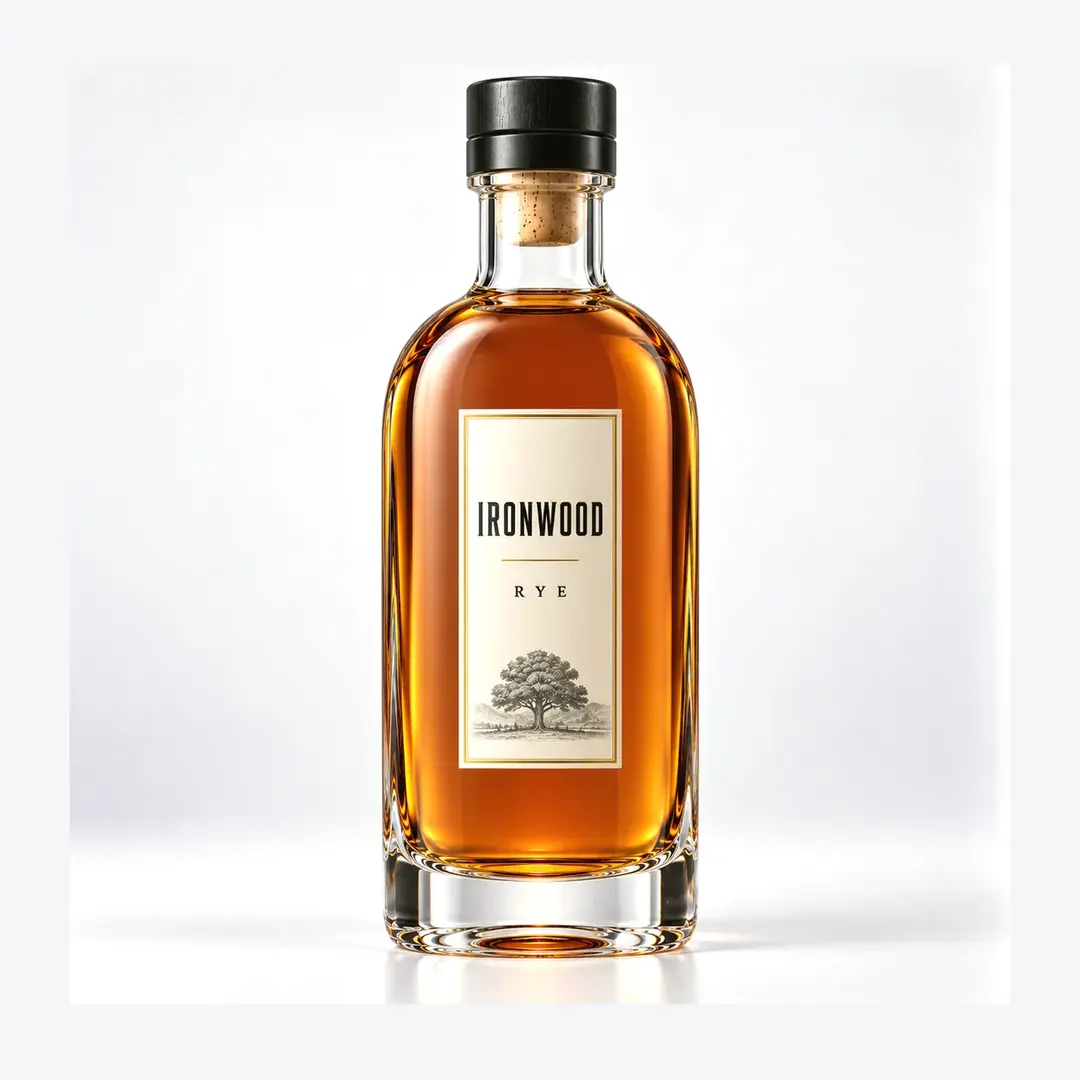
Model B2835 is a clear flint glass spirits bottle built around a slim oval flask silhouette: a flattened, pillow-shaped body with softly rounded shoulders, a short cylindrical neck finished with a rolled ring lip for bar-top closures, and a noticeably thick, heavy base. The intent is easy to read — this is a bottle designed to look lean from the side, generous from the front, and expensive in the hand. For distilleries, brand owners, and importers sourcing a custom liquor glass bottle that reads “premium” without paying for a fully bespoke mould, B2835 is a strong candidate worth requesting samples of.
The Oval Flask Silhouette: Slim Where It Matters
The defining feature of the B2835 is its oval cross-section. Viewed face-on, the bottle presents a broad, continuous label panel that gives designers plenty of room for brand storytelling. Rotate it ninety degrees and the profile collapses into a narrow slab that slips easily into a duty-free carton, a gift tube, or the inside pocket of a presentation box. That dual personality — wide billboard, thin footprint — is exactly why the flask format has survived from hip flasks to modern premium spirits.
For trade buyers, the practical payoff shows up in logistics and retail math. A flatter bottle packs more units per carton layer than an equivalent round bottle, and on a back-bar or retail shelf it occupies less depth, letting a retailer face more SKUs per metre of shelving. E-commerce sellers benefit too: slim cartons are cheaper to ship and less prone to the dimensional-weight penalties that punish tall, round gift packaging.
The rounded shoulder transition visible in the photo — no sharp crease between neck, shoulder, and body — also matters beyond aesthetics. Smooth shoulder geometry distributes impact stress better than hard edges, which is one reason flask bottles travel well through long sea-freight routes when properly annealed and packed.
A Base That Signals Value Before the Label Is Read
Turn the bottle and the second message appears: the base is thick. You can see the deep glass gather at the bottom of the B2835, the kind of weight that used to be reserved for XO brandy and top-shelf whisky. That extra glass does three jobs at once.
First, it lowers the centre of gravity, so the bottle sits more stably on a bar shelf and survives the occasional knock from a busy bartender. Second, it creates a lens effect: light passing through a heavy base refracts and gives the liquid above it a jewel-like depth, a trick premium vodka and aged rum brands use constantly. Third, it changes the hand feel. Consumers consistently associate bottle weight with liquid quality — a well-documented purchasing cue — and a heavy base is the cheapest way to add perceived weight without upsizing the entire container.
Exact base thickness, glass weight, and brimful capacity are not visible in a photograph, so treat those as numbers to confirm with the factory when you request the technical drawing for the B2835 mould.
Neck Finish and Closure Pairing
The neck on the B2835 is short and straight, terminating in the rolled ring lip typical of bar-top (cork-style) finishes. That finish pairs naturally with T-corks, wooden-topped synthetic closures, and natural cork stoppers — the closure family that dominates premium whisky, rum, tequila, and craft gin packaging. A bar-top closure also gives the brand a ritual moment at opening: the tactile pull of a cork stopper reads as craft in a way a screw cap never will.
If your program requires a tamper-evident or pourer-fitment closure instead, ask the factory whether the B2835 neck tooling can be adapted; many flask moulds exist in both bar-top and screw-finish variants. The precise neck finish designation ( GPI / CETIE reference, bore diameter, lip height ) should always be confirmed against the factory drawing before you order closures from a separate supplier, because a 1 mm mismatch on the lip can scrap an entire closure purchase.
Decoration: Two Flat Panels, Endless Options
The flat front and back panels of the B2835 are effectively two glass canvases. Because the surfaces are planar rather than curved, every decoration technology performs better on them:
- Screen printing registers sharply on flat glass, with no distortion at the panel edges — ideal for bold typography and one- or two-color craft branding.
- Pressure-sensitive and paper labels apply cleanly with standard labeling equipment; flat panels eliminate the flagging and edge-lift problems common on tight-radius round bottles.
- Acid etching and frosting can be masked to the panel boundary for a framed, frosted-window effect that suits gin and vodka programs.
- Metallic hot-stamping and decals fire evenly on flat surfaces, keeping fine filigree intact through the decorating lehr.
The clear flint glass shown in the photograph also leaves the door open for sprayed color coatings, gradient lacquers, or electroplated finishes on later production runs — a practical way to refresh a seasonal SKU without touching the mould.
Production Quality You Can Audit
Whatever decoration route you choose, the container underneath has to survive the journey. Our liquor bottle lines run under documented QC protocols that buyers can audit on request: annealing stress is controlled and verified per ASTM C148, internal pressure resistance is tested to ISO 7458, and thermal shock endurance is checked against ISO 7459 — the three standards that together predict whether a bottle will survive hot-fill-adjacent processes, carbonated-adjacent handling, pasteurization-style temperature swings, and the long vibration of container shipping. Ask for the batch test reports with your sample order; a serious factory supplies them without prompting.
What to Confirm with the Factory
Because the product photo cannot show dimensions, treat the following as your sample-request checklist for the B2835: brimful and nominal capacity, overall height and panel width, glass weight, neck finish code, base thickness, available decoration area, mould ownership and exclusivity terms, and current minimum order quantity. Our guide on glass bottle MOQs explains how MOQ shifts with mould type and decoration, and the supplier checklist gives you the full audit framework for qualifying any bottle source.
Request Samples of Model B2835
If your next whisky, rum, tequila, or premium vodka program needs a slim oval flask with a genuinely premium base, ask us for B2835 samples and the mould drawing. We ship sample sets worldwide and can quote decoration, closures, and export packing in one step. Contact our team with your target capacity and annual volume, and we will reply with pricing and lead time.
Frequently Asked Questions
What spirits categories is the B2835 oval flask bottle best suited for?
The slim oval flask format with a bar-top finish is most commonly used for premium whisky, aged rum, reposado and añejo tequila, and craft vodka. Its wide front panel also works well for liqueurs that rely on large label storytelling. Final suitability depends on your target capacity, which should be confirmed against the mould drawing.
Can the B2835 be ordered with a screw-cap finish instead of a bar-top cork finish?
Many flask moulds exist in both bar-top and screw-finish variants, but the neck tooling for this specific model must be confirmed with the factory. Tell us your closure type when requesting samples and we will verify the available neck finish options for the B2835.
What is the capacity and weight of the B2835 bottle?
The photograph does not show dimensions, and we do not quote unverified specifications. Brimful capacity, nominal fill capacity, glass weight, and base thickness are all listed on the technical drawing that accompanies a sample request — please confirm these figures with the factory before finalizing your packaging bill of materials.
Is the heavy base on this bottle standard or can it be made heavier?
The base shown is the standard mould configuration for this model. Adjusting base thickness normally requires mould modification, which affects cost and MOQ. If you need extra weight for a super-premium positioning, ask the factory about mould modification options and the associated tooling budget.
What decoration methods work best on the flat panels of this flask bottle?
Flat panels are ideal for screen printing, pressure-sensitive labels, acid-etched frosting, hot-stamped metallics, and fired decals. Curved-panel decoration problems such as label edge-lift and print distortion are largely eliminated, which is one of the commercial advantages of the flask format.
What is the minimum order quantity for the B2835, and can I get samples first?
MOQ depends on whether you order the bottle plain or decorated, and on current furnace scheduling — confirm the figure when you request a quote. Sample bottles from existing stock can usually be shipped within days so you can test closures, labels, and filling-line behavior before committing to production.


