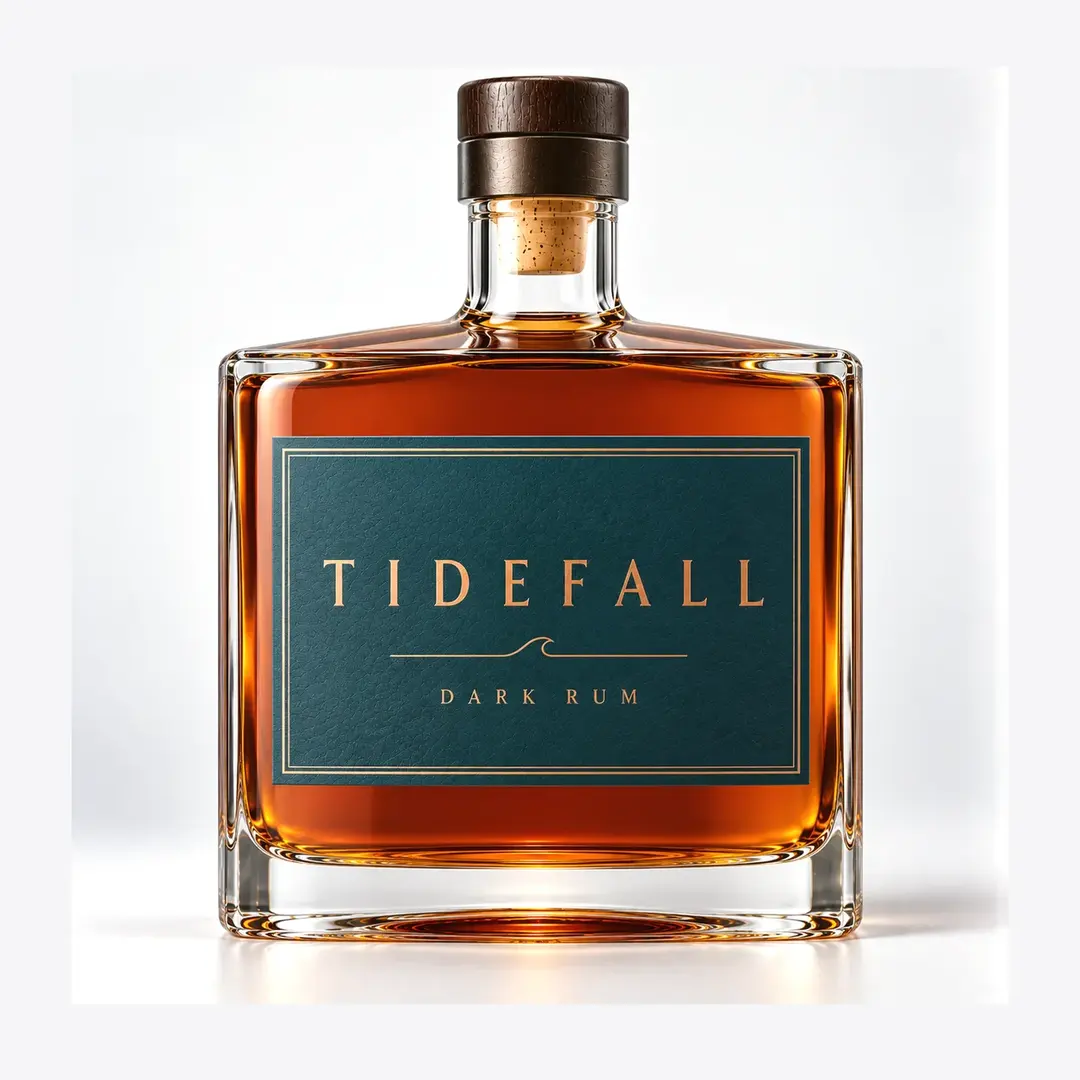
Model BOT makes its argument in geometry. The photograph shows a clear flint glass bottle with a wide, flat rectangular body, crisply angled shoulders that rise to a short cylindrical neck, a rolled ring lip for bar-top closures, and a thick stable base. Nothing about it is round, soft, or shy. This is a bottle designed to stand on a retail shelf like a small billboard — and for whisky, gin, and premium spirit brands fighting for attention in a crowded fixture, that billboard quality is the product.
Shelf Presence Is a Geometry Problem
Retail spirits shelving is a war of front-facing area. A round bottle presents a curved sliver to the shopper; a flat square-shouldered bottle like the BOT presents nearly its full width. At equal capacity, the flat format delivers dramatically more visible label area from the aisle, which is why the silhouette has been a favorite of Scotch whisky, American whiskey, and contemporary gin brands for decades. The bottle does part of the marketing before a single word is read.
The angled shoulder deserves attention too. Where a soft round shoulder visually shrinks toward the neck, the BOT’s defined shoulder line keeps the body’s width reading all the way up, giving the bottle an architectural, almost decanter-like stance. On a back-bar under spot lighting, that geometry catches highlights along the shoulder edges — free visual drama from plain flint glass.
Two Flat Panels, Zero Decoration Compromise
Decorators prefer flat glass for a simple reason: every print and label technology was engineered around planes. On the BOT’s front and back panels, screen printing registers edge-to-edge without the distortion curves introduce. Pressure-sensitive labels sit flat with no edge-lift, even in cold-chain or humid retail environments. Acid-etched frosting can be framed to the panel boundary. Fired ceramic decals and metallic hot-stamping apply evenly and survive the decorating lehr without the scorching risk that tight radii create.
Practical consequence for buyers: a flat-panel bottle usually lowers decoration cost per unit and raises first-pass yield at the decorator, because fewer pieces are rejected for registration drift. If your brand plan involves complex multi-color artwork, this shape will treat your budget more kindly than any round alternative.
Who Buys This Shape — and Why They Stay with It
The square-shouldered flat format attracts three recurring buyer profiles. First, whisky and whiskey brands at the premium end of the value tier, where the silhouette borrows decades of category equity: shoppers have been trained by generations of blends and bourbons to read this shape as “proper whisky,” and a young brand can rent that credibility while its own reputation matures. Second, contemporary gin distilleries, who discovered that the format’s flat panels are the perfect stage for the botanical illustrations and typographic labels their category runs on — the bottle behaves like a picture frame for the artwork. Third, travel retail and duty-free operators, who value the slim depth for shelf-back stock efficiency and for the gift cartons their channel sells through.
What keeps all three loyal is consistency of supply. A distinctive mould only builds brand equity if the same bottle is available year after year at stable quality, which is why buyers of shaped bottles should qualify the factory’s furnace capacity and mould maintenance discipline as carefully as the design itself.
Bar-Top Finish and Closure Strategy
The rolled ring lip visible at the neck of the BOT is the classic bar-top finish, built for T-corks and topped stoppers in wood, synthetic, or natural cork. In premium whisky and gin positioning, that closure is part of the brand theatre: the stopper is what the consumer touches first, and a wooden-topped cork over a heavy square bottle signals craft before the seal is broken.
Closure sourcing discipline still applies. The photograph cannot show bore diameter or lip height, so confirm the neck finish code on the factory drawing and share that drawing — not a description — with your stopper supplier. If your market requires tamper evidence, pair the bar-top with a printed shrink capsule, a standard and inexpensive solution for this format.
Packing and Case Efficiency
Flat bottles reward the logistics-minded. Rectangular bodies nest into cartons with less void space than rounds, so more saleable volume ships per container and less dunnage is needed to stop in-case movement. The BOT’s stable flat base and low-slung profile also reduce tip-over incidents on conveyor corners and in case packers. For e-commerce and duty-free channels, the slim depth fits postal cartons and travel retail gift boxes that round bottles of equal capacity cannot enter.
One honest caveat: flat and square geometries concentrate stress at panel corners differently than cylinders, which is why annealing quality matters more, not less, on this shape — and why the QC documentation below should be part of your supplier audit rather than an afterthought.
Manufacturing Standards Behind the Shape
Our liquor bottle production is verified against the standards export buyers expect: annealing stress controlled and tested per ASTM C148, internal pressure resistance measured to ISO 7458, and thermal shock endurance validated to ISO 7459. Together these confirm the container will survive washing cycles, filling temperature differentials, and the vibration of ocean freight. Batch reports are issued per production lot and are available for your QC team to review with the sample set.
Numbers to Confirm with the Factory
Before committing the BOT to your bill of materials, confirm on the mould drawing: nominal and brimful capacity, body width and depth, overall height, glass weight, base thickness, neck finish code, and the flat-panel dimensions available for decoration. To frame your order planning, see our guide to glass bottle MOQs, and run your shortlisted suppliers through the glass bottle supplier checklist before placing a deposit anywhere.
Start Your BOT Sample Request
If your whisky, gin, or premium spirits brand needs a bottle that behaves like media space on the shelf, the BOT’s square-shouldered flat format deserves a place on your shortlist. We ship samples worldwide and can quote glass, closures, decoration, and export packing together. Contact us with your target capacity and volumes for a fast quotation.
Frequently Asked Questions
What spirits categories suit the BOT square-shoulder bottle?
The flat square-shouldered silhouette is strongly associated with Scotch and American whisky, and it is increasingly used by contemporary gin, premium vodka, and dark rum brands that want maximum front-facing label area. The bar-top finish suits any spirits closure program built around T-corks or topped stoppers.
Does a flat square bottle cost more to decorate than a round one?
Usually the opposite. Flat panels eliminate the registration drift and label edge-lift common on curved surfaces, so screen printing, labeling, and decal application all run with higher first-pass yield. Complex multi-color artwork in particular is cheaper to execute well on flat glass.
What capacity is the BOT bottle?
Capacity cannot be read from a photograph, and we do not publish unverified figures. Nominal and brimful capacity, dimensions, and glass weight are stated on the technical drawing that comes with a sample request — confirm these with the factory before finalizing your packaging specification.
Is the bar-top neck finish tamper-evident?
A bar-top cork finish by itself is not tamper-evident, but the standard industry solution is a printed or plain shrink capsule over the stopper, which this format accepts readily. If your market requires a tamper band built into the closure itself, ask the factory whether a screw-finish variant of the mould exists.
How does the flat format affect shipping and case packing?
Rectangular bodies nest with less void space than rounds, so more saleable volume fits per carton and per container, and in-case movement is reduced. The trade-off is that corner stress concentrates differently than on cylinders, which is why annealing verification per ASTM C148 is part of every production batch.
What is the MOQ for the BOT and can we test closures before ordering?
MOQ depends on plain versus decorated supply and furnace scheduling — it will be confirmed in your quotation. Samples from stock are normally available within days, and we strongly recommend testing your chosen stoppers, capsules, and labels against sample bottles before committing to production.


