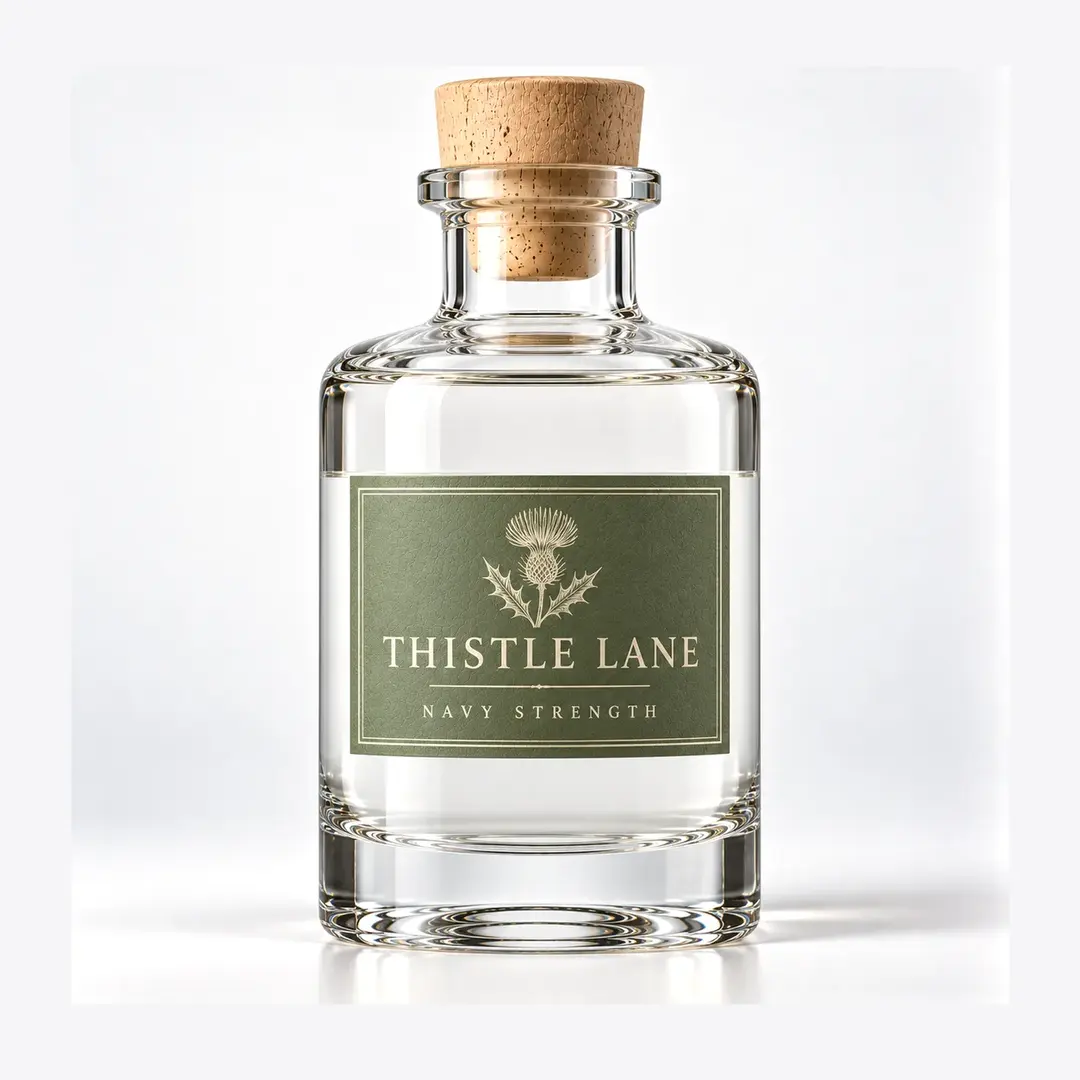
Model BR1HAO belongs to a silhouette older than the modern spirits industry itself. The photograph shows a clear flint glass bottle with a generously rounded dome shoulder, a short neck, a wide mouth finished with a rolled ring lip, a slightly domed push-up base, and faint raised lettering embossed across the shoulder. It is the classic apothecary form — the shape of pharmacy jars, tonic bottles, and nineteenth-century elixirs — and it is enjoying a serious revival among craft gin, bitters, amaro, and small-batch spirits brands that want heritage credibility without paying for a bespoke mould.
The Apothecary Revival Is a Positioning Tool
Shapes carry meaning, and few bottle forms carry as much meaning per dollar as the apothecary round. Consumers read the domed shoulder and wide mouth as “compounded,” “botanical,” “small-batch” — associations the craft spirits movement has spent fifteen years building. A gin brand launched in this bottle inherits an instant backstory: it looks like something an herbalist would have decanted, which is precisely the cue botanical spirits need on a shelf crowded with industrial-looking cylinders.
The subtle embossed lettering visible on the shoulder of the BR1HAO reinforces that effect. Mould-embossed text is the oldest branding technology in glass packaging, and it remains the most durable: it cannot peel, fade, or scuff off in a carton. For buyers, the strategic question is whether to use the stock embossing as-is or commission modified mould inserts with your own brand mark — an option worth pricing, since insert changes on an existing mould are far cheaper than a fully new mould. Confirm with the factory what the current shoulder engraving reads and what insert modification would cost.
What the Wide Mouth Actually Buys You
The wide mouth of the BR1HAO is not only an aesthetic decision; it changes operations. Filling is faster and less foam-prone at equivalent line speeds because air escapes freely around the fill tube. For products with suspended botanicals, fruit pieces, or infused ingredients — the defining trend in craft gin and liqueur — a wide bore removes the bridging and blockage risk that narrow-neck bottles create. And at end of line, cleaning and reuse programs (where markets support them) are dramatically easier through a wide opening.
The rolled lip finish pairs naturally with cork stoppers, bar-top closures, and swing-top-style presentation stoppers depending on the exact neck specification. Because the photograph cannot show bore diameter or lip height, the neck finish code must be confirmed against the factory drawing, and your closure supplier should receive that drawing before any stopper order is placed.
Small-Batch Friendly by Design
Craft producers operate at volumes that make large-format mould economics painful, and the apothecary round suits them for practical reasons beyond image. The short neck and domed shoulder make the bottle stable and easy to handle on the semi-automatic and low-speed lines that small distilleries actually run. Hand-labeling — still common at craft scale — is forgiving on the bottle’s gently curved main panel. And the format photographs beautifully for the direct-to-consumer and social channels where craft brands live, with the dome shoulder catching light in a way flat industrial bottles never do.
For importers and distributors, the same shape serves a second duty: specialty food, cocktail syrup, and mixer brands cross-shop this silhouette constantly, so a single mould investment can serve a portfolio spanning spirits and adjacent premium grocery lines.
Decoration Routes That Respect the Shape
The BR1HAO’s gently curved body panel and domed shoulder reward a particular decoration philosophy: restraint on the curve, confidence on the detail. Paper labels with letterpress or textured stock suit the apothecary character and apply reliably on the main panel’s generous radius. Single-color screen printing — a brand mark, a batch number, a botanical illustration — reads authentically on this silhouette in a way loud multi-color wraps do not. Wax-dipped neck finishes over the closure, colored capsules, and neck tags all pair naturally with the format and cost little at craft volumes.
For brands scaling beyond the apothecary aesthetic later, the same clear flint body accepts full spray coatings and frosting without mould changes, so the bottle can evolve with the brand rather than being replaced by it.
One operational note for buyers consolidating multiple SKUs: because this silhouette reads as a family even across different capacities, brands often build a whole range — tasting-miniature, standard, and gift sizes — on apothecary rounds. Ask the factory which companion moulds exist in the same design language, since a matched family simplifies photography, shelving, and export carton planning.
Verification Standards for Export Buyers
Heritage styling must not mean heritage quality control. Every batch of our liquor bottles is produced under documented testing: annealing stress is controlled and verified per ASTM C148, internal pressure resistance is measured to ISO 7458, and thermal shock endurance is validated against ISO 7459. These three standards together predict survival through washing, filling temperature differentials, and long ocean transits. Batch test reports accompany shipments and are available for review with your sample set.
Confirm Before You Commit
The following BR1HAO specifications must be confirmed with the factory because they cannot be read from a photograph: nominal and brimful capacity, mouth bore and neck finish code, overall height and body diameter, glass weight, the exact content of the shoulder embossing, and mould insert modification options and pricing. For order planning, our explainer on glass bottle MOQs shows how volume thresholds work, and buyers new to sourcing should read the guide on importing glass bottles from China before their first container.
Request BR1HAO Samples
If your craft gin, bitters, amaro, or botanical spirits program needs heritage shelf presence with small-batch economics, put the BR1HAO apothecary round on your sample list. We ship sample sets worldwide and quote decoration, closures, and export packing together. Contact our team with your target capacity and annual volume for pricing and lead time.
Frequently Asked Questions
What products is the BR1HAO apothecary-style bottle best for?
The domed-shoulder apothecary form is most commonly chosen for craft gin, bitters, amaro, herbal liqueurs, and small-batch spirits that want a botanical or heritage positioning. Specialty syrups, shrubs, and cocktail mixers also use this silhouette, so one mould can serve a cross-category portfolio.
What does the embossed lettering on the shoulder say, and can it be customized?
The stock shoulder embossing is part of the existing mould; confirm its exact content with the factory when requesting samples. Replacing it with your own brand mark is usually possible through mould insert modification, which is far cheaper than a new mould — ask for an insert modification quote with your inquiry.
What closure fits the wide mouth of this bottle?
The rolled ring lip finish typically pairs with cork stoppers and bar-top closures, but the exact neck finish code and bore diameter must be confirmed on the factory drawing. Send that drawing to your closure supplier before ordering stoppers to guarantee fit.
Is a wide-mouth bottle suitable for spirits with botanicals or fruit inside?
Yes — this is one of the format’s genuine advantages. A wide bore prevents bridging and blockage when filling products with suspended botanicals or infused ingredients, and it reduces filling foam at equivalent line speeds. Confirm the bore diameter against your ingredient particle size before committing.
What is the capacity and weight of the BR1HAO?
These figures cannot be determined from a photograph and we do not publish unverified specifications. Nominal and brimful capacity, dimensions, and glass weight appear on the technical drawing supplied with a sample request — verify them with the factory before finalizing your packaging bill of materials.
What MOQ applies, and is this mould suitable for a first-time craft brand?
MOQ depends on plain versus decorated supply and furnace scheduling, and will be confirmed in your quotation. The format is well suited to craft-scale launches: it runs reliably on semi-automatic lines, hand-labels forgivingly, and sample bottles are normally available within days for closure and label testing.


