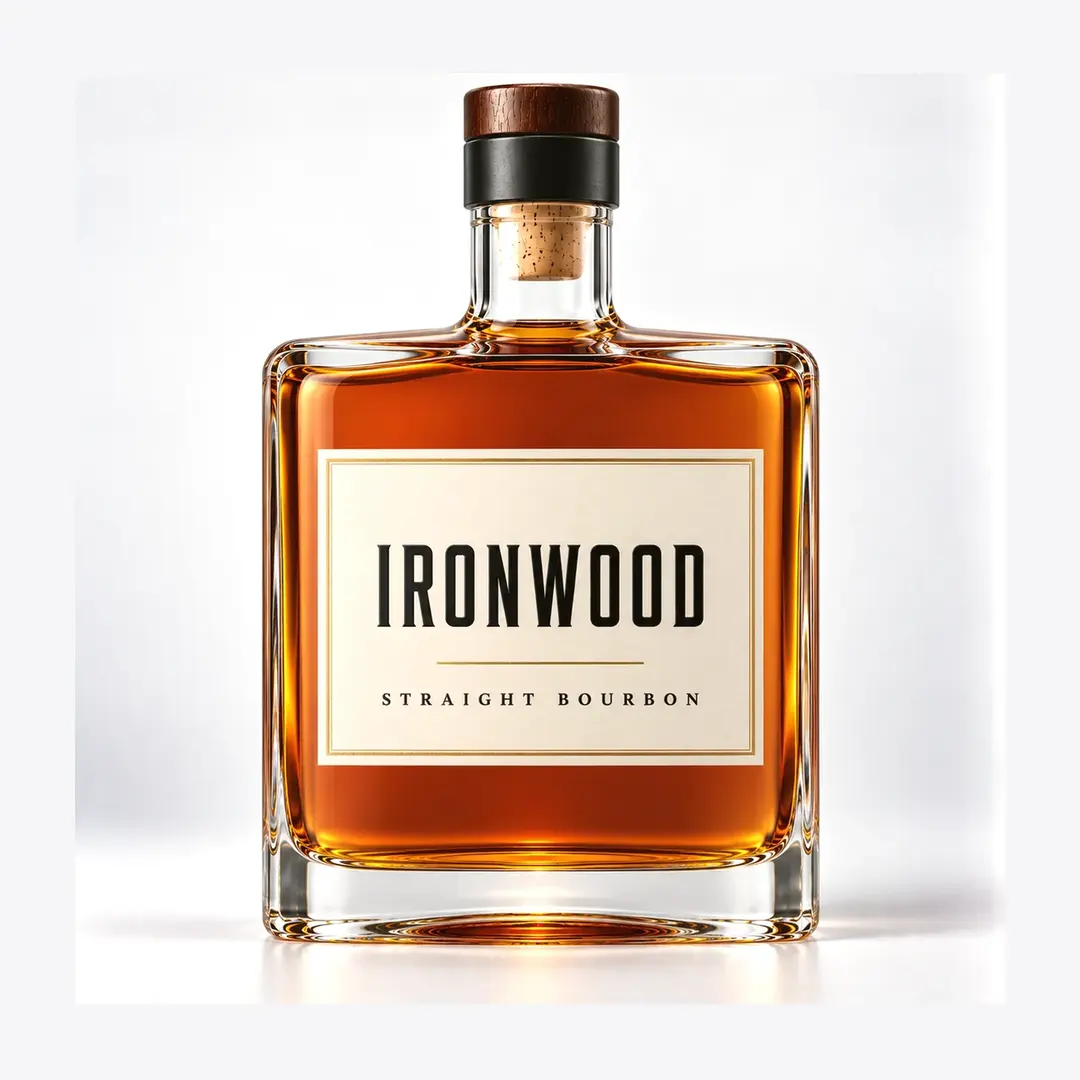
There is a reason so many American whiskey brands still reach for a flat flask when they launch a private-label bourbon: the silhouette is instantly legible. Before a shopper reads a single word on the label, the low-slung, broad-shouldered profile of a 750ml flat bottle already says “whiskey” — and more specifically, it says heritage, honesty, and value. Our FLAT model 2 was developed for exactly that brief. It is a second-generation flat mold that sits alongside our original FLAT design, giving brand owners, contract distillers, and import houses an alternative geometry when the first mold’s proportions do not match their label die-line or their shelf planogram.
This page is written for B2B buyers who are speccing a private-label bourbon, a Tennessee-style whiskey, or an entry-to-mid-tier American whiskey line for retail, travel retail, or on-premise accounts. If that is your project, the sections below walk through why the flat format works commercially, how this second mold differs from its sibling, what decoration and closure routes are realistic, and how to move from inquiry to a container on the water.
Why a Flat Flask Still Wins for American Whiskey
Walk the bourbon aisle of any large US liquor chain and count the flat and flask-adjacent formats. They are everywhere below the forty-dollar shelf price, and for good reason. The flat flask is the visual shorthand of American whiskey culture — it references the pocket flasks of the pre-Prohibition era, the medicinal whiskey bottles of the early twentieth century, and decades of value-brand bourbon packaging that trained consumers to associate the shape with straightforward, unpretentious juice.
For a private-label program, that built-in semiotic value is free marketing. A contract-packed store brand or a regional distillery’s value expression does not have the budget to educate consumers about an exotic bespoke bottle. A flat flask borrows a century of category memory. Shoppers do not need to be told what is inside; the bottle tells them. That is precisely why so many private-label bourbon briefs we receive start with the sentence “we want something that looks like a classic American flask, but ours.”
The 750ml capacity reinforces the positioning. It is the standard US spirits size, the fill that every state control board, every chain planogram, and every back-bar speed rack is built around. Choosing 750ml in a flat format means zero friction at retail: the bottle fits existing shelf brackets, existing case configurations, and existing consumer expectations.
Engineering Notes on the Flat Format
Beyond shelf signaling, the flat format solves real logistics problems that round bottles cannot. The reduced front-to-back depth of a flat bottle changes how the product lives after purchase. It slides into a coat pocket, a golf bag, or a suitcase side compartment — which is why flat flasks over-index in travel retail, in gifting channels, and in markets where consumers carry bottles to gatherings rather than serving at home.
For gift-boxed programs, the flat geometry is a genuine cost lever. A shallower bottle means a shallower rigid box, which means less board per unit, more units per master carton, and more cartons per pallet position. Buyers who have costed both a round 750ml gift set and a flat 750ml gift set know the board and freight savings are not trivial at container scale. Exact carton and pallet configurations for this mold are confirmed with the factory at quotation stage, since they depend on final closure height and any decoration that adds to the envelope.
From a filling-line perspective, flat bottles reward a conversation with your co-packer early. The broad, flat label panels are generous — they accept large front labels and back labels without the curvature compensation that round bottles demand — but the bottle’s stability on conveyor and its behavior through labeling heads should be validated with your line’s change parts. We routinely supply technical drawings and sample bottles for line trials; confirm current lead times for samples with the factory when you inquire.
Model 2 vs. Our Original FLAT Mold
Buyers often ask why we run two flat molds in the same capacity. The honest answer is that “flat flask” is not one shape — it is a family, and small proportional differences change what a label can do and what a brand communicates. The table below summarizes the practical differences at a briefing level; for millimeter-level dimensions, request the technical drawing pack from the factory rather than relying on any published summary.
| Decision factor | Original FLAT mold | FLAT model 2 (this page) |
|---|---|---|
| Overall character | Classic, taller-leaning flask read | Alternative proportions for a different shelf stance — confirm exact profile with the factory |
| Label panel layout | Suited to traditional vertical label die-lines | Suited to brands whose existing die-line did not fit mold 1 — confirm panel dimensions with the factory |
| Typical program fit | Heritage and value bourbon lines | Private-label bourbon needing a distinct-but-still-classic flat read |
| Capacity | 750ml | 750ml |
| Mold exclusivity | Shared mold, custom decoration | Shared mold, custom decoration — discuss exclusivity options with the factory if required |
The practical takeaway: if you specced our original FLAT mold and found that your label die-line, your gift-box internals, or your shelf mock-up fought the proportions, model 2 is the first alternative to evaluate before paying for a bespoke mold. Shared-mold economics are the whole point of this product family — you get a differentiated look without bespoke-mold tooling cost or bespoke-mold MOQs.
Fillers, Markets, and Price Tiers That Fit This Bottle
The obvious filler is bourbon and American whiskey, and that is where most volume on this mold goes: private-label bourbon for US chains, contract-distilled Kentucky-style whiskey for export, and flavored whiskey extensions that benefit from a recognizable parent format. But the flat 750ml is more versatile than its whiskey reputation suggests.
- Bourbon and Tennessee-style whiskey — the core use case, from store brands to regional distillery value tiers.
- Blended whiskey and whiskey-based liqueurs — the heritage read supports “old recipe” storytelling.
- Dark rum and aged rum — several Caribbean and Latin American programs use flat flasks for their value-to-mid tiers; the shape reads “aged spirit” without category conflict.
- Ready-to-drink and pre-batched cocktails — the flask format is resurgent in premium RTD, where portability is a selling point.
Market-wise, this mold ships most often to the United States, but we also see it specified for Canadian whisky programs, for travel-retail exclusive bottlings, and for markets in Asia and the Middle East where American whiskey cues carry premium connotations. If you are importing into a market with specific fill-size or labeling regulations, confirm capacity compliance for your destination with the factory and your importer of record before committing to artwork.
Decoration and Closure Options
A shared mold becomes “yours” through decoration, and this flat bottle takes the full standard toolkit. Frosting gives a matte, premium hand-feel that photographs well for e-commerce. Screen printing applies branding directly to glass in one or more colors — the right route for bold, label-free looks or for combining a small paper front label with printed back-panel storytelling. Spray coating opens up opaque and gradient color routes for brands that want shelf-blocking color. And conventional labeling — paper, film, textured stocks — remains the most flexible and lowest-cost route, especially for multi-SKU private-label families where each SKU needs distinct information.
Closures for this bottle are standard bar-top corks or caps in the usual spirits configurations; the exact neck finish and closure compatibility for this mold are confirmed with the factory during sampling, since closure choice interacts with fill line and regulatory requirements in your destination market. If your program needs tamper-evidence features or specific liner materials for high-ABV or flavored fills, raise that at RFQ stage rather than after tooling decisions.
Quality Standards Behind the Run
Decoration gets the attention, but buyers live with the glass itself for years. Our liquor bottle production follows the standard framework B2B buyers should demand from any supplier: annealing verified per ASTM C148 to ensure residual stress stays within safe limits, internal pressure resistance tested per ISO 7458, and thermal shock resistance per ISO 7459 so bottles survive hot-fill-adjacent processes, pasteurization-adjacent environments, and the temperature swings of container shipping and warehouse storage. Ask for test documentation with your quotation — any serious factory supplies it, and it belongs in your supplier file alongside the checklist in our glass bottle supplier checklist.
Ordering, MOQ, and Getting a Quote
As a shared-mold product, this bottle runs at standard production MOQs rather than bespoke-mold quantities — the exact figure depends on decoration route and current line scheduling, so confirm the current MOQ with the factory when you inquire, and see our explainer on glass bottle MOQ for how decoration choices move the number. Sampling precedes any production commitment, and we recommend line-trial samples with your co-packer before the full run.
To start, send your target fill (bourbon, rum, RTD), destination market, annual volume estimate, and decoration direction through our contact page. If you are new to sourcing from China, our guide on importing glass bottles from China covers incoterms, packaging, and freight realities. We respond to structured RFQs with pricing, sampling timelines, and drawing packs — typically the fastest path from “we want a flat bourbon flask” to a bottle on the water.
Frequently Asked Questions
Is 750ml the right fill size for a US private-label bourbon program?
Yes. 750ml is the standard US spirits size and fits existing retail planograms, case configurations, and state control board requirements. If you are bottling for other markets, confirm capacity compliance for your destination with the factory and your importer of record before finalizing artwork.
How is the FLAT model 2 different from your original FLAT mold?
Both are 750ml flat flasks, but they differ in proportions and label panel layout, so they suit different die-lines and shelf presentations. We recommend requesting technical drawings of both molds from the factory and mocking up your label on each before deciding. Exact millimeter dimensions are provided in the drawing pack, not published online.
What is the MOQ for this bottle?
This is a shared-mold product, so MOQs are standard production quantities rather than bespoke-mold volumes. The exact figure depends on your decoration route and current line scheduling, so confirm the current MOQ with the factory at RFQ stage. Our MOQ explainer page covers how decoration choices affect minimums.
Can I get samples before committing to a full run?
Yes. Sampling is standard before production, and we recommend running line trials with your co-packer using sample bottles, since flat bottles behave differently on conveyors and labeling heads than round bottles. Confirm current sample lead times with the factory when you inquire.
What decoration options work on a flat flask?
Frosting, screen printing, spray coating, and conventional labeling all work well on this format. The broad flat panels are especially friendly to large labels and to screen-printed branding. Confirm the final decoration combination and its effect on the bottle envelope with the factory before ordering gift boxes or cartons.
Can this bottle be used for spirits other than bourbon?
Yes. While most volume goes to bourbon and American whiskey, the mold also works for dark rum, blended whiskey, whiskey-based liqueurs, and premium RTD cocktails. Discuss your fill’s ABV and any liner or closure compatibility questions with the factory during sampling.


