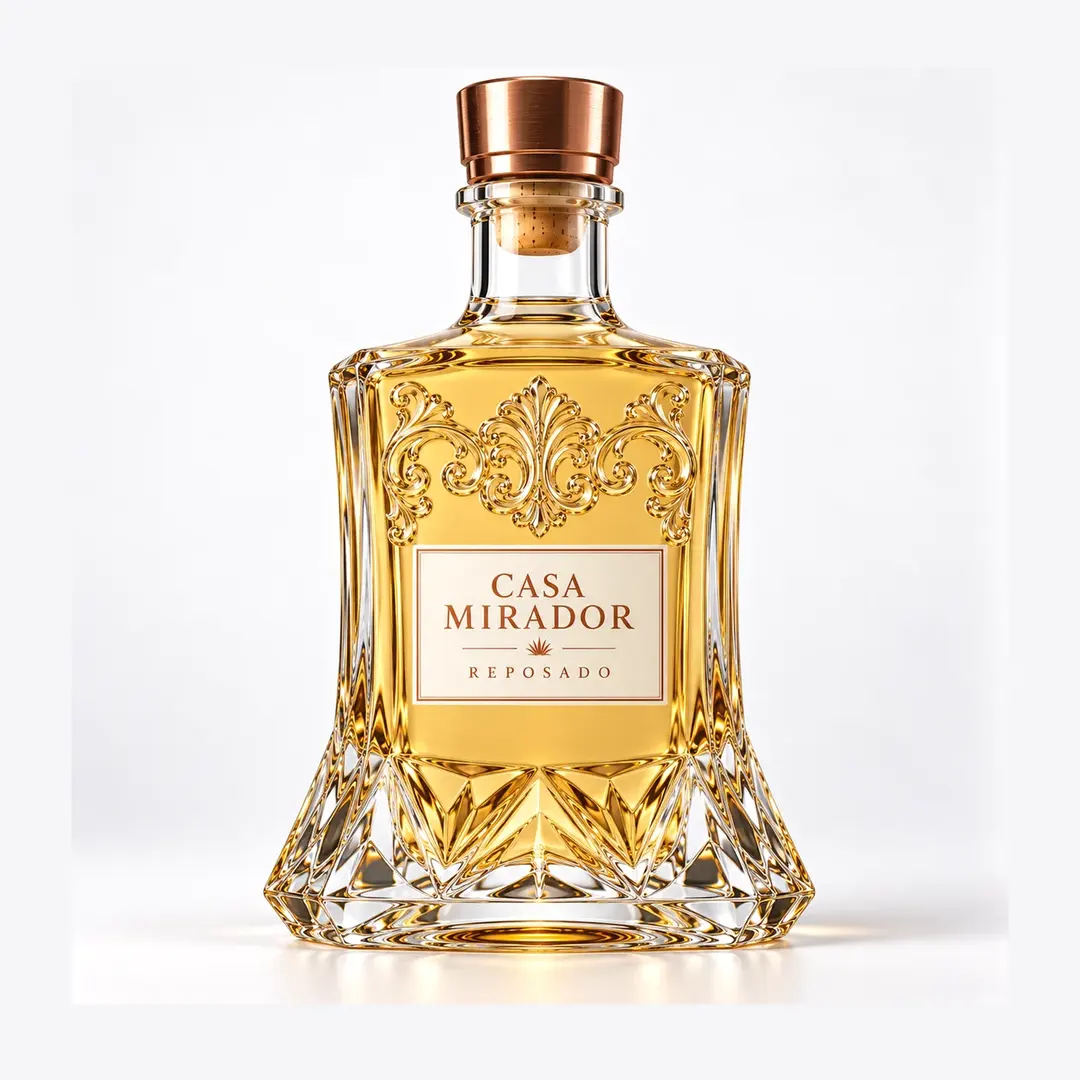
Some bottles carry a brand on a label; Model GAT-17 carries the brand in the glass itself. The product photograph shows a rectangular, decanter-style flint bottle whose entire front panel is given over to deep embossed branding — ornate filigree above and below a bold brand wordmark, with the phrases “American Craftsmanship” and “American Pride” pressed into the glass. Below the body, the base flares outward into a dramatic faceted skirt, so the bottle reads as part flask, part showpiece. For craft distilleries and private-label buyers who want packaging that communicates heritage before a single word of marketing copy is read, this model is a working example of what custom embossing can do.
Anatomy of the Bottle in the Photo
Here is what is directly visible, and what remains to be confirmed:
- Body: a flat-sided rectangular flask body with broad front and back panels — generous real estate for embossing, labels, or a combination of both.
- Embossing: a fully branded front panel with decorative scrollwork, a central wordmark, and the legible lines “American Craftsmanship” and “American Pride”. The embossing is crisp, which tells you the mold work is capable of fine detail.
- Base: a flared, twisted-facet skirt at the bottom that widens the footprint and catches light along its angled surfaces.
- Neck: a short neck rising from a flat shoulder, finished with a flared lip consistent with a cork or bar-top style closure. Exact neck finish code should be confirmed with the factory.
- Glass: clear flint with no frosting or spray visible in the photograph.
Capacity is not legible on the bottle, so we do not state it; ask for the current spec sheet and we will confirm fill volume, weight, and tolerances.
Embossing as a Brand Asset, Not a Decoration
There is a strategic reason craft spirits brands invest in embossed glass: embossing cannot peel off, fade, or be scuffed in transit. It survives wet bars, ice buckets, and back-bar lighting, and it photographs beautifully — which matters when your customers do your marketing for you on social media. GAT-17 demonstrates the two levels of embossing that buyers typically specify: structural embossing (the flared faceted base, which changes the silhouette itself) and surface embossing (the wordmark and filigree panel). When you commission a custom mold, both levels are designed together, so the brand story runs from the base of the bottle to the neck.
It is also worth noting what the embossing replaces. A bottle with this much identity in the glass needs only a minimal label — a small paper tag, a neck hanger, or a single-color screen print — which reduces per-unit label cost and removes an entire failure point (label adhesion in cold or humid conditions) from your supply chain.
The Engineering Hidden in the Flared Base
That dramatic skirt is not only visual. Widening the footprint lowers the center of gravity of the filled bottle, which improves stability on uneven bar shelves and in retail refrigeration. The faceted surfaces stiffen the base against impact, and the angled planes create the light-play that makes flint glass look closer to crystal. From a manufacturing perspective, shapes like this require careful mold cooling and controlled forming to keep wall thickness even through the flared section — one of the reasons it pays to work with a factory that can show you real production samples rather than renderings.
Who This Bottle Fits Best
The photograph practically names its own market: American craft whiskey, bourbon-style programs, and heritage-brand rye or corn whiskey are the obvious fits, and the “American Craftsmanship / American Pride” wording shows exactly the kind of messaging embossing can carry. Beyond whiskey, the rectangular decanter format works for premium rum aged programs, artisanal brandy, and limited-edition liqueurs positioned as gift purchases. Duty-free and gift-box channels favor this silhouette because the flat panels pack efficiently into presentation cartons and the bottle presents face-forward with no awkward rotation on the shelf.
Closures, Capsules, and Line Compatibility
The flared lip in the photo points to a cork or bar-top closure, which suits the heritage positioning — natural cork for tradition, synthetic for consistency, wood-top bar-tops for the premium shelf. Confirm the neck finish dimensions with the factory before ordering closures, and if your market requires tamper evidence, plan a full-body shrink sleeve or capsule. On the filling line, rectangular bottles run happily on standard rotary fillers but need correctly spaced change parts (star wheels and guides); tell your co-packer the bottle’s cross-section early so change parts can be quoted with the bottle order.
Manufacturing Quality You Can Audit
Every lot is annealed to relieve forming stress, verified in line with ASTM C148; internal pressure resistance follows ISO 7458; and thermal shock resistance is tested per ISO 7459. For embossed designs we add definition checks on the raised artwork — soft or washed-out lettering is a mold-wear signal we reject before packing. Third-party inspection is welcome at our plant.
From This Sample to Your Own Embossed Bottle
There are three ways to buy. First, take GAT-17 as it stands if the shape suits your program and apply your own labels and closure. Second, keep the shape and replace the embossed artwork with your own — this typically involves new mold engraving and is the most common route for established brands. Third, use this bottle as a reference point for a fully custom decanter: our team will translate your sketches into mold drawings and a physical sample. MOQ and tooling logic for each route is laid out in our MOQ guide, and our supplier checklist helps you compare us line-by-line against any other factory you are evaluating. When you are ready for pricing, samples, or mold quotations, reach us through the contact page — tell us your spirit category, target annual volume, and whether you want to keep or replace the embossed artwork, and we will come back with a concrete plan.
Frequently Asked Questions
Can the embossed branding on GAT-17 be changed to my own logo?
Yes. The embossing shown in the photo — the wordmark, filigree, and the lines ‘American Craftsmanship’ and ‘American Pride’ — is produced by the mold, so replacing it means new mold engraving. This is a routine customization for established brands; send us your artwork and we will quote the tooling and produce an engraved sample for approval before full production.
What capacity is this rectangular decanter bottle?
Capacity is not legible on the bottle in the photograph, so we do not state a figure on this page. Contact us for the current specification sheet, which lists brimful and nominal capacity, glass weight, neck finish code, and carton packing for Model GAT-17.
What closure fits this bottle?
The flared lip visible in the photo is consistent with a cork or bar-top closure, which suits the heritage decanter positioning. Confirm exact neck finish dimensions with the factory before ordering closures, and add a shrink capsule if your market requires tamper evidence.
Will a rectangular bottle run on my existing filling line?
Rectangular flasks run on standard rotary fillers, but they need correctly spaced change parts — star wheels, guides, and labeler adjustments matched to the bottle’s cross-section. Share the bottle drawing with your co-packer early so change parts can be quoted alongside the bottle order.
Why choose embossing instead of a larger label?
Embossing cannot peel, fade, or scuff in transit, survives wet-bar conditions, and gives the bottle identity even unlabeled — which also lets you use smaller, cheaper labels. The flared faceted base on this model adds stability and a crystal-like light effect that labels alone cannot achieve.
What quality standards apply to production?
Lots are annealed with verification aligned to ASTM C148, internal pressure resistance is tested per ISO 7458, and thermal shock resistance follows ISO 7459. Embossed artwork is additionally checked for definition, and third-party inspections at the factory are welcome.


