
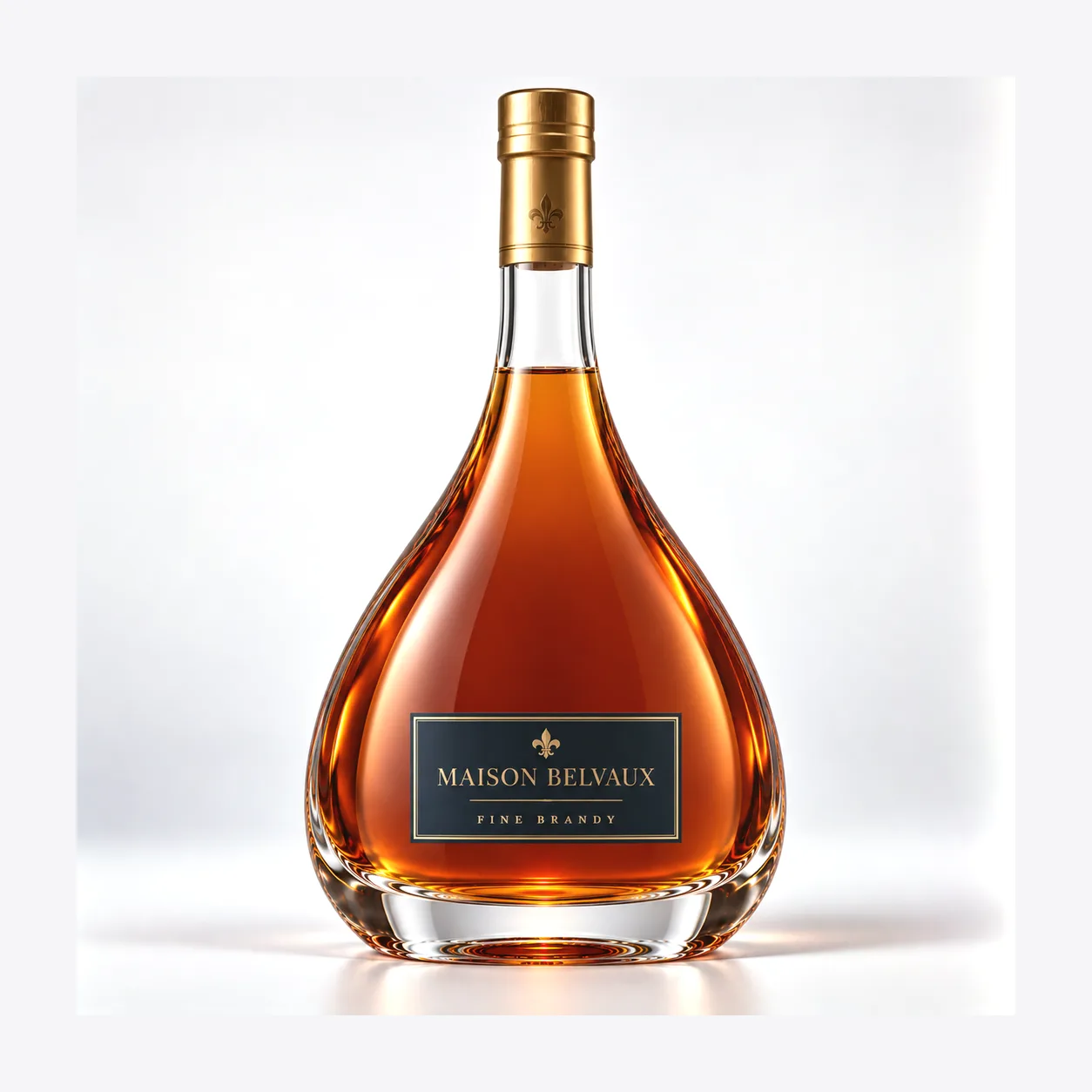
Model JDK is one of those designs that tells you what it wants to be the moment you see it on the shelf. The product photo shows a clear flint glass bottle with a distinctive arched, almost cathedral-window silhouette: the body rises in a smooth teardrop curve from a thick, heavy base, sweeps through tall bowed shoulders, and resolves into a slim, straight neck finished with a small ring at the mouth. There are no sharp corners anywhere on this mold. Every transition is a radius, which gives the bottle a calm, sculptural presence that reads as premium before a single label is applied.
What the Product Photo Tells Us
Because model codes alone do not describe a bottle, we always start from the physical sample. From the photo we can confirm the following: the glass is clear flint with high transparency and good brilliance; the profile is a tall arched teardrop, wider at the base and narrowing continuously toward the neck; the base is visibly thick, suggesting a deliberate weight-at-the-bottom design; and the neck finish is a small-diameter mouth of the type normally paired with a bar-top cork or a similar premium stopper. Any dimension you do not see here — exact brimful capacity, neck finish tolerance, glass weight, and punt depth — should be confirmed with the factory before tooling commitments, since photographs cannot replace a technical drawing.
The Design Language of an Arched Shoulder
Arched-shoulder bottles occupy a special place in spirits packaging. The long uninterrupted curve behaves like a lens: it catches light along the shoulder line and pushes reflections down into the body, making the liquid inside look deeper and richer. For amber spirits — brandy, cognac-style blends, aged rum, or whisky-based liqueurs — this optical effect is essentially free advertising on the shelf. The teardrop outline also reads as “cellar” rather than “bar rail,” which is why this silhouette family is so common among XO-tier and gift-boxed products.
The thick base visible in the photo does two jobs at once. In the consumer’s hand it creates the low center of gravity and satisfying heft that buyers associate with premium spirits. On the filling line it stabilizes the bottle through conveying, rinsing, filling, and corking. If your brand brief asks for “a bottle that feels expensive the second someone picks it up,” base weight is the single most effective lever, and this mold has clearly been designed with that in mind.
Which Spirits and Brands This Model Suits
Based on the observed shape, Model JDK is a natural candidate for brandy and cognac-style products, aged rum, premium fruit or cream liqueurs, and limited-edition gift spirits where the bottle itself must carry much of the perceived value. It is less suited to high-speed bar-rail vodkas, where tall heavy bottles slow down bartenders, and it is not the economical choice for entry-level SKUs where glass weight directly drives unit cost. If you are building a flagship expression, a duty-free exclusive, or an anniversary bottling, this silhouette is working in your favor. For standard-price volume lines, ask us about lighter molds in the same category instead.
Decoration and Customization Options
The smooth, uninterrupted body of this model is a blank canvas for decoration. Acid-etched frosting over the full body, partial frosting that leaves a clear window at the shoulder, screen-printed or decal-applied artwork, metallic hot-stamping, and spray-color gradients are all compatible with a curved flint surface like this. Because the bottle has no flat label panel, many brands choose a small front medallion label plus a neck tag, letting the glass itself do most of the talking. Embossing a crest or brand mark into the shoulder area is possible at the mold stage — this requires a custom mold modification, so raise it early in the inquiry if it is part of your brand plan.
Quality Control Behind the Glass
Every bottle in this category passes through the same quality framework regardless of shape. Thermal stress is managed through controlled annealing verified against ASTM C148, so the curved walls and thick base cool without locked-in tension. Internal pressure resistance is tested per ISO 7458, which matters even for still spirits because of hot-fill-adjacent processes and transport stacking loads. Thermal shock resistance is checked per ISO 7459, protecting the bottle during pasteurization-style washes or rapid temperature changes in warehousing. Surface quality is inspected for seeds, blisters, stones, and mold-line defects, with cosmetic grading agreed with the buyer before mass production. Curved bottles like this one receive extra attention at the shoulder, where wall thickness variation is most likely to appear.
Mold Consistency and Production Notes
A silhouette this dependent on smooth curvature lives or dies by mold condition. Worn molds soften the shoulder line and introduce waviness that is invisible in a single bottle but obvious across a retail shelf. For that reason, curved-profile molds in our production schedule run on defined maintenance intervals, and first-article samples from each production campaign are measured against the master sample for profile accuracy, verticality, and base thickness. If your program spans multiple production runs across a year, we recommend retaining a signed master sample at both ends — yours and ours — so that batch-to-batch comparison has an objective reference. This is standard practice for premium spirits programs and costs nothing beyond a courier fee.
Ordering, Sampling, and Logistics
Minimum order quantities for a mold of this type follow our standard framework — see glass bottle MOQ explained for how quantity breaks affect unit pricing. Physical samples from existing stock molds can normally be arranged before any deposit, so your team can verify hand feel, weight, and closure fit with real product. For buyers consolidating spirits bottles with closures, cartons, and gift boxes into one shipment, our guide to importing glass bottles from China covers palletization, container loading, and documentation. When you are ready to price this model with your decoration specification, send the brief through our contact page and include your target capacity and annual volume — that is enough for a same-week quotation.
Frequently Asked Questions
What is the capacity of the Model JDK liquor bottle?
The product photo does not state a capacity, and we never guess from a picture. Bottles of this arched-shoulder style are commonly produced in standard spirits sizes, but the exact brimful and nominal capacities for this mold must be confirmed with the factory from the technical drawing. Tell us your target fill volume and we will verify fit before sampling.
Can the Model JDK bottle be customized with embossing or frosting?
Yes. The smooth curved body accepts full or partial acid frosting, spray color, decals, screen printing, and hot stamping. Embossed logos or crests require a mold modification, which is possible but adds tooling cost and lead time, so it should be decided before the first production order.
What closure fits this bottle?
The photo shows a small-diameter neck finish typical of bar-top cork closures. Exact neck finish dimensions and tolerances must be confirmed with the factory, and we recommend testing your chosen cork or stopper against physical samples before committing to a closure purchase.
What is the minimum order quantity for this model?
MOQ depends on whether the run uses an existing stock mold or a modified/custom mold, and on decoration complexity. Stock-mold orders start considerably lower than custom tooling. See our MOQ guide or send your annual volume through the contact page for an exact figure.
How is quality controlled for a thick-based curved bottle like this?
Annealing is verified per ASTM C148 to remove residual stress from the thick base and curved walls, internal pressure resistance is tested per ISO 7458, and thermal shock resistance per ISO 7459. Shoulder wall-thickness distribution receives additional inspection because curved profiles are more sensitive to forming variation.
Can I get a physical sample before ordering?
Yes. Samples from existing stock molds can usually be arranged prior to any deposit so you can evaluate weight, hand feel, clarity, and closure fit with your actual product. Decoration samples (frosting, printing) can also be produced for approval before mass production begins.


