
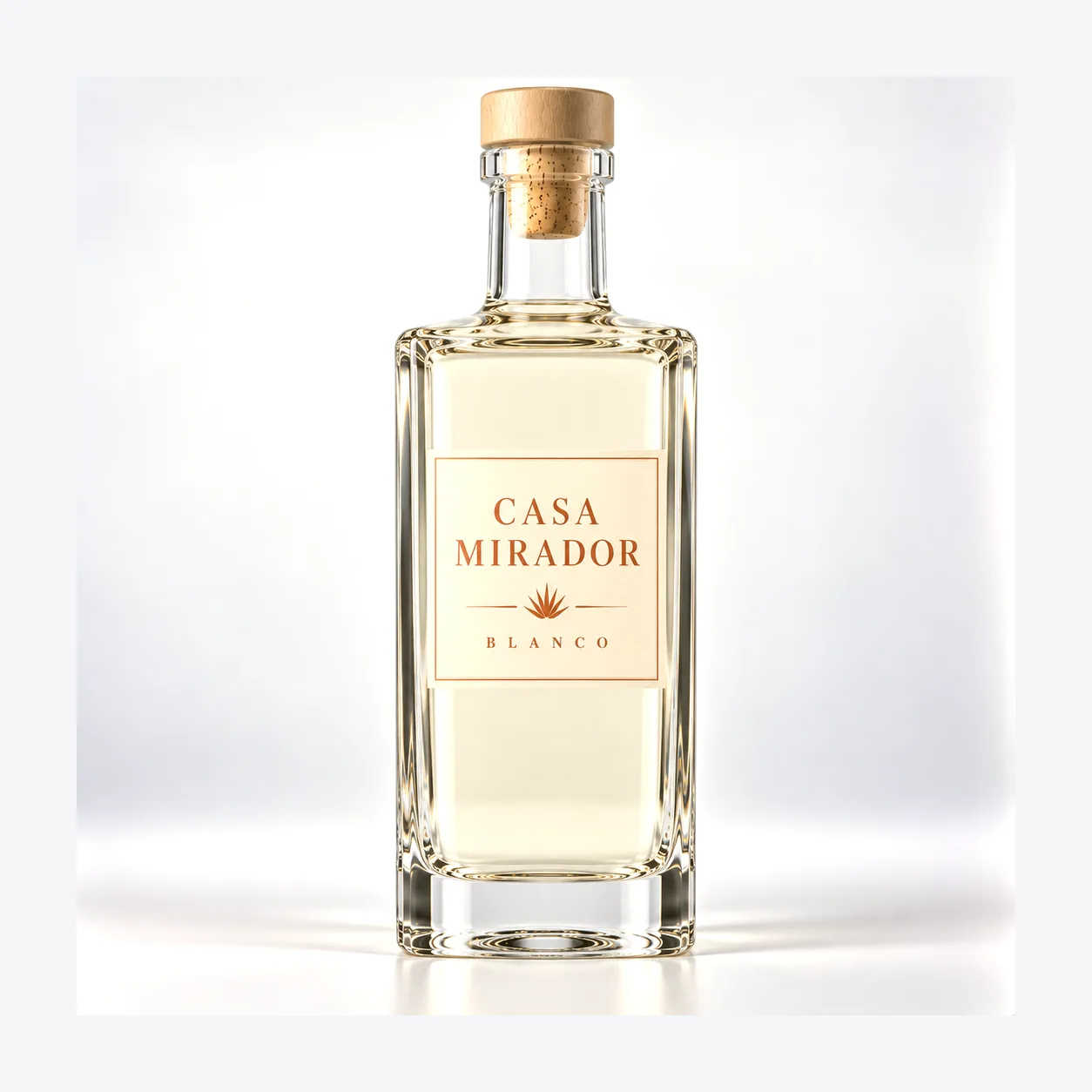
Square flask bottles are the workhorses of the spirits shelf, and Model LF is a clean, well-proportioned example of the breed. The product photo shows a clear flint glass bottle with a rectangular body, softly rounded shoulder transition, short cylindrical neck, and a defined ring at the mouth of the type used for bar-top cork closures. Two details stand out on closer inspection: a faint arched panel embossed into the front face of the body, and a thick, well-formed base that gives the compact silhouette real visual weight. This is a bottle designed to carry a label proudly and stack efficiently — a combination that explains why the square flask format dominates whisky and vodka mid-shelves worldwide.
Reading the Bottle from Its Photo
Here is what the photo allows us to state with confidence. The glass is clear flint, bright and transparent, suitable for showcasing any spirit color from pale vodka to deep whisky. The body is a square-section flask with gently rounded vertical edges — not a sharp-cornered design — which improves both impact resistance and label-wrap behavior. The front face carries a shallow arched embossment forming a natural label panel. The neck is short with a smooth ring finish consistent with bar-top cork closures. What the photo cannot tell you — exact capacity, glass weight, neck bore tolerance, and panel depth — must be confirmed with the factory against the mold drawing before you commit to labels or closures.
Why the Square Flask Format Keeps Winning
The commercial logic of the square flask is hard to argue with. Rectangular bodies pack tighter on pallets and in cartons than round bottles of equivalent volume, cutting freight cost per unit — a real number when you ship containers of glass across oceans. On the retail shelf, flat faces let bottles sit shoulder-to-shoulder with no wasted gap, so a facing of square flasks presents a solid wall of brand where round bottles show slivers of competitor product between them. For distributors managing mixed warehouses, square flasks also stack more predictably in case goods, reducing damage claims. If your brand competes in the crowded whisky, vodka, or white-spirits mid-market, this format gives you shelf presence and logistics efficiency at the same time.
The Embossed Panel: Built-In Label Real Estate
The shallow arched embossment on the front face is a small detail with outsized practical value. It frames the label visually, giving even a simple paper label a deliberate, designed look. It also creates a subtle tactile boundary that helps automatic labeling equipment register position consistently, which reduces skew and wrinkle rejects on high-speed lines. Brands that prefer a minimalist approach can skip the front label entirely and print directly inside the panel area with screen printing or a ceramic decal — the embossed border does the framing work for free. If your brand plan calls for a deeper custom embossment, such as a crest or logotype raised from the glass itself, that is a mold-level modification: feasible, but it must be decided before production, so raise it at inquiry stage.
Target SKUs and Brand Positioning
Within a spirits portfolio, this model fits the dependable core range: the blended whisky that sells every week, the vodka that anchors a distributor’s white-goods lineup, the gin that needs to look honest rather than theatrical. It is also a sensible vessel for private-label programs, where the retailer’s brand must sit confidently next to national brands without outspending them on packaging. The compact proportions keep glass weight — and therefore unit cost — under control, while the embossed panel stops the bottle from looking like a generic container. That balance, cost discipline with designed-in detail, is exactly what mid-market SKUs need to survive a price war on the shelf.
Decoration Routes for This Format
Beyond labels, the flat faces of a square flask accept nearly every decoration process without distortion: multi-color screen printing, organic or ceramic decals, acid frosting across the full body or inside the panel only, spray coating in brand colors, and metallic hot stamping. Many whisky and vodka brands combine a paper front label inside the embossed panel with a screen-printed back story on the rear face — readable through the liquid, which adds a small moment of discovery for the consumer. If you plan a frosted or sprayed finish, ask for decoration samples on this actual mold rather than a similar one, because panel depth and edge radius affect how coatings read at the corners.
Closures, Filling, and Line Compatibility
The short neck and ring finish visible in the photo point to bar-top cork closures — the natural pairing for premium-positioned whisky, vodka, gin, and liqueur products in this format. The bottle’s flat base and square footprint convey stably through rinsing, filling, and closure stations, and the broad shoulder gives filling-machine grippers plenty of contact area. If your bottling line is set up for ROPP or screw closures instead, tell us at inquiry: neck finish is a mold feature, and matching the mold to your line is far cheaper than adapting a line to a bottle.
Quality Standards Applied to Every Run
Square flasks concentrate stress at their vertical edges, so process control matters more here than on round bottles. Annealing is controlled and verified per ASTM C148 to relieve forming stress through the edge radii and base. Internal pressure resistance is tested per ISO 7458, and thermal shock resistance per ISO 7459 covers hot washing and cold-filling transitions. Cosmetic inspection covers the usual defects — seeds, blisters, mold-line flash — plus edge-specific checks for corner thinning, since square sections draw glass toward the corners during forming. Agreed cosmetic grading samples are signed before mass production so both sides inspect against the same standard.
Commercial Terms and Next Steps
Model LF, as a catalog flask shape, is one of the more accessible molds in terms of minimum order quantity — the framework is laid out in our glass bottle MOQ guide. Buyers building a full spirits SKU often consolidate this bottle with bar-top corks, capsules, and printed cartons in one shipment; our import guide for glass bottles from China walks through consolidation, pallet specs, and paperwork. To move from interest to quotation, send your target capacity, annual volume, and closure choice through the contact page — a stock-mold project of this type typically returns pricing within the week.
Frequently Asked Questions
Is the Model LF bottle suitable for whisky and vodka?
Yes — the square flask format is the classic mid-shelf format for whisky, vodka, gin, and white spirits. The clear flint glass shows spirit color accurately, and the flat front face with its embossed panel is designed around a prominent front label. Final suitability for your filling line should be verified with physical samples.
What capacity is this bottle?
Capacity is not stated on the product photo and we do not estimate volumes from images. Square flasks of this style are produced in several standard spirits sizes, but the exact nominal and brimful capacity of this mold must be confirmed with the factory from the technical drawing.
Can the embossed front panel be customized with our logo?
A custom raised logo or crest inside the panel area requires a mold modification, which adds tooling cost and lead time but creates a permanent branded bottle. Decorating the existing panel with screen printing, decals, or labels requires no mold change and is the faster route to market.
What closure does the neck finish accept?
The photo shows a ring finish typical of bar-top cork closures. If your line uses ROPP or screw caps, the neck finish must be matched at mold level — confirm your closure system with us at inquiry so we can verify compatibility before sampling.
How do square flasks reduce logistics cost?
Rectangular bodies pack tighter in cartons and on pallets than round bottles of equal volume, so more units fit per container and less air is shipped. Flat faces also eliminate shelf gaps at retail. The exact pallet efficiency for this mold can be calculated once capacity is confirmed.
What quality tests does this bottle pass?
Annealing is verified per ASTM C148 with attention to edge stress, internal pressure resistance per ISO 7458, and thermal shock resistance per ISO 7459. Square-section bottles additionally receive corner-thickness inspection, since glass draws toward the corners during forming.


