
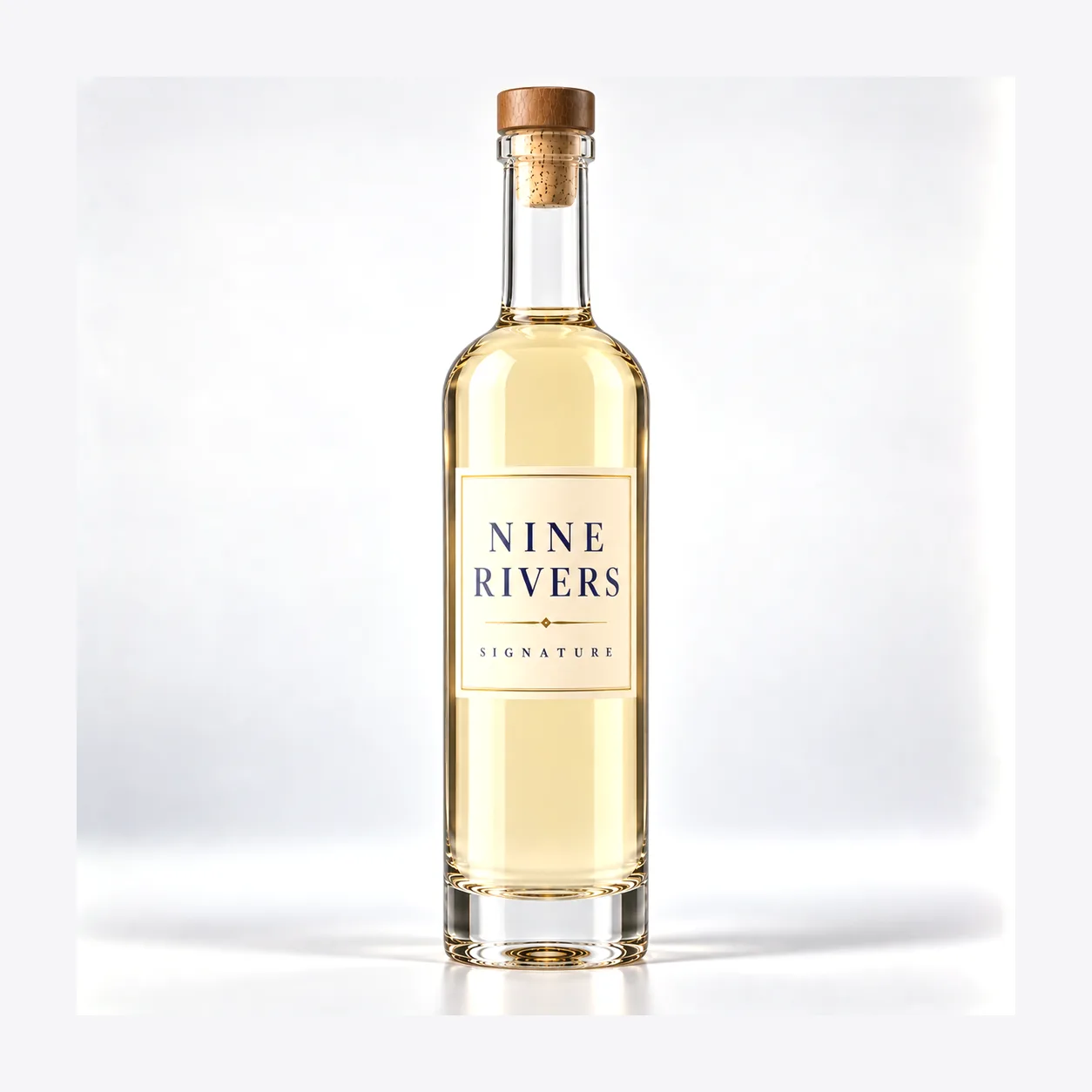
Some bottles borrow their authority from the decanter tradition, and Model M9S is clearly one of them. The product photo shows a clear flint glass bottle built on a generous rounded body — an onion-like teardrop volume with no flat faces and no sharp transitions — rising through a sweeping shoulder into a tall, slim cylindrical neck. The base carries a visible punt and substantial glass thickness, and the mouth is a small-diameter finish suited to bar-top cork or stopper closures. The overall impression is of a tasting-room decanter scaled down and sealed for retail: elegant, pourable, and unapologetically premium in stance.
What We Can Confirm from the Photo
Honesty about image-based description matters, so here is the verified list. The glass is clear flint, transparent and bright. The body is fully round in cross-section with a broad, low-slung volume and a deep punt visible at the base. The neck is long and slim relative to the body — a defining proportion of this mold. The mouth finish is small-diameter, consistent with bar-top cork closures. Not confirmed from the image, and to be verified with the factory from the technical drawing: nominal and brimful capacity, glass weight, neck finish specification and tolerance, punt depth, and overall height. If any of these numbers drive your label size, closure purchase, or gift box design, get them in writing before tooling or printing begins.
The Decanter Silhouette as a Brand Asset
Decanter-shaped bottles carry a message no label can print: this spirit deserves ceremony. The round body and long neck reference the vessels people use to serve their best bottles to guests, so putting a spirit in this silhouette positions it for slow, deliberate consumption — neat pours, tastings, gifting. Brandy and cognac-style products are the traditional tenants of this shape, but it has migrated successfully into premium vodka, aged rum, and high-end fruit spirits wherever a brand wants ritual rather than refreshment. The deep punt adds to the effect: it thickens the base visually, catches light, and gives the bottle the grounded stance of hand-blown decanter ware.
The long neck is not only aesthetic. It gives the pourer control — a slim neck slows and directs the stream, which suits sipping spirits — and it provides natural label space for a neck tag or capsule story panel. On the shelf, tall-neck round bottles read as a distinct height class, breaking the row visually among square flasks and short-shoulder designs. For a brand launching into a crowded premium tier, that silhouette differentiation is often worth more than any decoration budget.
Decoration Approaches That Respect the Shape
A silhouette this clean punishes visual clutter and rewards confidence. The strongest decoration schemes we see on decanter-style molds share a pattern: the body stays almost naked, a small printed or embossed medallion carries the brand mark, and the neck wears a capsule, tag, or printed story strip. Screen printing directly on the curve works well for one- or two-color artwork; multi-color photographic imagery is better handled as a ceramic or organic decal, which conforms to the curve without the distortion a paper label would show. Full frosting flattens the light play that makes this shape attractive, so if frosting is part of the brief, consider a frosted body with a clear window at the punt, letting the thick base keep doing its optical work. Metallic capsules and wax-dipped finishes both pair naturally with the bar-top neck and reinforce the cellar-release impression.
Gift Editions and Series Potential
Decanter-style bottles earn their keep fastest in gifting and limited-edition programs. The shape already implies a presentation moment, so adding a tube, coffret, or wooden box feels inevitable rather than extravagant. For series planning — annual releases, single-cask programs, vintage-dated spirits — keeping one bottle constant while varying capsule color, tag artwork, and outer packaging builds collector recognition without repeated mold investment. If this is your plan, tell us at the first order: we can reserve mold capacity and glass composition consistency across campaigns so that year three’s bottle sits perfectly beside year one’s on a collector’s shelf.
Practical Considerations for Round, Tall-Neck Formats
Buyers should plan for the format’s realities. Round bodies pack less densely than square flasks, so per-container freight cost is higher — factor this into landed-cost comparisons against alternative shapes. Tall necks require adequate head clearance on filling and corking equipment; share your line specs at inquiry and we will confirm compatibility. Fully curved faces rule out large paper labels, which pushes decoration toward small medallion labels, neck hangers, screen printing, or decals — most brands in this format embrace that and let the glass carry the design. Finally, the round body and punt make this bottle a natural fit for tube or coffret gift packaging, which is frequently the actual sales channel for decanter-style SKUs.
Quality Control for a Curved, Punted Mold
The production standards behind this bottle follow our category framework. Annealing is controlled and verified per ASTM C148, with particular attention to the punty area and neck junction where section thickness changes fastest. Internal pressure resistance is tested per ISO 7458, and thermal shock resistance per ISO 7459 covers hot-wash and cold-fill transitions. Round, punted molds receive dimensional checks on punt concentricity and neck verticality — a slightly off-center punt or leaning neck is instantly visible in a design this clean. Cosmetic inspection follows agreed grading samples covering seeds, blisters, and mold-line quality, signed by both parties before volume production.
How to Specify and Order
To price this model we need three things: your target capacity, your closure choice, and your annual volume. Send them through the contact page and expect a quotation with mold availability within days. Minimum order quantities for a premium round mold of this type are explained in our glass bottle MOQ guide. Buyers new to sourcing spirits glass from China should review our import guide for palletization and documentation basics — round tall bottles ship on standard pallets but with lower unit counts, and we model that for you during quotation. Physical samples from stock are available for hand evaluation before any deposit, and we recommend testing your bar-top cork against the sample neck before ordering closures in bulk.
Frequently Asked Questions
Which spirits suit the Model M9S decanter-style bottle?
The round body, deep punt, and long slim neck are classic for brandy and cognac-style spirits, and the format has also proven itself with premium vodka, aged rum, and high-end fruit spirits — anywhere a brand wants a slow-pour, ceremony-led positioning rather than bar-rail speed.
What is the capacity of this bottle?
Capacity is not marked on the product photo and we never infer volumes from images. The exact nominal and brimful capacity of this mold must be confirmed with the factory from the technical drawing — share your target fill volume and we will verify the match before sampling.
Can I apply a large paper label to this bottle?
The body is fully curved with no flat panel, so large wrap labels do not sit well. Brands typically use a small front medallion label, a neck hanger, screen printing, or decals. This is a feature of the format: the decanter silhouette is meant to carry the design with minimal paper.
What closure fits the neck finish?
The photo shows a small-diameter mouth consistent with bar-top cork closures. Exact neck finish dimensions and tolerances come from the mold drawing, and we recommend testing your chosen stopper against a physical sample before purchasing closures in volume.
Does the round shape increase shipping cost?
Round bodies pack less densely than square flasks, so fewer units fit per pallet and container. We model landed cost with real pallet plans during quotation so you can compare this silhouette against more freight-efficient shapes with actual numbers.
What quality tests apply to this punted, long-neck mold?
Annealing is verified per ASTM C148 with attention to the punt and neck junction, internal pressure resistance per ISO 7458, and thermal shock per ISO 7459. Punt concentricity and neck verticality receive dedicated dimensional checks, since any drift is immediately visible in this clean silhouette.


