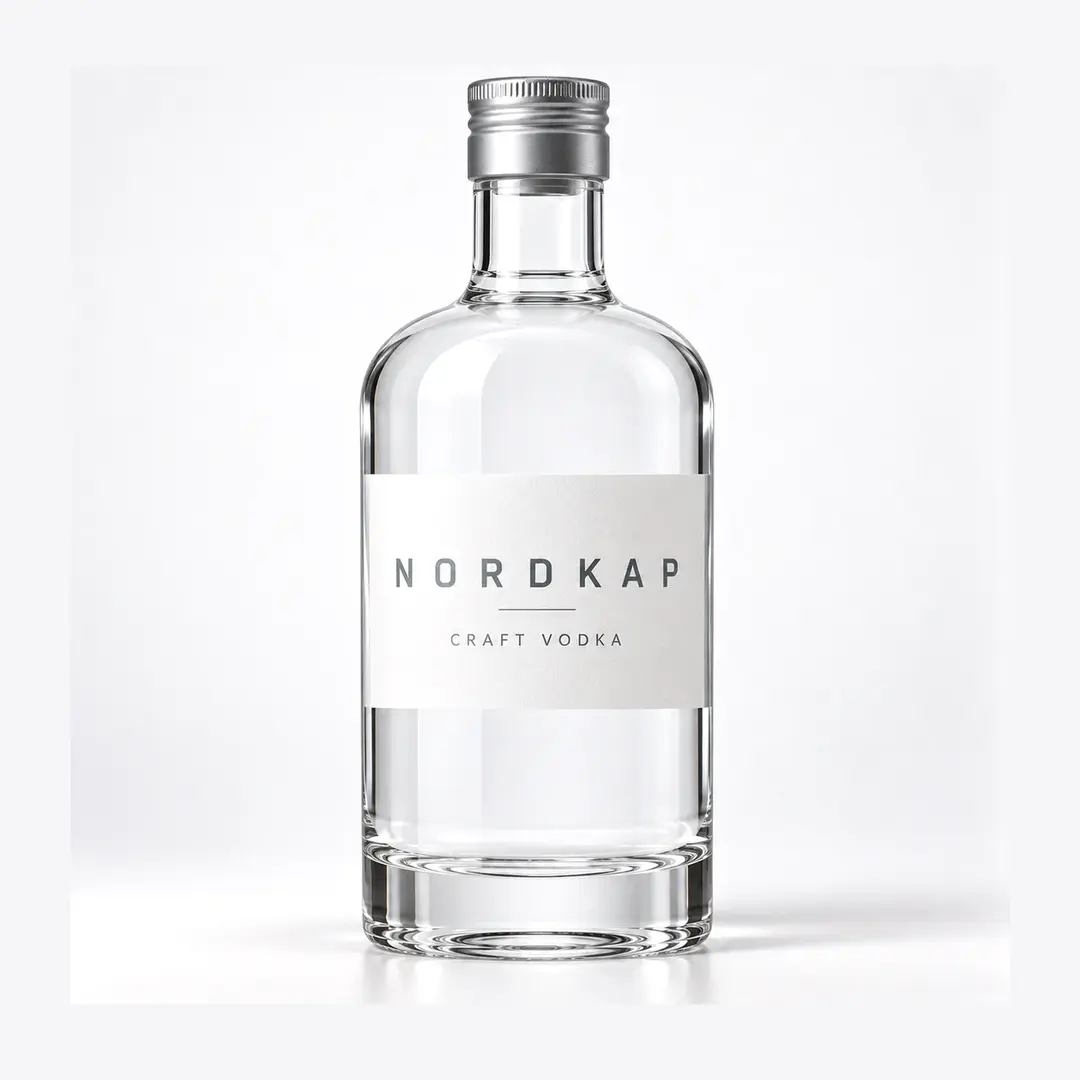
Not every successful spirits brand needs a sculptural bottle. If your program lives in the value-to-premium mainstream — high volumes, tight margins, big co-packing runs — what you need is a proven cylindrical bottle that runs fast, caps reliably, labels perfectly, and stacks efficiently. That is exactly what this model is. The product photograph shows a tall, clean round bottle in clear flint glass with smooth sloped shoulders, a thick base, and — the detail that defines its commercial role — a screw-thread neck finish ready for ROPP aluminum caps.
The Details Visible in the Photo
- Body: a straight-sided cylinder — the most line-friendly shape in the industry — with a smooth, uninterrupted label panel from shoulder to base.
- Shoulder: a gentle, even slope from body to neck with no sharp steps, which reduces stress concentration and gives the bottle its balanced, slightly softened profile.
- Neck finish: a clearly visible screw thread at the top of the neck, designed for ROPP (roll-on pilfer-proof) aluminum closures with tamper-evident bands.
- Base: a thick glass bottom with a shallow push-up, adding stability and a quality hand-feel.
- Glass: clear flint, unembossed, undecorated — a true blank platform.
Capacity is not marked legibly in the photo, so we do not state it; ask for the spec sheet and we will confirm the volumes currently tooled for this mold.
Why the Screw Thread Matters More Than the Shape
Buyers new to spirits often underestimate the closure decision. A screw-thread (ROPP) finish delivers four operational advantages that cork-family closures cannot match at scale. Speed: ROPP capping heads run at the full pace of modern filling lines, with no stopper orientation or cork moisture management. Tamper evidence: the roll-on process forms the aluminum cap to the thread and leaves a breakaway band — built-in compliance for markets that mandate tamper-evident packaging. Seal consistency: every cap applies with the same torque geometry, which protects flavor over years of shelf life and through temperature swings in shipping. Cost: at volume, ROPP closures are among the cheapest premium-acceptable closures available, and they need no capsules or wax.
For export brands selling into supermarkets, travel retail value tiers, or markets with strict tamper-evidence rules, a thread-finish bottle is often not a compromise but a requirement. This model gives you that finish on a shape every co-packer already knows how to run.
The Round Bottle as a Logistics Weapon
Cylindrical bottles are the default of the spirits industry for reasons that show up on your freight invoice. They feed, fill, label, and case-pack on standard equipment with minimal change parts; they orient automatically on rotary labelers; they pack into cartons with predictable efficiency; and they survive automated warehouse handling better than any faceted or flat alternative. If you are launching into multiple markets with different co-packers, a round screw-cap bottle is the lowest-friction choice you can make — every line in the world can run it. The smooth shoulder on this model also accepts both paper and clear film labels, wrap or front-and-back, without special tooling.
Which Brands Should Shortlist This Model
We most often see this profile specified for: mainstream and premium vodka, where glass clarity carries the brand; white, gold, and spiced rum in high-volume programs; blended whiskey and value bourbon-style lines; gin brands that decorate with a full-wrap printed label or sleeve rather than embossed glass; and ready-to-fill private-label spirits for retail chains. It is also the standard answer for house brands and contract bottling, where the buyer’s priority is reliable supply at a sharp price. If your positioning is ultra-premium or gift-led, we will honestly point you toward our heavier or shaped models instead — this bottle’s job is efficiency, and it does that job exceptionally well.
Decoration Without Slowing the Line
The uninterrupted cylinder is the easiest canvas in packaging. Full-wrap printed sleeves turn a stock bottle into a distinctive brand at minimal tooling cost; pressure-sensitive labels — paper, textured, or clear — apply at line speed; direct screen printing in one to three colors gives a no-label premium look for mid-tier positioning; and spray frosting or gradient color spray over the whole body creates a flavored-vodka or seasonal-edition look. Because the bottle is a standard cylinder, decoration suppliers need no custom fixtures, which keeps decoration lead times short.
Quality Control for Volume Programs
High-volume bottles need boring, consistent quality — and that is what our QC is built to deliver. Production lots are annealed with verification aligned to ASTM C148; internal pressure resistance is tested per ISO 7458; and thermal shock resistance follows ISO 7459, covering hot-fill, pasteurization, and cold-chain scenarios. Thread finishes are gauged for dimensional accuracy so your caps roll on correctly, and visual inspection screens stones, blisters, and birdswings before packing.
Buying for a Multi-Market Rollout
One more advantage of choosing a standard round thread-finish bottle appears when your brand crosses borders. Different markets often mean different co-packers, different label applicators, and different closure suppliers — and every non-standard bottle multiplies the qualification work at each stop. With this model the qualification conversation is short: the drawing is conventional, the thread is a standard ROPP geometry, and reference samples are easy to ship. Brands that launch first in one country and expand later consistently tell us that starting on a proven cylinder was the decision that made expansion cheap. You can always add a sculptural limited-edition bottle later; starting with one is the expensive way around.
MOQ, Sampling, and Next Steps
As a stock shape, this model carries the friendliest MOQ in our range; decoration changes the breakpoints, and both are explained in our MOQ guide. First-time importer? Our practical article on importing glass bottles from China covers packing, pallets, and freight in plain language. To get the spec sheet, current capacity list, ROPP closure compatibility details, and a physical sample of this model, send your annual volume estimate and target markets through the contact page — if you can share your filling line speed and capper type, we will confirm compatibility in the same reply.
Frequently Asked Questions
What closure does this model use?
The neck in the product photo shows a screw-thread finish for ROPP (roll-on pilfer-proof) aluminum caps. ROPP gives built-in tamper evidence via a breakaway band, consistent seals at full line speed, and low per-unit closure cost — which is why this bottle suits high-volume spirits programs. Confirm the exact thread specification with the factory before ordering caps.
What capacity is this bottle?
No volume is legibly marked in the photograph, so we do not state one here. Request the specification sheet and we will confirm the capacities currently tooled for this mold, along with glass weight, neck finish drawing, and carton packing data.
Why choose a screw-cap bottle over a cork-finish bottle?
For mainstream and volume programs, ROPP screw caps run faster on filling lines, need no capsules or wax, apply with identical seal geometry every time, and provide the tamper evidence many markets mandate. Cork-family closures suit premium and gift positioning; thread finishes suit efficiency — this model is built for the second job.
Will this bottle run on my co-packer’s line?
Cylindrical thread-finish bottles are the most line-friendly format in the industry — every standard filler, rotary labeler, and case packer handles them with minimal change parts. Share the bottle drawing and thread specification with your co-packer and they can confirm compatibility immediately.
What spirits is it best suited for?
Mainstream and premium vodka, white and spiced rum, blended whiskey, gin programs that decorate with full-wrap labels or sleeves, and private-label or contract spirits for retail chains. For ultra-premium or gift-led positioning, ask us about our heavier shaped models instead.
What quality standards does production meet?
Lots are annealed with verification aligned to ASTM C148, internal pressure resistance is tested per ISO 7458, thermal shock resistance follows ISO 7459, and thread finishes are gauged for dimensional accuracy so caps roll on correctly, with visual defect inspection before packing.


