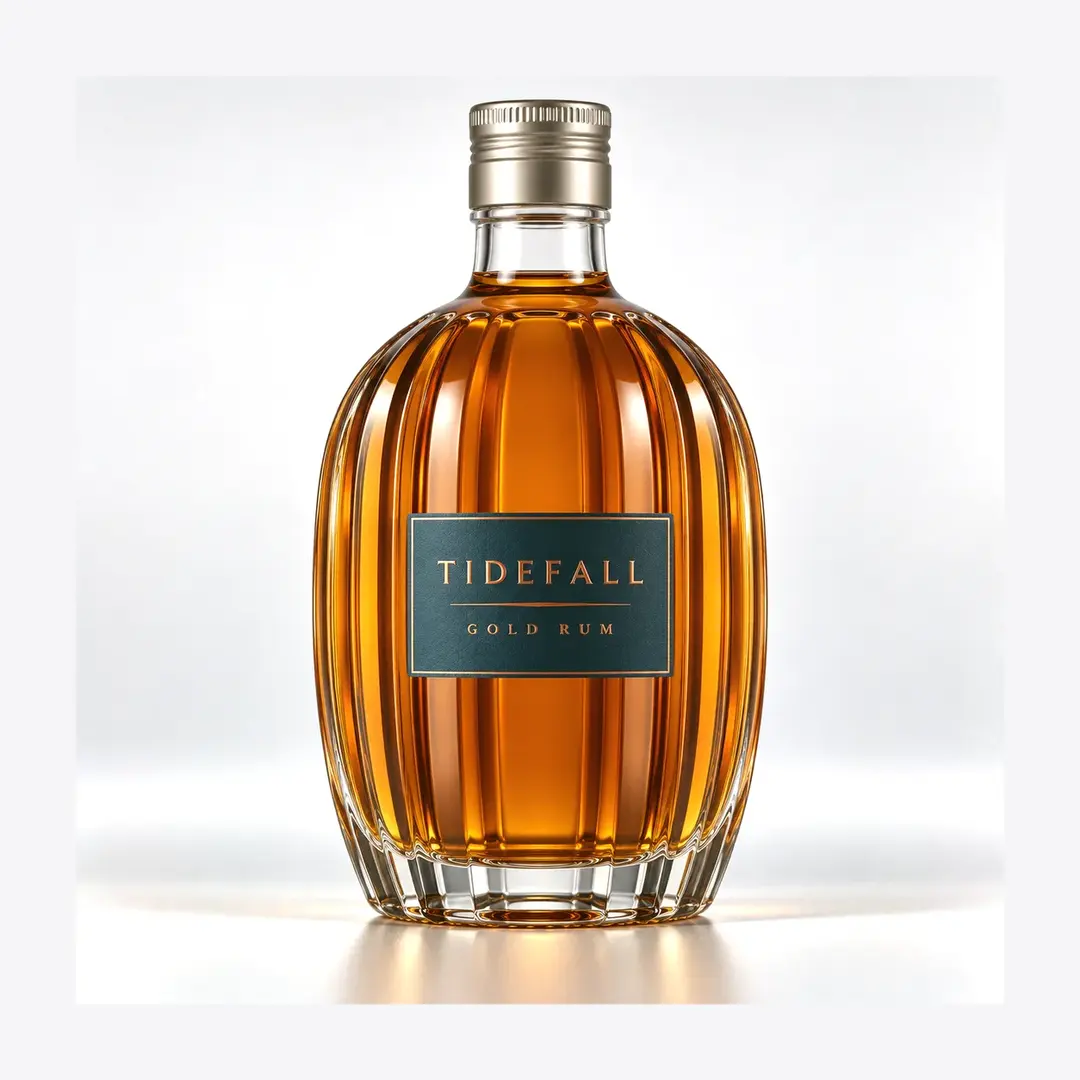
Model 376 is a wholesale catalog staple, and the reason distributors keep it on their reorder list is easy to state. The bottle is a clear flint glass oval flask — flattened front-to-back, rounded side-to-side — with vertical fluted ribs running the full height of the body, a thick glass base, and a compact threaded neck finish at the top. Catalogue imagery on this page is a decoration mock-up; the mould itself is a long-running catalogue staple, and pre-production samples are available before you commit. The mould carries no decoration of its own; everything on the shelf is added by your decorator.
Confirmed Observations from the Sample Photo
What the photo verifies: clear flint glass with good transparency; an oval, flattened flask profile; deep vertical fluting around the full body; a visibly thick base; and a threaded neck finish of the screw-cap family. What the photo does not tell you, and what must be confirmed with the factory from the technical drawing before ordering: exact nominal and brimful capacity, glass weight, thread specification and cap compatibility, overall dimensions, and case-pack configuration. These numbers determine your closure purchase, carton design, and pallet plan, so they belong in writing before any volume commitment.
Why Fluted Oval Flasks Move Volume
The fluted oval flask is one of the most traveled formats in the spirits wholesale trade, and its longevity is functional rather than nostalgic. The ribs serve three practical purposes. First, grip: a fluted surface sits securely in wet hands behind a bar and in consumers’ hands at the table, reducing drops. Second, light: vertical ribs break the surface into dozens of narrow lenses, so even a modest spirit picks up sparkle and movement on the shelf — decoration that costs nothing after the mold exists. Third, stiffness: fluted geometry increases the section rigidity of the glass, allowing the walls to do their structural job efficiently across large flat-ish faces. The oval footprint, meanwhile, packs more densely than a round bottle and presents a broad front face to the shopper.
For wholesale buyers, the format’s real appeal is versatility. One fluted oval mold can serve a liqueur brand, a fruit spirit, a herbal digestif, and a private-label vodka across four different customers — the decoration and closure differentiate, the bottle amortizes. That is the core economics of a catalog model: the mold cost is long since recovered, the line is proven, and unit pricing reflects volume rather than novelty.
Who Buys This Model, and Why They Come Back
The typical buyer of a fluted oval catalog flask falls into one of three profiles. Regional spirits distributors building a house brand need a proven bottle at an accessible minimum, with no tooling risk — this mold delivers that. Brand owners launching a second or third SKU beside an established flagship often choose a catalog shape for the flanker so capital stays concentrated on the hero product. And contract bottlers, who fill for many clients on shared lines, favor threaded-finish catalog flasks because closure logistics stay simple and changeovers stay fast. What all three have in common is a preference for certainty over novelty: a bottle that has already shipped in volume, to many destinations, without drama. Repeat ordering on this model is deliberately boring — specification on file, slot in the schedule, container on the water. In wholesale glass, boring is a compliment.
Decoration and Private-Label Routes
The fluted surface changes decoration tactics slightly but not painfully. Paper labels apply best to the front face where the fluting is shallowest, and many brands choose a die-cut label sized to sit between ribs. Screen printing works across the ribs for bold one- or two-color artwork; fine photographic detail is better left to labels or decals. Spray coating the full bottle in brand color turns the fluting into a texture feature — the ribs catch highlights through the coating and read as intentional design. For private-label programs where several retail brands share the mold, we recommend differentiating through closure color, capsule, and label architecture first; those changes cost nothing at the mold and keep every customer’s line flexible.
The Threaded Neck and High-Speed Filling
The threaded finish visible on this model points to screw-cap closure systems — the workhorse of high-throughput spirits and liqueur bottling. Screw caps apply fast, seal consistently, tolerate line-speed variation better than cork-type closures, and suit the price points where most wholesale volume actually lives. If your program uses tamper-evident aluminum closures, confirm the exact thread specification with us before purchasing caps; thread standards are matched at the mold, and physical fit-testing with your closure supplier’s samples is a step we always recommend. The bottle’s oval base and low center of gravity convey stably through rinsing, filling, capping, and labeling at commercial line speeds.
Wholesale Ordering: Quantities, Stock, and Repeat Runs
As a wholesale catalog model, this bottle is structured for distributor-scale purchasing. Minimum order quantities follow our standard framework — see the glass bottle MOQ guide — and catalog molds typically offer the most accessible entry quantities in the range because production slots recur regularly. Repeat buyers benefit from mold familiarity: once your specification is on file, reordering is a scheduling exercise rather than a new project. For buyers consolidating multiple catalog models into mixed containers, our team plans palletization and carton configuration as part of the quotation, and the import guide covers the shipping and documentation side. Buyers evaluating us alongside other suppliers may also find the glass bottle supplier checklist useful for structuring the comparison.
Quality Control on a Volume Catalog Mold
High-volume molds demand process discipline, because small drifts multiply across hundreds of thousands of units. Annealing is controlled and verified per ASTM C148 so the fluted walls and thick base carry no residual stress. Internal pressure resistance is tested per ISO 7458, and thermal shock resistance per ISO 7459 covers hot-wash and cold-fill transitions. Fluted surfaces receive dedicated inspection for rib completeness and definition — a worn mold quietly softens the fluting, and we gauge rib profile against the master sample at defined intervals. Cosmetic grading covers seeds, blisters, and mold-line quality against signed limit samples agreed before the run.
Frequently Asked Questions
What products is wholesale Model 376 typically used for?
The fluted oval flask format is a general-purpose spirits and liqueur vessel. Wholesale buyers commonly fill it with fruit spirits, herbal liqueurs, digestifs, and private-label vodka or brandy lines — the same mold serves multiple brands because decoration and closure do the differentiating.
What capacity is this bottle?
Capacity is not stated on the sample photo and we do not estimate from images. The exact nominal and brimful capacity of this catalog mold must be confirmed with the factory from the technical drawing, along with dimensions and case-pack configuration.
What closure fits the threaded neck?
The photo shows a threaded finish of the screw-cap family, suited to tamper-evident aluminum or plastic screw closures. The exact thread specification must be confirmed with the factory, and we recommend fit-testing with your closure supplier’s samples before purchasing caps in volume.
What are the MOQ and lead time for this wholesale model?
Catalog molds typically carry the most accessible minimums in our range because production slots recur regularly — see our MOQ guide for the framework. Lead time depends on current scheduling; repeat orders against an on-file specification move fastest. Send your volume through the contact page for current figures.
Can multiple brands share this bottle with different decoration?
Yes — that is the core economics of a catalog mold. Screen printing, decals, spray color, and different closures make one bottle serve several distinct brands, while the mold cost is already amortized. Decoration samples on this actual mold can be produced for approval before volume.
How is quality kept consistent across high-volume runs?
Annealing is verified per ASTM C148, internal pressure per ISO 7458, and thermal shock per ISO 7459 on every campaign. Rib definition is gauged against the master sample at intervals because worn molds soften fluting over time, and cosmetic grading follows signed limit samples agreed before each run.


