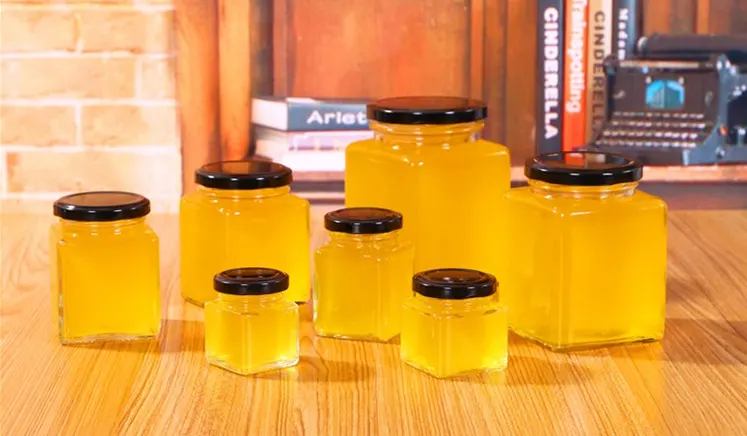
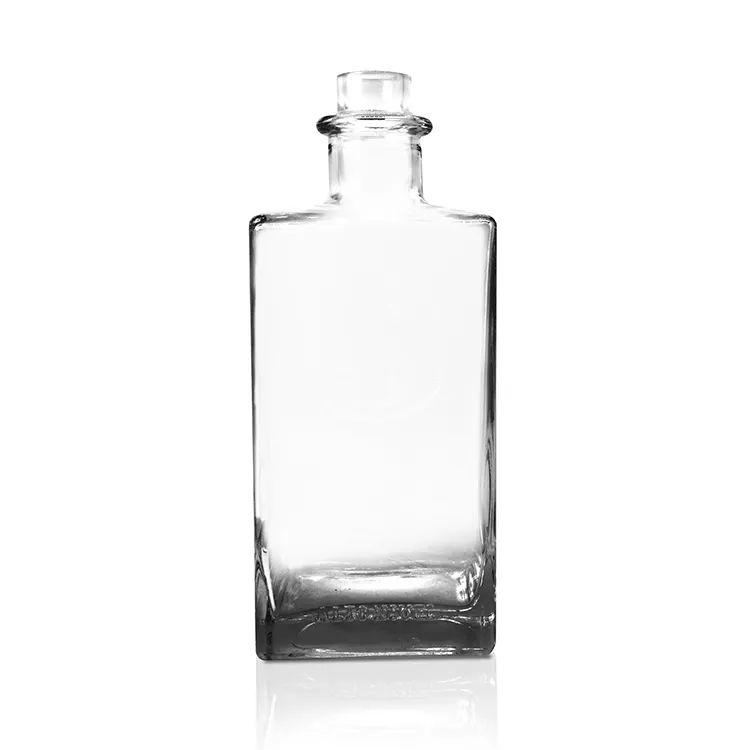
Square glass bottles suit products sold on presentation and filled at moderate speed: olive oil, premium sauces, spirits-adjacent drinks and gift-channel foods. They stand more steadily than round bottles, offer flat label panels and typically recover 12 to 18 percent of case volume. In return they need orientation equipment and multi-panel labelling on the line, carry 5 to 10 percent more glass, and are a poor choice for carbonated products.
Where a square bottle earns its place
A base that resists tipping
At equal height, a square footprint is much harder to knock over than a round one. That counts on open shelving, on wire fridge racks and on foodservice prep counters. With tall formats above 280mm, it often decides whether a bottle lasts in a restaurant kitchen.
Flat panels for labels
Four flat sides give two to four separate label surfaces, for example a front panel, an ingredients panel and a brand-story panel. Regulated products benefit most. Olive oil needs origin and harvest-date declarations, and sauces often need ingredient lists in several languages; on a square bottle each block of text simply gets its own panel. This explains why the shape leads in premium edible oil, and why much of our bulk olive oil bottle range uses square stock moulds.
Tighter cases and pallets
Square bottles tessellate. Six round 500ml bottles leave roughly a fifth of the case as air, while six square ones lose only corner clearance. As an example, a full pallet can take 1,600-plus square 500ml bottles against roughly 1,440 round. The exact count depends on carton design; our packing specification for glass bottles sets out the pallet calculation.
What square costs on the filling line
The drawbacks appear at three points, and it is worth confirming with your co-packer that they can run square bottles before you commit.
- Orientation. Each bottle has to reach the filler and labeller facing the correct way. That takes unscrambler timing screws, orientation rails or a vision system, none of which a round bottle requires.
- Labelling. Flat sides call for front-and-back or multi-panel labellers. These run more slowly than wraparound machines and cost more for every label applied.
- Corners. Stress concentrates at corners, so a square bottle needs somewhat more glass than a round one of equal capacity and process rating, typically 5 to 10 percent. We ask for annealing verification to ASTM C148, with the corner sections inspected specifically.
Line speed is the dividing line. For commodity beverages filled above 200 bottles per minute, round nearly always costs less overall. At moderate speeds, for gift channels, premium retail and foodservice tabletops, the packing and freight gains of square generally outweigh the line costs.
Carbonation is the other limit. Internal pressure creates hoop stress, and corners concentrate it, so we advise putting pressure-rated products under ISO 7458 in round bottles. Still and hot-fill products are fine in square.
Typical dimensions of stock square formats
Use these values for planning; each is confirmed on the project drawing. Corner radius, panel flatness tolerance and punt depth are not listed and are also confirmed per drawing.
| Parameter | 250ml square | 500ml square (Marasca) | 750ml square | 250ml square jar |
|---|---|---|---|---|
| Brimful capacity | ~265ml | ~520ml | ~770ml | ~265ml |
| Height | 190 – 210mm | 240 – 265mm | 265 – 290mm | 85 – 100mm |
| Width across flats | 52 – 58mm | 62 – 70mm | 72 – 80mm | 68 – 74mm |
| Weight of glass | 210 – 250g | 340 – 400g | 480 – 560g | 200 – 240g |
| Usual finishes | 28mm CT, 31.5mm oil | 31.5mm oil, 38mm TO | 31.5mm oil, bar-top | 58mm / 63mm TO |
| Filling process | Hot-fill to 90°C | Hot-fill to 90°C | Ambient fill | Hot-fill to 92°C |
| Typical pallet | ~3,000 pcs | ~1,600 pcs | ~1,100 pcs | ~2,800 pcs |
Stock, modified stock or custom mould
There are three ways to source a square bottle, and they differ in how distinctive the result is and where the risk lies.
| Route | What you get | Fits | Main risk |
|---|---|---|---|
| Stock mould | An existing square or Marasca shape | Launching an oil or sauce | Other brands share the same Marasca shape |
| Modified stock | A changed finish or weight, or an embossed mark on a panel | Differentiation through a brand mark | The change is only at the surface |
| Full custom mould | A proprietary square profile | Premium national brands | Corner stress has to be designed out |
Sampling time and minimum quantity are quoted per project, since both depend on the mould and the line it runs on. When comparing totals, remember that the freight efficiency of square offsets part of its extra glass.
Square or round
Pick square when presentation makes the sale, when regulatory text needs several flat panels, or when case and pallet efficiency outrank line speed. Pick round for high-speed commodity filling and for anything carbonated. Our page on round glass bottles runs the same analysis from the other side, so the two can be read together.
Frequently asked questions
Do square bottles need special filling equipment?
Yes. They need orientation hardware ahead of the filler and labeller, and a multi-panel labeller in place of a wraparound machine.
Are square bottles heavier than round ones?
Typically by 5 to 10 percent at equal capacity, because the corners need extra glass to handle concentrated stress.
How much more product fits on a pallet?
Typically 12 to 18 percent more than round at equal capacity. A 500ml pallet holds roughly 1,600 square bottles versus about 1,440 round, subject to the carton design.
What is the MOQ for stock square bottles?
It is quoted per project and depends on the mould and the production line.