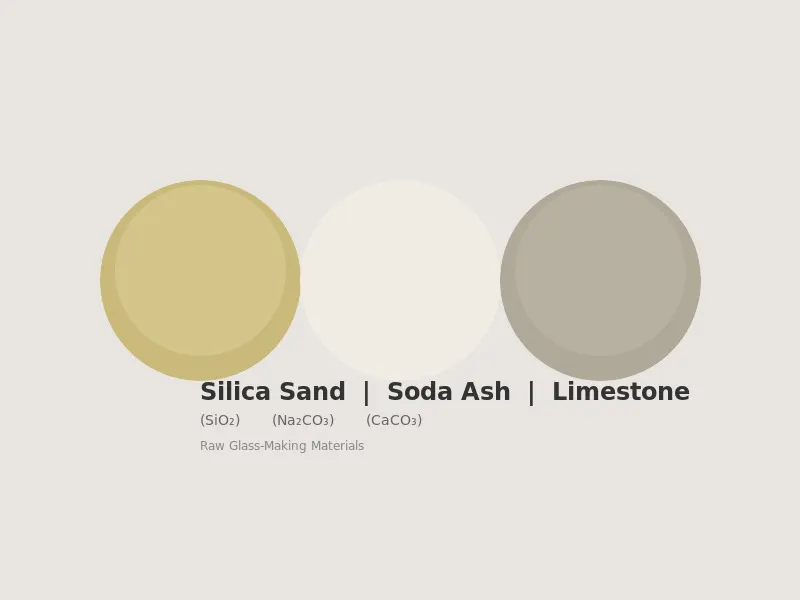
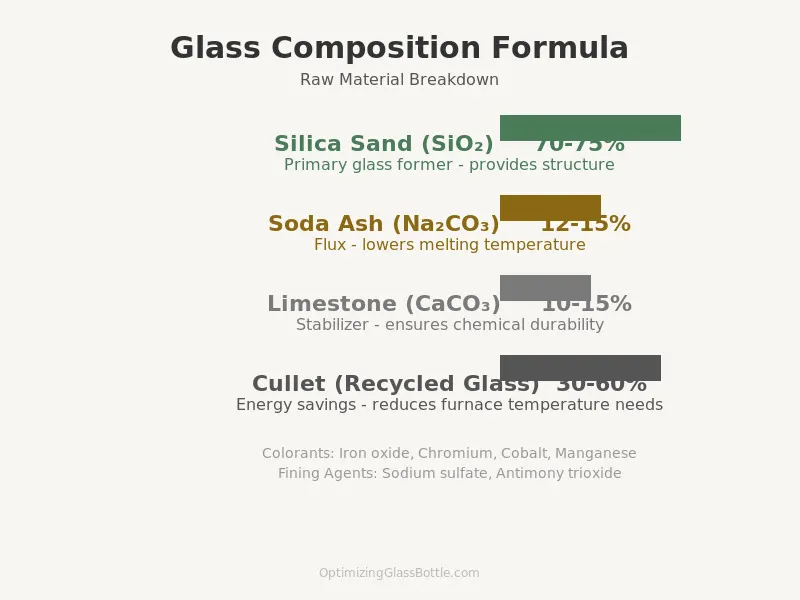
A container glass batch is mostly silica sand, soda ash and limestone, which together make up roughly 90 to 95 percent of batch weight. The remainder is cullet, colorants or decolorizers, and fining agents. Sand forms the glass network, soda ash brings the melting temperature down, limestone makes the result resistant to water, and the minor additions decide color, clarity and bubble content. For a buyer, these inputs explain why two bottles that look alike can behave differently in filling, transport and storage.
What each ingredient does
| Material | Role in the batch | What the plant controls |
|---|---|---|
| Silica sand (SiO₂) | Forms the structure that makes glass rigid and transparent | SiO₂ content, typically above 95 percent; iron oxide; grain size |
| Soda ash (Na₂CO₃) | Flux that lowers the melting point | Ratio to sand; sodium carbonate concentration; moisture |
| Limestone (CaCO₃) | Stabilizer that stops the glass dissolving in water | 10 to 15 percent of batch weight; calcium carbonate purity; magnesium level |
| Cullet | Recycled glass that melts more easily than raw batch | Share of the mix, anywhere from 30 to 60 percent; color sorting |
| Colorants and decolorizers | Metal oxides that add a color or cancel one | Dosing accuracy |
| Fining agents | Help trapped bubbles leave the melt | Dosing accuracy |
The three main raw materials
Silica sand
Sand is silicon dioxide, and it supplies the molecular framework of the glass. Ordinary sand is not suitable. Glassmaking grades carry a high SiO₂ content and very little iron oxide, because iron tints the glass green or brown.
Grain size has to be even as well. Coarse grains do not fuse fully in the furnace, while very fine sand is awkward to handle and can blow away during batching. Plants therefore grade their sand and usually buy from dedicated quarries where the mineral composition is tested before purchase. Glass-grade sand is sourced in the United States, notably Wisconsin and Illinois, and in France, Germany and China. A sensible supplier question is how the sand is contracted, since long-term agreements with verified quarries keep quality steady through the year.
Soda ash
On its own, silica sand melts at around 1,700 degrees Celsius, a temperature too expensive to run a furnace at. Soda ash, or sodium carbonate, is the flux that brings the melting point of the mixture down to approximately 1,500 degrees Celsius or below. That cuts fuel use and is kinder to the furnace.
The dose has a ceiling. Too much soda ash weakens chemical durability, leaving the glass open to attack by water and to weathering. The sand-to-soda-ash ratio is among the first things settled for a new bottle specification, and plants adjust it to the bottle's use, the clarity wanted and the cost target. Most treat the figure as proprietary.
Limestone
Glass made from sand and soda ash alone would dissolve in water. Limestone, which is calcium carbonate, prevents that: during melting it reacts with the other ingredients to form calcium silicate compounds, and these give the glass its chemical stability.
Plants choose limestone sources for consistent calcium carbonate content and low magnesium, because excess magnesium changes melting behavior and the quality of the finished glass. Some integrated producers run their own limestone quarries to keep supply consistent.
Cullet, colorants and fining agents
Cullet
Cullet is crushed recycled glass returned to the batch. How much a plant uses depends on the color and quality required of the bottle. Because cullet melts at a lower temperature than raw materials, energy consumption falls by approximately 2.5 to 3 percent for every 10 percent increase in cullet.
A higher cullet ratio also reduces the need for virgin raw materials, lowers furnace emissions and extends the life of the furnace lining. That makes cullet share one of the most concrete numbers to ask for in a sustainability discussion; our page of sustainability data for glass packaging covers the wider picture.
Colorants and decolorizers
Bottle color comes from metal oxides weighed into the batch:
- iron oxide gives green;
- chromium gives emerald green;
- cobalt gives blue;
- iron with sulfur, melted under reducing conditions, gives amber.
Clear glass needs the opposite treatment. Trace iron in the sand leaves a natural green cast, so the plant adds a decolorizer such as manganese dioxide or selenium to cancel it. Very clear vodka bottles and cosmetic jars depend on both purer raw materials and accurate decolorizing chemistry.
Fining agents
Small air bubbles get trapped in molten glass. Fining agents, typically sodium sulfate or antimony trioxide, help those bubbles rise and escape before the glass is formed. Under-fined glass shows tiny bubbles in the wall, which weaken the container and spoil its appearance.
Storage, batching and incoming tests
Each material is held in its own silo or hopper, protected from contamination and moisture. Soda ash needs particular care. It is hygroscopic, meaning it absorbs water from the air, and once it clumps the weighing is no longer accurate.
Modern batch houses are automated, with computer-controlled weigh feeders dosing each material. The batch house is often regarded as the most critical control point in the plant, since a small drift in the sand-to-soda-ash ratio can produce melting defects, uneven color or lower chemical durability. The later stages are described in our walkthrough of how glass bottles are made.
Incoming materials are tested before they are used:
- sand for silicon dioxide content, particle size distribution and impurity levels;
- limestone for calcium carbonate purity;
- soda ash for sodium carbonate concentration and moisture content.
What raw materials mean for cost and supply
Sand, soda ash and limestone prices are fairly stable next to other industrial commodities. Energy is the volatile part. Natural gas, electricity and coal costs feed into the cost of melting, which is why producers keep refining furnace design and batch formulation.
When energy prices climb, some plants pass part of the increase to buyers and others absorb it to protect market share. Knowing a plant's cullet ratio, energy source and raw material purchasing approach helps you anticipate which way its quotations will move and plan orders around that.
Location matters too. A plant close to a good silica quarry pays less for transport than one hauling sand hundreds of miles, and glassmaking has clustered near deposits as a result: the Ohio Valley in the United States, Lorraine in France and Shandong province in China.
Environmental and regulatory pressure on sourcing
Quarrying sand and limestone is subject to local rules on land use, water extraction and habitat restoration. Soda ash production can involve heavy chemical processing and wastewater discharge. Producers respond with responsible sourcing programs, environmental audits and cleaner production technology.
Many now publish sustainability reports that state where raw materials come from, energy consumption per ton of glass and carbon emissions. Ask for the report when you compare suppliers.
What to ask a supplier about raw materials
Differences in raw material quality rarely show on a sample held up to the light. They appear later, in filling, shipping and long-term storage; a bottle made from inconsistent sand batches, for example, can have weak points that crack under thermal stress.
Write the requirement into the specification. Ask for raw material grades, batch consistency data and test results on finished bottles, and compare those results with the methods in our guide to quality inspection for glass packaging. A supplier confident in its process hands these over readily. When we match a project to a plant, raw material standards are part of the comparison, whether the brief calls for very clear flint for a spirit or a colored bottle for a food product.