Background reading: the glass bottle manufacturing process, from sand to finished bottle.
The EU recycles about 80% of its glass packaging and puts roughly 52% recycled content into new bottles, while the United States manages 31–34% and about 31%. The average EU container now weighs 277 grams, and the Packaging and Packaging Waste Regulation (PPWR) applies across the single market from August 12, 2026. For a buyer, that turns two figures into specification lines: cullet percentage and grams per unit.
What to put in a 2026 glass specification
Recycled content and bottle weight used to be marketing copy. Brand owners now write a minimum cullet share and a maximum gram weight into supply contracts, because retailers ask for a packaging carbon footprint and "glass is recyclable" no longer answers the question. Extended producer responsibility (EPR) schemes add a second reason: where fees are eco-modulated, the pack you choose changes what you pay each year, and the explanation for a rising fee sits in the bill of materials.
So a supplier conversation should open with three things: documented cullet content, which lightweight moulds exist for the format, and the forming process used. Comparing gram weights per format on a bottle size and weight chart is a sensible first step.
Weight norms differ by category. A brand developing a custom spirits bottle works to different expectations than a beer bottle programme, and in wine bottles with cork finishes the 443-gram standard now sits alongside 350–380-gram lightweight lines. Water brands can ask for custom water bottles in glass with documented recycled flint. Retailer pressure has reached neighbouring categories too, which is why candle jars made from recycled glass now travel with recycled-content paperwork.
When a brief calls for verified recycled content or a lighter format, we match it to a plant that can run lightweight bottle designs and high-cullet glass, and we collect the documents an EPR or PPWR audit asks for: cullet percentages and gram weights.
Recycled content and what cullet saves
Cullet is crushed recycled glass, and it is the strongest decarbonisation lever a glass furnace has. It melts at a lower temperature than virgin batch, so energy and emissions fall as its share rises. The gap between regions comes from collection, not furnace capability: a furnace cannot melt cullet that never arrives.
| Measure | Figure | Source |
|---|---|---|
| Recycled content in new bottles, EU average | ~52% | FEVE (2025) |
| Cullet share in German container glass furnaces | up to 91% | FEVE / Eurostat (2025) |
| Recycled content, US average | ~31% | Glass Packaging Institute (2025) |
| Furnace energy saved for each extra 10% cullet | ~2.5–3% | FEVE |
| CO2 cut for each extra 10% cullet | ~5% | FEVE |
| CO2 avoided by one tonne of cullet replacing virgin batch | up to 500 kg | FEVE |
| Melting energy reduction from cullet | 20–30% | FEVE |
| Recycled content achievable in green and amber | 80–90%, no loss of strength | FEVE |
Colour matters. Green and amber bottles already run at 80–90% recycled content. Flint, the clear glass, is harder to push that high because colour contamination restricts how much suitable cullet is available.
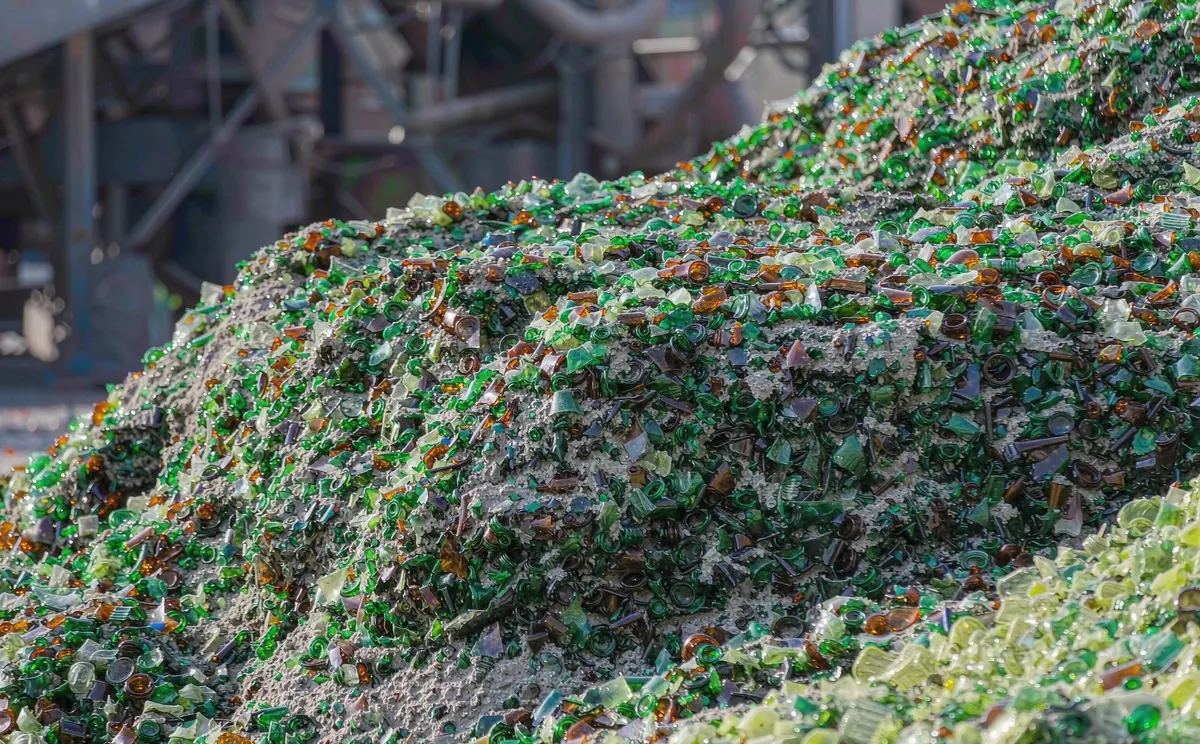
The practical point for procurement is that a high recycled-content requirement is a carbon reduction you can document and defend in an audit. Brands buying recycled glass bottles in volume can carry the supplier's cullet percentage straight into scope 3 reporting.
Bottle weights and how far lightweighting goes
FEVE's 2025 reporting gives 277 grams as the average weight of a glass container produced in the EU and 443 grams for the standard still wine bottle. Both are the lowest on record, and both are industry averages, not pilot runs.
| Measure | Around 2015 | 2025 | What made it possible |
|---|---|---|---|
| Average EU container | Falling steadily each year | 277 g | NNPB and better annealing |
| Standard still wine bottle | ~500 g typical | 443 g | Even wall distribution from NNPB |
| Lightweight wine formats | Niche projects | 350–380 g, mainstream capability | NNPB with surface coatings |
| EU food and beverage output | — | 20.3 M tonnes / 73.3 B units | Adoption across the industry |
NNPB stands for narrow-neck press-and-blow. A plunger presses the parison (the pre-form) instead of air blowing it, which spreads glass more evenly through the wall and removes the thick patches that were only there to get the bottle through forming. That is how a wine bottle once made at 500 grams can come in at 350–380 grams with the same top-load strength. Improved annealing and surface coatings let the lighter bottle pass the same drop and pressure tests.
Each gram saved is multiplied over billions of units: less raw material, less melting energy, lower freight emissions and, where EPR fees are weight-based, a smaller fee.
Recycling rates by country
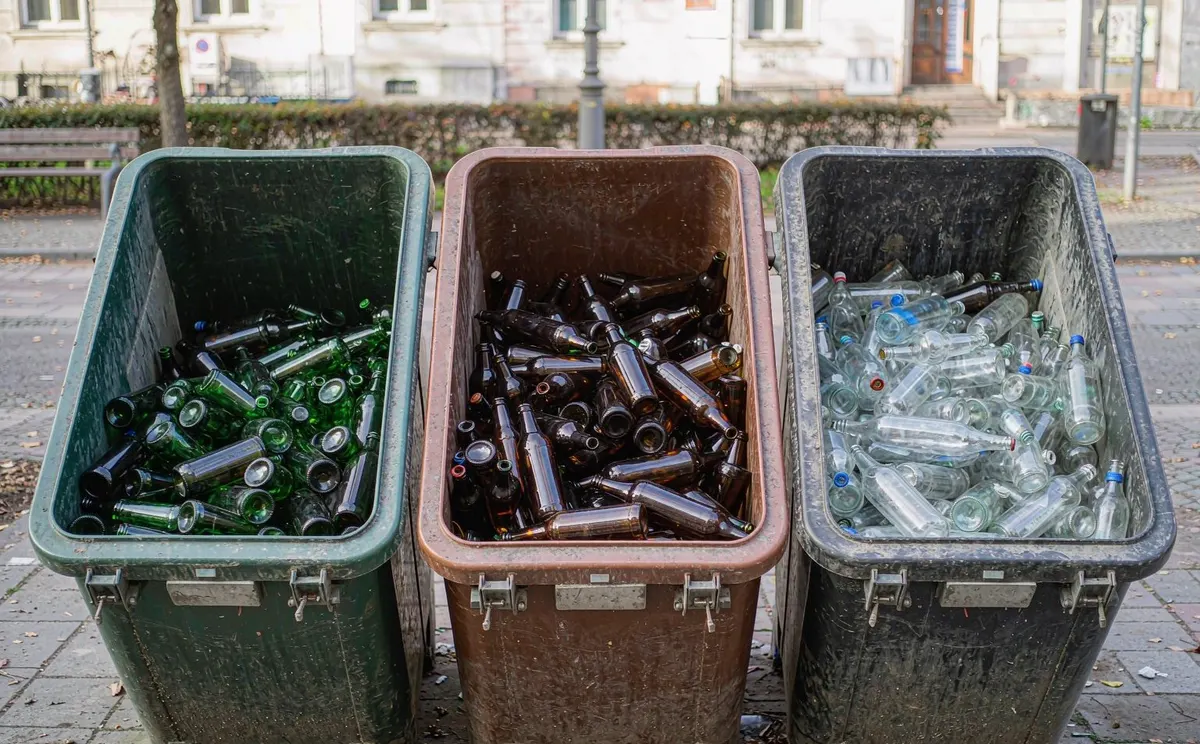
Europe's rates rest on deposit-return schemes, dense networks of colour-sorted bottle banks and decades of producer funding. FEVE also estimates that around 40% of EU glass beverage containers are refillable, meaning reused without remelting, which lifts real circularity above the recycling figure.
| Country or region | Recycling rate, glass packaging | How collection works | Source (reporting year) |
|---|---|---|---|
| South Korea | 86% | Compulsory separation, deposit schemes | National statistics (2025) |
| Germany | 85.3% | Colour-sorted street collection and deposits | Eurostat (2025) |
| France | 83.7% | Dense bottle banks, eco-modulated fees | Eurostat (2025) |
| European Union average | ~80% | Bottle banks, deposits, established EPR funding | Eurostat / FEVE (2025) |
| Spain | 75.9% | Igloo banks, capture from hospitality | Eurostat (2025) |
| Japan | 71% | Sorted municipal collection, bottle-to-bottle loops | National statistics (2025) |
| Global average | ~50% | Large regional differences | Industry estimates (2025) |
| Brazil | ~47% | Informal collectors, patchy coverage | Industry estimates (2025) |
| United States | 31–34% | Mostly single-stream; 27% cullet rejection at MRFs | EPA (2025) |
The US figure is low for a structural reason. In single-stream collection glass shares a bin with paper and plastics, breaks, contaminates the other materials and reaches processors dirty. Rejection of cullet at material recovery facilities (MRFs) has risen to 27%, so more than a quarter of the glass collected never gets to a furnace. States with bottle bills consistently do better than single-stream states.
EPR and PPWR dates to plan around
EU PPWR
The PPWR entered into force in February 2025 and applies directly in all 27 member states from August 12, 2026. It is a regulation, so there is no national transposition and one rulebook covers the whole market. Its main mechanisms are recyclability grades from A to C, with packaging below grade effectively designed out; void-space limits for e-commerce and transport packs; a PFAS ban in food-contact packaging; eco-modulated EPR fees; and deposit-return obligations for beverage containers. For anyone exporting to Europe, compliance is a condition of market access from that date.
US state laws
There is no federal packaging EPR law. Seven states have passed their own, and national brands have to model seven fee schedules, registration calendars and definitions of recyclability.
| State | Obligation | Timing |
|---|---|---|
| Oregon (SB 582) | Programme already live | Fees began July 2025 |
| Colorado | Producer fee payments start | January 2026 |
| Maine | Registration and startup fees | 2026 |
| Maryland | Producer registration | Before July 1, 2026 |
| Washington | Producer registration | Before July 1, 2026 |
| California (SB 54 / SB 343) | Join the PRO; no chasing-arrows symbol on packs that fail the state's recyclability criteria | PRO by Jan 2027; labelling rule from October 4, 2026 |
| Minnesota | Programme in full effect | 2032 |
How the two systems differ
| Aspect | EU PPWR | US state laws |
|---|---|---|
| Legal form | One regulation, directly applicable in 27 states | Seven state statutes, nothing federal |
| Recyclability | Compulsory A–C grading and design duties | Varies by state; California limits chasing-arrows labelling under SB 343 |
| Food contact | PFAS ban | No comparable packaging-wide rule |
| Transport packaging | Void-space limits for e-commerce | Not covered |
| Beverage containers | Deposit-return obligations | Bottle bills in some states only |
| Key dates | August 12, 2026 | Oregon live, most others 2026–2027, Minnesota 2032 |
The EU route is stricter but predictable; the US route is fragmented. Brands selling in both increasingly design to PPWR as their baseline and handle the state filings as an extra compliance layer.
FAQ
Does a high recycled share make bottles weaker?
No. Green and amber bottles at 80–90% cullet show no strength loss, and NNPB forming with good annealing keeps top-load and impact performance level with bottles made from virgin glass. In flint the constraint is the colour purity of the cullet, not the physics.
Is there a lower limit to bottle weight?
Yes. It sits where the wall can no longer cope with filling-line handling, pallet stacking and use by the consumer. Standard wine bottles have come down from 500 grams to the 350–380 gram range, and there is little room under about 300 grams unless the pack's role changes, for instance to a refillable.
Does glass or plastic do better on EPR fees?
Eco-modulated fees follow recyclability grade and material-specific costs, not weight alone. In Europe glass tends to score well as a mono-material with established recycling. In US states its position is moderate: ahead of composites and foams, behind fibre.
Do small brands have to comply with PPWR?
If they sell packaged goods into the EU, marketplaces included, yes, from August 12, 2026. The regulation covers all packaging placed on the EU market whatever the company's size. Small brands usually comply through an importer or authorised representative, but recyclability grading and the PFAS restriction attach to the packaging itself, so supplier documentation is needed from the start.
Sources and data notes
- US EPA, Advancing Sustainable Materials Management: glass container recycling (2025 reporting)
- Eurostat: packaging waste recycling rates by country (2025 reporting)
- FEVE (feve.org): European container glass statistics on recycling, refillables, cullet and lightweighting (2025)
- Glass Packaging Institute (gpi.org): US recycled content and cullet data
- CalRecycle: implementation guidance for SB 54 and SB 343
- O'Melveny: 2026 survey of US state packaging EPR laws
- GlassOnline: reporting on the FEVE 2025 annual report
Figures are the latest available as of September 2026. Where a source publishes a range, the range is given.