Sizes are easiest to judge against the standard, and the benchmark most wine, spirits and oil buyers start from is 750ml glass bottles.
Quick answer
What are the common glass bottle sizes?
Common glass bottle sizes run from the 50 ml miniature to the 1,750 ml spirits handle. The 750 ml bottle is the US standard for spirits and wine, and 700 ml is the EU spirits standard. The figure on the label is the nominal capacity; the brimful capacity to the top of the finish is typically 2–5% higher, and both belong on the purchase order.
| Millilitres | US fl oz | Common name |
|---|---|---|
| 50 ml | 1.7 oz | Miniature / nip |
| 187 ml | 6.3 oz | Split (wine) |
| 375 ml | 12.7 oz | Half bottle / demi |
| 700 ml | 23.7 oz | EU spirits standard |
| 750 ml | 25.4 oz | US spirits & wine standard |
| 1,750 ml | 59.2 oz | Handle (spirits) |
A glass bottle is defined by its capacity, its neck finish and its outer dimensions, and the finish is the one that decides which closures you can buy. The tables below list typical values by category: spirits run from 50 ml miniatures to 1.75 L handles, wine centres on 750 ml with an 18.5 mm cork finish, beer on a 26 mm crown, and food jars on lug finishes. Use them to shortlist, then work from the drawing of the specific mould, which always governs.
Reading the figures correctly
Every bottle drawing states two volumes, and mixing them up is the sourcing error we meet most often. Nominal capacity is the declared fill, the 750 ml printed on a wine label, which the filler aims for at the specified fill point. Brimful capacity, also called overflow capacity, is everything the bottle holds up to the rim of the finish, and it normally sits 2–5% higher.
The difference is headspace. It lets the product expand when it warms and gives the filling machine room to operate. Put both volumes on the purchase order.
Sizes in the tables are height × widest body diameter, in millimetres. A range describes how much common commercial moulds differ from one another; it is not the tolerance of any single mould. Weight is left out on purpose, because grams depend on wall thickness and punt depth and so belong to one mould only.
Millilitres to US fluid ounces
| Trade name | Millilitres | US fluid ounces |
|---|---|---|
| Miniature / nip | 50 ml | 1.7 oz |
| Travel size | 100 ml | 3.4 oz |
| Split (wine) | 187 ml | 6.3 oz |
| Flask / half-pint | 200 ml | 6.8 oz |
| Standard beer (EU) | 330 ml | 11.2 oz |
| Standard beer (US) | 355 ml | 12 oz |
| Half bottle / demi | 375 ml | 12.7 oz |
| Half liter / pint (EU) | 500 ml | 16.9 oz |
| EU spirits standard | 700 ml | 23.7 oz |
| US spirits and wine standard | 750 ml | 25.4 oz |
| Liter | 1,000 ml | 33.8 oz |
| Handle (spirits) | 1,750 ml | 59.2 oz |
How neck finish codes work
A finish code such as 28-400 carries two pieces of information. The number before the hyphen is the outside diameter across the thread in millimetres, known as the T dimension. The number after it names a thread style set by the Glass Packaging Institute (GPI), the North American reference.
| Thread style | What it means | Where it is used |
|---|---|---|
| 400 | A single full turn of continuous thread | The default screw finish |
| 410 | One and a half turns | Personal-care pumps |
| 415 | Two turns on a taller neck | Closures that must stay firmly retained |
| 2000-series (2030, 2040 and similar) | Lug, or twist-off | Food jars closed with plastisol-lined metal caps |
Three finish families sit outside the GPI numbering and each owns its category. Carbonated drinks use the 26 mm crown, wine and spirits use the 18.5 mm cork finish, and droppers and pharmaceutical-style closures use DIN 18, also written 18-DIN.
To match a cap you already have, put calipers across the crests of the thread to read the T dimension. Measuring in the valleys between threads is the usual way a finish ends up specified 1–2 mm out.
Spirits and liquor bottles
No category has more shapes than spirits. The 700 ml and 750 ml sizes lead it, and the split between them is a matter of EU versus US regulation, so most moulds are offered in both. We go further into that format in the guide to 750 ml glass bottles, and the whiskey bottle style families page sorts the shapes.
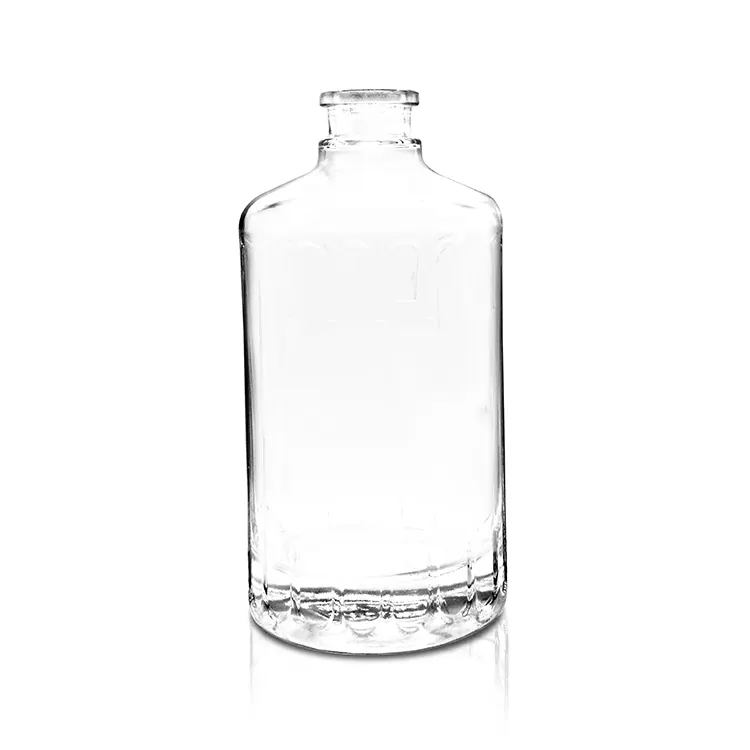
| Capacity | Where it sells | Usual finish | Height × diameter (mm) |
|---|---|---|---|
| 50 ml | Samples, minis, airline | 18-400 / 20-400 screw | 85–105 × 35–45 |
| 200 ml | Flasks, gift sets | 22-400 / 28-400 | 150–180 × 55–70 |
| 375 ml | Half bottles, craft runs | 18.5 mm cork / 28-400 | 180–220 × 60–75 |
| 500 ml | Craft and higher-tier spirits | 18.5–21.5 mm cork / GPI 28-400 | 200–240 × 65–80 |
| 700 / 750 ml | The category standard | 28-400 / 31.5 mm / 18.5–21.5 mm cork | 220–300 × 70–95 |
| 1,000 ml | Duty-free, value tier | 28-400 / 31.5 mm | 260–320 × 80–100 |
| 1,750 ml | Handles, club stores | 33-400 / 38-400 | 290–350 × 105–130 |
Wine bottles
Wine is the most uniform part of glass packaging. Nearly all production is 750 ml in a Bordeaux or Burgundy shape. Sparkling bottles keep the capacity but add a reinforced body and a deep punt to carry pressure.
Closures fall into two groups: the 18.5 mm cork finish, which takes natural cork, technical cork or a bar-top, and the 30×60 mm aluminium screwcap known as Stelvin. Our page on matching wine bottles and corks covers the pairing.
| Shape | Capacity | Finish | Height × diameter (mm) |
|---|---|---|---|
| Bordeaux | 187 ml | Cork / screwcap | 175–190 × 52–56 |
| Bordeaux / Burgundy | 375 ml | Cork / screwcap | 230–250 × 60–66 |
| Bordeaux | 750 ml | 18.5 mm cork / 30×60 Stelvin | 285–315 × 73–78 |
| Burgundy | 750 ml | 18.5 mm cork / 30×60 Stelvin | 280–300 × 82–88 |
| Sparkling | 750 ml | Crown 29 mm / cork + cage | 290–320 × 86–92 |
| Magnum | 1,500 ml | Cork | 340–370 × 100–115 |
Beer and cider bottles
Volume beer runs on the 26 mm crown; craft and specialty lines also use swing-tops of the Grolsch type. Whatever the closure, a carbonated product needs a pressure-rated design, and a mould made for still drinks should never be specified for it. Amber is the default colour because it blocks UV, with flint and green chosen to set a brand apart.
| Capacity | Notes | Finish | Height × diameter (mm) |
|---|---|---|---|
| 250 ml | Specialty / export stubby | 26 mm crown | 200–220 × 55–60 |
| 330 ml | EU longneck standard | 26 mm crown | 225–240 × 60–66 |
| 355 ml | US 12 oz heritage | 26 mm crown | 225–240 × 60–66 |
| 500 ml | EU half-liter, craft | 26 mm crown / swing-top | 260–290 × 66–75 |
| 650 ml | Bomber, US craft | 26 mm crown | 280–300 × 72–80 |
Food jars and mason jars
North American buyers specify jars in fluid ounces and everyone else in millilitres, so the table gives both. Hot-filled products mostly take a lug finish, since it lets go of the vacuum cleanly on the line. Continuous thread is the choice for dry goods and cold-filled products. For closure pairing in detail, see the pages on mason jar formats and jars supplied with lids.
| Capacity | Typical contents | Metric | Usual finish |
|---|---|---|---|
| 1–2 oz | Samples, spices | 30–60 ml | 38-400 / 43-2010 lug |
| 4 oz | Jelly, baby food | 120 ml | 43-400 / 48 lug |
| 8 oz | Jam, salsa, candle jars | 240 ml | 58-2030 / 70-450 |
| 12 oz | Honey, preserves | 350 ml | 63-2030 / 70-450 |
| 16 oz | Sauces, pickles, mason | 470 ml | 70-2030 / 70G lug |
| 26–32 oz | Pasta sauce, quart mason | 770–950 ml | 70G / 82-2040 lug |
| 64 oz | Half-gallon, bulk pantry | 1.9 L | 82-2040 / 110-400 |
Gallon-scale containers for pantry and food-service use apply the same finish logic at 110 mm. They are listed in the glass gallon jug reference.
Essential oil, perfume and cosmetic bottles
These are the smallest containers in the chart, and the ones where finish accuracy counts most: a deviation of 0.2 mm alters how a dropper or pump seats. Boston rounds and Euro droppers both belong to the 18 mm DIN finish family, which explains why closures within that family mostly swap between suppliers.
| Capacity | Closure | Finish | Usual shape |
|---|---|---|---|
| 5–10 ml | Dropper, rollerball | 18-DIN / 13-425 | Euro dropper / vial |
| 15 ml | Dropper, treatment pump | 18-400 / 18-415 | Boston round / cylinder |
| 30 ml | Dropper, serum pump | 20-400 / 18-DIN | Boston round |
| 50 ml | Spray, lotion pump | 24-410 / crimp 15 mm | Cylinder / square |
| 100 ml | Fine mist, fragrance spray | 24-410 / crimp 15 mm | Cylinder / apothecary |
Tolerances to expect on a production order
Glass takes its shape at roughly 1,100 °C. Two moulds therefore never turn out identical containers to the micron, and they do not have to: the variation only needs to stay within what your filler and closures can absorb.
| Property | Typical window | Why it matters |
|---|---|---|
| Capacity | ±1–2% of nominal | Standard moulds; pharmaceutical-grade work is held tighter |
| Height and body diameter | ±1.0–1.5 mm | For decoration, a flat label panel counts for more than the absolute diameter |
| Finish dimensions | ±0.2–0.4 mm | A closure cannot take up more than this |
| Thermal shock | 42 °C differential | Routine for annealed soda-lime glass |
If the bottle will be hot-filled or pasteurised, say so at the start. The annealing cycle and the distribution of glass in the wall are then engineered for that duty.
On the IS machine, the forming machine that shapes the bottle, drawing dimensions are controlled through gob weight and forming-air settings. Once a mould is set up, a modern line keeps those windows over millions of cycles. That is the reason to approve the first article inspection of a new mould and not a catalogue number.
Specifying a custom bottle
When no stock mould suits the product, a custom one takes fewer steps than buyers tend to assume, provided the decisions come in this order.
- Capacity and fill point. State the nominal volume and the headspace the product needs. Hot-fill and carbonated products need more of it.
- Finish before body. The neck is limited by which closures exist. Settling the cap ahead of the bottle shape avoids a mould revision.
- Glass family. Soda-lime in flint, amber or green, or borosilicate where chemical resistance or thermal shock calls for it.
- Drawing, then sample mould. After the drawing is approved, a single-cavity sample mould proves the design before the full mould set is cut.
The same sequence applied to jars is set out on the custom glass jars page, and custom spirits shapes get fuller treatment in the liquor bottle size guide. For recycling rates, recycled content, lightweighting and EPR rules, see the glass packaging sustainability data.
Frequently asked questions
Will one cap fit bottles from two different suppliers?
It will when both necks carry exactly the same finish code, two 28-400 finishes for instance, and each supplier keeps the finish within tolerance. Ask for the finish drawing as well as the code, since thread profiles can differ a little inside one code.
Why are spirits bottles 700 ml in the EU and 750 ml in the US?
Regulatory history. The standard fill is 700 ml in the EU and 750 ml in the US, and nothing else changes: glass, finish and closure options are the same for both.
How far can the typical dimensions in a size chart be trusted?
Far enough to shortlist, because they show the spread across common moulds. Anything that has to run through a filler, a labeller or a capping head should be checked against the supplier's drawing for the exact mould being bought.