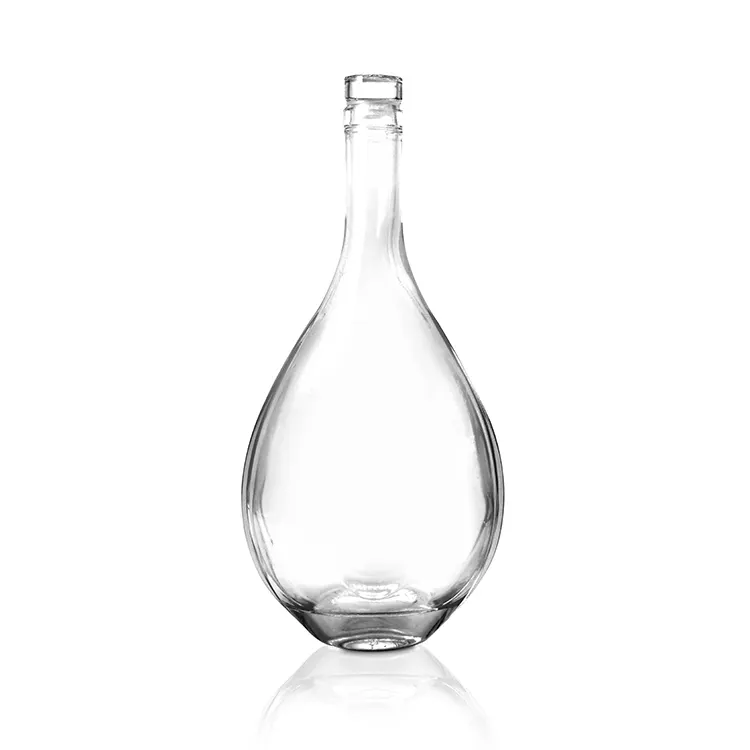
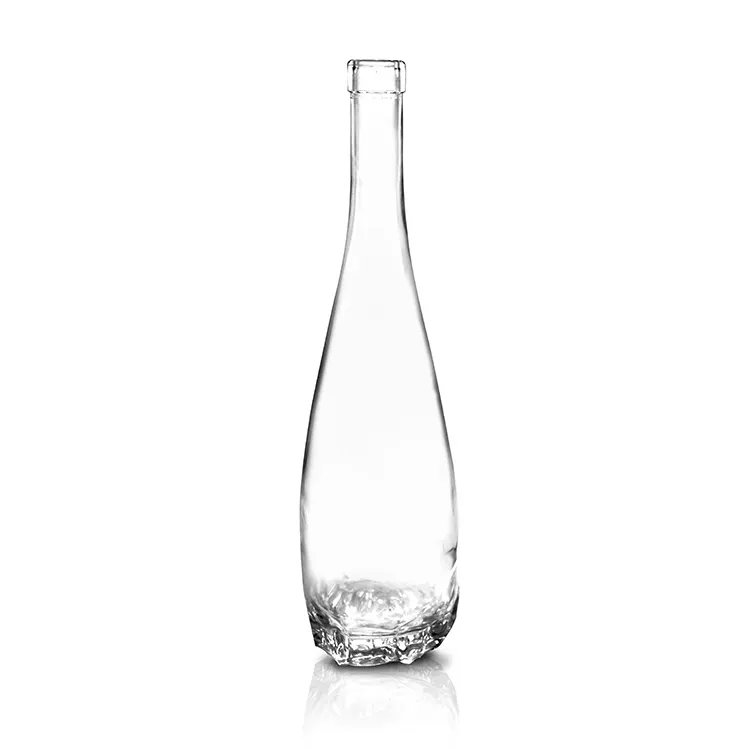
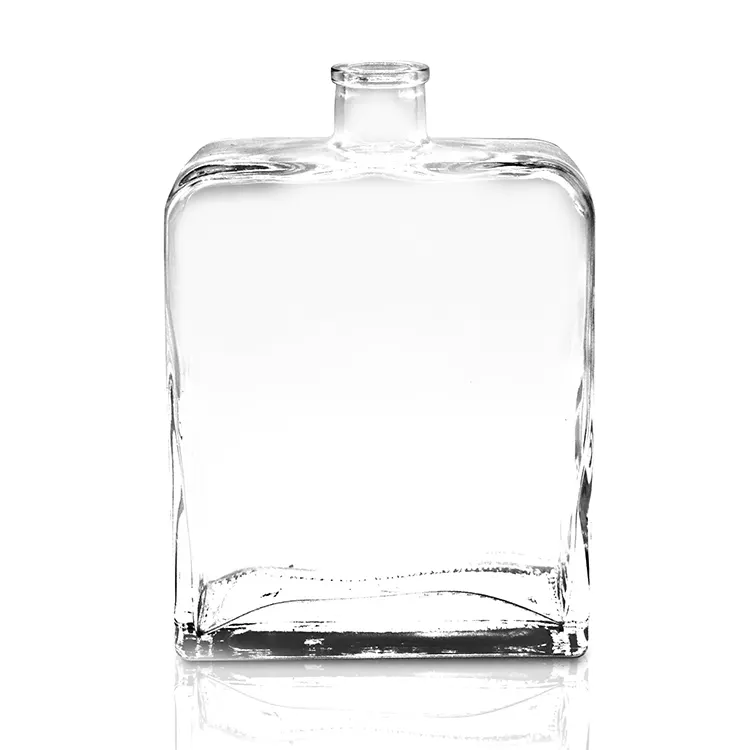
Part of our empty liquor bottles range; the stock moulds are pictured at the end of this guide.
Quick answer
What are the standard liquor bottle sizes?
There is no single standard size. The full-size bottle is 750 ml in the United States and 700 ml in the European Union, and travel retail runs on 1 litre. Around them sit the 50 ml miniature, the 200 ml and 375 ml flask sizes, 500 ml, and the 1.75 L handle, which is a North American format.
| Size | Name or channel |
|---|---|
| 50 ml | Miniature, also called a nip, shooter or airplane bottle |
| 200 ml and 375 ml | Flasks and half bottles: trial SKUs, value brands |
| 500 ml | European value spirits, Asian premium retail |
| 700 ml / 750 ml | Full size: EU / US |
| 1 L | Duty free and back bar |
| 1.75 L | Handle: North American value format |
Mainstream liquor bottles come in eight capacities: 50 ml, 200 ml, 375 ml, 500 ml, 700 ml, 750 ml, 1 L and 1.75 L. There is no single "standard bottle": Europe means 700 ml, the United States means 750 ml, and travel retail means 1,000 ml. The choice that carries legal weight is 700 versus 750, because the EU does not permit 750 ml for spirits while the US accepts both.
Liquor bottle sizes at a glance
| Capacity | Trade name or role | Where it sells | Typical finish and glass notes |
|---|---|---|---|
| 50 ml | Miniature, nip, shooter, airplane bottle | Airlines, hotel minibars, tasting flights, gift-with-purchase | 18 mm or 28 mm ROPP or a small screw cap; 60–80 g of glass |
| 200 ml | Flask | Trial SKUs, value brands, control-state markets | Flat flask profile |
| 375 ml | Half bottle | Same channels as 200 ml, plus fortified and port-style products | Flask, or a Bordeaux shoulder profile |
| 500 ml | European value size, Asian premium size | European value spirits, craft second SKUs, Asian retail | 380–520 g; round, square or flat bodies |
| 700 ml | EU standard | EU retail; also legal in the US | Bar-top cork in premium tiers |
| 750 ml | US standard | US retail; highest global volume | 450–550 g in standard flint |
| 1 L | Liter | Duty-free and bars | 28 mm or 31.5 mm bar-top cork or ROPP |
| 1.75 L | Handle | North American value vodka, whiskey and rum | 1.4–1.8 kg of glass, often with a finger grip |
This page stays at category level. Size questions specific to one spirit are answered in the separate guides to vodka bottle capacities, gin bottle capacities and rum bottle capacities.
700 ml or 750 ml for export
The EU's list of permitted spirits sizes contains 700 ml and leaves out 750 ml. The US added 700 ml to its permitted sizes when Treasury Decision TTB-165 took effect on 29 December 2020. A 700 ml bottle can therefore be sold in both markets, and a 750 ml bottle cannot be sold as spirits in the EU. The 50 ml gap is impossible to see by eye, which is how buyers end up with the wrong glass.
A mold fixes brimful volume, so each nominal size needs its own cavity. Brands that want both sizes design the hero bottle for their primary market and tool the other as a volume-adjusted variant of the same design. Changing the base push-up is often enough to move 50 ml; sometimes the body has to be redrawn.
Two specification points follow from this. Regulators measure the fill, not the mold, so record overflow capacity on the spec sheet: a 750 ml bottle typically has 765–775 ml brimful. Weight targets also differ, with EU 700 ml bottles running slightly lighter than their US equivalents as brands lightweight under packaging-levy pressure. Heavier options in the US size are set out on the 750 ml liquor bottle page.
What each size demands from the glass
50 ml miniatures
Miniatures are bought in the tens of millions as a sampling tool, and a good one is usually a scaled copy of the parent 700/750 ml bottle, so the mold work deserves attention. They are formed on lighter IS machines at very high speed, with walls down to 1.6–2.0 mm. On a 60–80 g bottle, a weight tolerance of ±3 g is the line between an acceptable lot and complaints about leaking caps.
200 ml and 375 ml flasks
Flat bottles anneal differently from round ones because stress concentrates at the panel corners. Flask molds therefore get more generous heel and shoulder radii, and panel flatness held within 0.4 mm keeps labels from wrinkling during application.
500 ml
This is the largest size that still feels personal on a shelf, which is why craft distilleries often choose it for a second SKU before committing to 700 ml. It runs on standard 6-section IS machines without the cycle-time penalty of bigger formats.
1 L
The channel sets the design. Duty-free liters lean toward a heavy base, a tall silhouette and decoration that reads on a crowded airport shelf. Bar liters are functional: a neck long enough for a pour spout, a shoulder that glugs less, and glass that survives a busy well. Stock and custom options are on the 1 liter liquor bottle page.
1.75 L handles
At 1.4–1.8 kg of glass per bottle, gob weight distribution, blank-side cooling and annealing lehr time are all stretched. Breakage risk concentrates at the handle root and the base heel, so the handle mold needs generous fillet radii and the wall around the handle should be verified by section cutting during production. Pallet density is poor: typically 300–360 units per pallet against 1,000+ for 750 ml, so freight per liter of product is far higher than for the standard size. The format is covered further under handle-size vodka bottles.
Regional sizes outside the main eight
Local regulation keeps several niche capacities alive. Canada's 1.14 L, the old 40-ounce, still sells in value spirits. The 350 ml size carries ready-to-drink and single-serve cocktail extensions of spirits brands. Sizes such as 600, 650 and 518 ml exist as dedicated molds for regional markets, including several in Asia and Africa.
When a distributor asks for something between 500 and 700, check for an existing regional mold first. New tooling for a bespoke in-between size only makes sense at very large annual volumes, in the region of half a million units.
Choosing sizes for a range
Most spirits portfolios settle on three sizes: a miniature for trial, a 700 or 750 for retail, and a 375 or a 1 L for the second channel. Two checks are worth making before the drawings are final.
First, keep the finish the same across sizes wherever the design allows. One closure spec across 50/375/750 simplifies purchasing and capping changeovers. Second, work out case and pallet counts for the channel before approving the shape. A 750 ml bottle that packs 6-per-case where 12-per-case was expected raises landed cost per unit once freight is added. The glass bottle size chart and the liquor glass bottle collection give case dimensions to work from, and the overview of alcohol bottle types helps with shape.
One closure plan for all sizes
Decide closures for the portfolio as a whole. Bar-top corks, also called T-corks, dominate premium spirits at 375 ml and above. ROPP aluminum dominates value tiers, miniatures and markets where resealing and line speed matter more than ceremony. Guala-style non-refillable fitments are mandatory in several markets for revenue protection.
Harmonizing finishes keeps this manageable. An 18.5 mm bar-top finish on the 375/700/750 and a 28 mm ROPP on the 50 ml and 1 L covers most portfolios with two closure specs. Without that discipline, every size change reaches the closure supplier's tooling, the capper's change parts and the QC torque matrix.
How size affects mold cost and timing
Mold cost and schedule are quoted per project; what size changes is the cavity count and the machine time. Miniature and 200 ml molds run 8–16 cavities per set, so the mold cost per unit is low but machine time per thousand bottles is high. Standard 700/750 ml molds at 6–8 cavities are the most optimized sets in the industry. Magnum-and-larger molds fall to 2–4 cavities with long cycles, one reason large formats stay costly per unit even before decoration. For a multi-size launch, approve the standard-size mold first and derive the other sizes from it.
FAQ
Which liquor bottle size is most common worldwide?
750 ml by global volume, because of the US market, with 700 ml leading inside the EU. Between them the two account for the large majority of spirits glass produced.
How heavy is a 750 ml liquor bottle?
Standard flint bottles run 450–550 g, and premium or super-premium designs with heavy bases run 600–800 g. Weight shapes both perceived quality and freight cost, so state it in the RFQ.
Should the miniature share a closure with the full-size bottle?
Where possible, yes. A 50 ml finish that stays within the closure family of the standard size is simpler to source.
Why is the 1.75 L handle still used if it ships so poorly?
A pallet holds roughly a third as many handles as 750 ml bottles. The format remains economical in North America only because its shelf velocity there justifies the freight.