Part of our liquor bottles wholesale range; the stock moulds are pictured at the end of this guide.
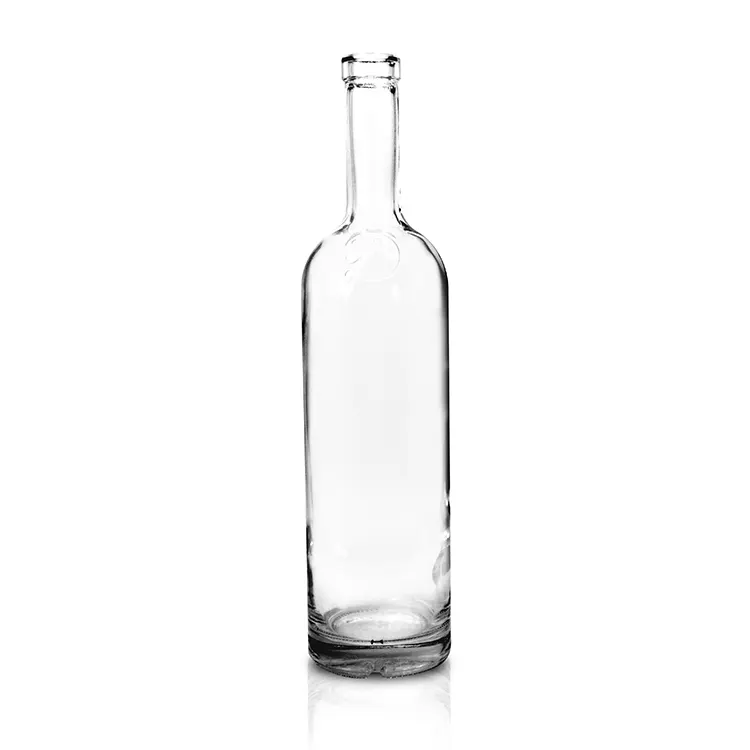
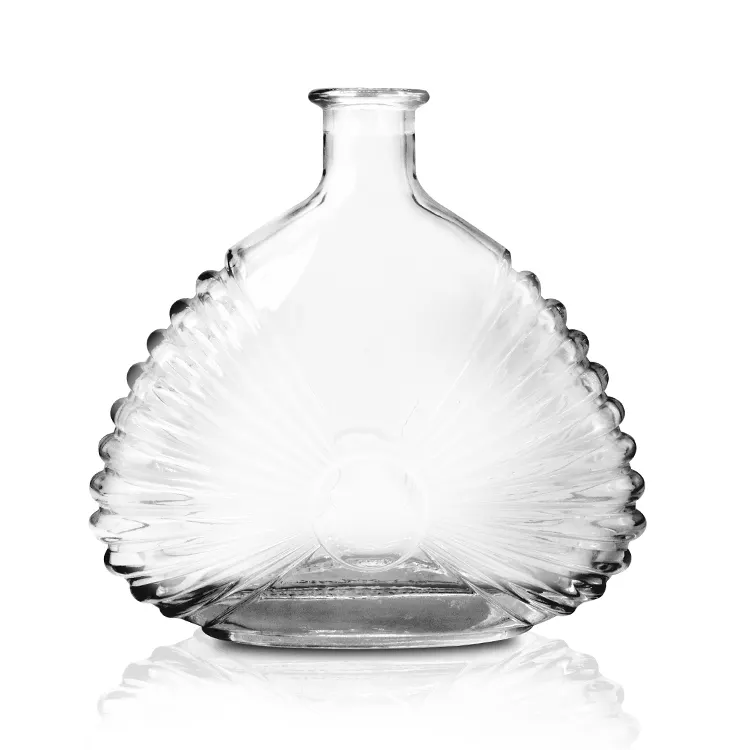
One-liter liquor bottles are bought mainly for duty-free, bars and value retail, and stock moulds already cover round, square and flask shapes in flint and super-flint glass. A typical stock bottle weighs 700 g to 880 g and loads at roughly 11,500 to 13,200 pieces per 40’HC container, so freight weighs heavily in the landed cost. Stock pricing is quoted per project and depends on the mould, decoration, quantity and freight terms.
Stock 1L bottle specifications
These four profiles are the reference points for stock programs. Finishes are either bar-top, which takes a cork stopper, or screw-cap.
| Profile | Nominal / brimful | Glass weight | Neck finish | Pcs per 40’HC |
|---|---|---|---|---|
| Round, standard shoulder | 1000 / 1045 ml | 720 g | 31.5×24 bar-top | ~12,800 |
| Round, heavy base | 1000 / 1050 ml | 880 g | 31.5×24 bar-top | ~11,500 |
| Square / Nordic style | 1000 / 1040 ml | 800 g | 28 mm bar-top or MCA | ~12,000 |
| Flask / hip profile | 1000 / 1035 ml | 700 g | 30 mm screw (GPI 400) | ~13,200 |
Super-flint is low-iron glass with higher clarity. It costs more than standard flint and is the usual choice for white spirits, where the look of the liquid helps sell the bottle.
What each sales channel needs from the bottle
The channel you sell through decides which of those profiles fits.
- Duty-free and travel retail. Most customs allowances are set at one liter per traveler, which made 1L the default size for whisky, vodka, gin, rum and liqueurs in this channel. Shelf presence is the priority.
- On-premise. Bars, hotels, airlines and cruise lines buy on pour cost. A 1L bottle gives roughly 33 thirty-milliliter pours against 25 from 750ml, so staff change bottles less often. Here the neck has to be easy to grip and work with a speed pourer.
- Value retail. Where the size may be sold off-premise, 1L and 1.75L act as the family-size price fighter. The aim is the lowest landed cost per liter.
Choosing between a stock and a custom mould
A stock mould is the quick route and covers most channel needs. A custom 1L mould is justified when the bottle itself carries the brand, as with high-end spirits, and the volume is large enough to carry the tooling.
Many brands take a middle path: a stock body with a custom embossing plate fitted in the mould. The result looks proprietary at a fraction of the tooling a fully custom bottle needs. The steps for a new shape are set out on our custom glass bottle page. Rum brands will find size-specific notes in the guide to rum bottle sizes, and non-spirits uses of this size are covered under one-liter bottles for beverages and oils.
Specification errors to avoid
Most problems with 1L orders trace back to one of four gaps in the specification.
- Nominal and brimful capacity mixed up. A quote for "1000ml" usually means brimful capacity, while "1L fill" means the nominal fill with headspace on top, typically 1030-1050ml brimful. Write down the nominal fill, the brimful capacity and the headspace target, because both the legal-fill claim on the label and the filler's calibration rest on them.
- Finish described in shorthand. "Cork top" does not define anything. Cite the finish drawing, for example a 31.5×24mm bar-top per CETIE or the plant's drawing number, since stopper and cap tooling is cut to that drawing.
- Local fill rules overlooked. Some markets set the allowable fill tolerance at 1L differently from 750ml.
- Line changeover assumed. The 1L size runs on standard filling lines, but ask your filler to confirm that the star wheels, guides and labeler accept its diameter and height.
Our quote request for alcohol bottles asks for the profile or drawing, glass weight, finish, annual volume and destination port. Other sizes are listed in the liquor bottle collection.
Freight and landed cost
Glass this heavy makes freight a large share of what a bottle costs on arrival. Two decisions reduce it. Lightweighting, such as redesigning a 720g bottle to 640g, lowers both the glass cost and the freight carried per unit. Shipping straight to your contract bottler's port, not to your own distribution center, removes one handling leg.
On request we quote CIF and DAP next to FOB so you can compare true landed figures. Glass quotes also move with soda-ash and energy surcharges, so an old quote is only a guide. The calculation is worked through in our guide to reducing bottle freight cost.
Frequently asked questions
What neck finishes do 1L spirits bottles use?
Bar-top finishes in 28mm and 31.5mm lead for cork-stoppered spirits. Screw-cap value lines use 28mm or 30mm MCA or GPI continuous-thread finishes.
What is the MOQ for 1 liter liquor bottles wholesale?
It is set per project. The minimum follows from the mould and the production line it runs on.
How much does a 1 liter liquor bottle cost wholesale?
We quote each project separately. Glass weight, flint or super-flint, decoration, order quantity and freight terms all change the figure.
Can 1L liquor bottles handle high-proof spirits?
Yes. Soda-lime and super-flint glass do not react with ethanol at any bottling proof, including overproof rums and neutral spirits at 75%+ ABV. The closure is the weak point. For high-proof products use T-corks with ethanol-rated synthetic shanks, or PP caps with EPE/EVOH liners, and check the liner against your bottling strength.
Is a 1000ml bottle different from a 1L bottle?
Not in capacity. The two terms tend to be used for brimful and nominal volume, so confirm in writing which one a quote refers to.