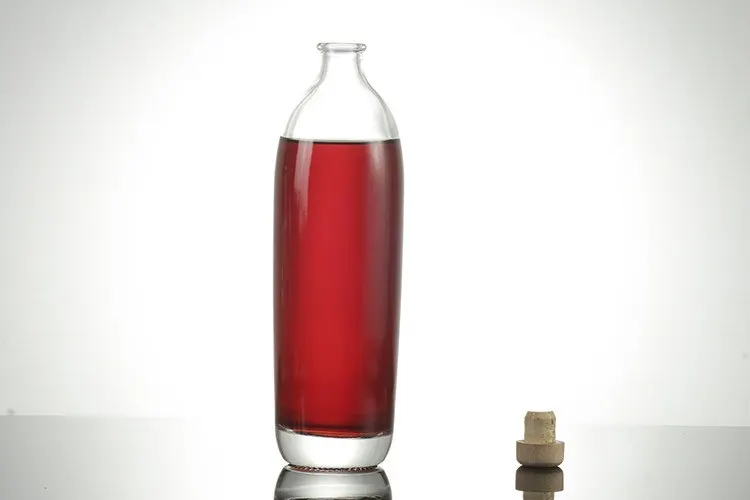
Part of our liquor bottles wholesale range; the stock moulds are pictured at the end of this guide.
A 750 ml liquor bottle is specified from the closure inwards: pick the cork, roll-on cap or pourer first, freeze the neck finish that closure needs, then choose the shoulder family and punt that suit the spirit and its positioning. A glass plant needs six values to quote it properly: capacity (nominal and brimful), body diameter, overall height, neck finish, punt and glass weight. It is not a 750 ml wine bottle with a different label, and treating it as one is the usual source of trouble at the filler.
How a spirits bottle differs from a wine bottle of the same volume
On a shelf the two can pass for each other. On a drawing they share only the declared volume. Spirits glass generally has a thicker wall and a heavier base, and that base is designed for stability and appearance, since a still spirit puts no internal pressure on it. The neck is usually shorter and ends in a screw finish or a spirits cork finish, whose bore and internal profile are not those of a still wine cork finish. Closure system, fill condition and label field all differ as a result.
The practical consequence is that wine closures, wine cartons and wine line settings cannot be assumed to carry over. Each has to be checked against the spirits drawing.
The six values a plant needs before it can quote
Buyers often send one or two of these and ask for a figure. The specification cannot be fixed until all six are stated, because each controls something different.
Capacity, nominal and brimful
Nominal capacity is the volume printed on the label and legally sold. Brimful capacity is what the bottle holds when filled right to the top of the finish. The gap between them is the headspace the filler works with, and the mould sets it, not the filling line. If the ratio is unusual, the declared 750 ml will not sit at the fill height the filler expects, so the brimful figure has to be known before a fill height is chosen. The legal tolerance on declared quantity in the destination market is the buyer's regulatory matter, but it decides how much margin the filler must leave.
Body diameter
Diameter governs the label panel, the carton, the pallet pattern and how substantial the pack looks. A wide, squat body signals weight and tradition; a narrow, tall one looks lighter and more contemporary. Variance deserves more attention than it usually gets. A body at the upper end of its tolerance must still pass through the label applicator, which forgives less than a carton does.
Overall height
Height is really four dimensions stacked: body, shoulder, neck and finish. Finish height together with neck outside diameter determines which capping or corking head can hold the bottle. Shoulder height marks the top of the label panel. Total height sets the carton and the container load. A bottle 5 mm taller than planned is enough to break a carton height agreed earlier, so this check is made on the drawing.
Neck finish
The finish is the interface with the closure and the costliest dimension to alter later. A screw finish is described by thread form and pitch; a cork finish by its bore and the internal geometry that holds the cork. Changing it invalidates closure tooling and the carton, and frequently moves the label position too. For that reason the finish is normally fixed first and the rest of the bottle is drawn around it.
Punt
The punt is the concave push-up in the base, and its depth is functional. Deepening it lifts the standing ring and stiffens the base, which helps a heavy bottle carry stacking load, and it alters the sound and feel of the bottle as it is put down. A shallow punt over a wide standing ring uses less glass and runs steadily on a conveyor. A deep punt goes with higher glass weight and with spirits sold on a sense of quality.
Glass weight
Customers read weight as quality; the freight calculation reads it as mass. Because extra weight in a given shape is a deliberate brand decision, write it into the specification as an agreed band. Left unstated, a supplier trimming glass to reach a target and a buyer assuming the heavier bottle will end up with glass that matches the drawing and disappoints the brand. Punt depth tends to shrink along with weight, so state both.
Choosing the closure before the finish is frozen
Three closure families are in regular use on 750 ml spirits glass. Each one dictates the finish, and through the finish it dictates the bottle.
Natural cork
A straight cork, or one fitted with a decorative head, seals by compression against the bore. Bore diameter, internal finish geometry and cork diameter therefore have to be matched, and the cork must go in to a defined depth. Cork is a natural, compressible material, so the finish has to absorb its dimensional spread; that takes a true cork finish with the right internal profile, not a narrow-bore screw finish pressed into service. Insertion depth has a visual side as well. Too shallow and the seal cannot be relied on; too deep and the intended opener may not extract it. On a spirits bottle the depth can be seen, which makes it part of the product.
Agglomerate and technical corks
These are built from granulated cork and a binder, or from a cork body with discs. They give the look of cork with steadier dimensions, but they compress differently, so the finish must be confirmed against the actual stopper to be used and not a generic cork sheet. Any cork seal also depends on compression holding over time, and storage orientation and temperature influence it. The buyer, the cork supplier and the filling line settle that question; the bottle specification then has to accommodate what they decide.
Screw caps
Aluminium roll-on pilfer proof caps are the most common closure on volume spirits programmes. The capping head crimps the cap onto the glass, sealing on the top face of the finish and, in many designs, down the sides. Thread form, top-face geometry and finish height define the finish. The variable that matters most in production is the capping head setting. With too little force the cap is not formed properly and the tamper band will not break away cleanly; with too much, the cap or the glass finish is damaged. Since the setting belongs to the head and the bottle as a pair, the closing trial must use the actual glass, never a sample from another mould.
Plastic screw caps are used too, some with a built-in pourer or measured-pour insert. A pourer or restrictor takes up room inside the finish and in some designs reaches into the neck. Bore and neck internal profile then stop being empty passage and become functional dimensions. This is where a closure choice begins to redraw the bottle, so select the pourer or dispenser before the finish is fixed.
Two mismatches that pass inspection and fail in use
The first is a cap chosen by finish diameter instead of finish standard. It seems to fit, then leaks once the pack goes through temperature cycling. The second is a bottle drawn for cork and closed with a screw cap, or the other way round, leaving a sealing surface shaped for a closure it never receives. In both cases the glass clears its own dimensional check and fails as an assembly.
Shoulder and punt families and the closures that suit them
The rows below are families, not catalogue models: one family covers many bottles of differing diameter, height and weight. Use the first table to find the family your spirit normally sits in, and the list after it as the pre-order checks for that family.
| Body and shoulder | Base and punt | Typical spirits | Usual closure | Versus a 750 ml wine bottle |
|---|---|---|---|---|
| Boston round, short sloped shoulder | Shallow punt, wide standing ring; a base made for conveyor stability, not pressure | Whiskey, bourbon-style spirits, rum, gin, flavoured spirits, private label volume lines | Aluminium roll-on pilfer proof cap, or lined plastic screw cap | Thicker wall and heavier base at equal height; screw finish in place of cork; carries no pressure rating and needs none |
| Tall, slender body with tapered shoulder | Shallow to medium punt; sometimes a pronounced standing ring because the centre of gravity is high | Gin, vodka, clear white spirits, modern craft spirits | Screw cap with long pilfer band; bar-top cork for a more upmarket look | Wine uses a long neck and cork finish; here the neck is shorter, the finish is screw and the body is taller |
| Square or rectangular flask, squared shoulder | Flat base, shallow push-up, resting on a flat rim | Whiskey, small-batch spirits, gift and travel retail, brand-led launches | Bar-top cork with decorative head; flat screw cap when no head is wanted above a square shoulder | Flat panels replace the single continuous label field of a round bottle, so label geometry and application are entirely different |
| Pot still, rounded shoulder (brandy and cognac profile) | Medium to deep punt, heavy base, weight used on purpose as a quality cue | Cognac-style brandy, aged spirits, premium rum, vintage-dated spirits | Natural or agglomerate cork with decorative head; now and then a bar-top cork on a short finish | Looks close to wine, but heavier glass, deeper punt and a spirits cork finish with its own bore and profile |
| Tall flute with extended neck | Shallow punt, light base, weight held down for the tall format | Vodka, dry gin, white rum, minimalist premium lines | Screw cap with tamper-evident sleeve; extended bar-top stopper for gift packs | A wine flute of this capacity is normally cork-finished and pressure-capable for sparkling; this one is still, screw-finished and weight-limited |
| Proprietary profile on a standard 750 ml body | Buyer-specified punt and base, within the limits of the mould and forming process | Brand-specific spirits whose silhouette forms part of the trademark | Any of the three families, generally fixed by the brand design | No real comparison: the shape is the point of difference, while the 750 ml wine bottle is a commodity format |
What to confirm with the plant for each family
- Boston round: finish standard and thread form; brimful capacity and the fill height at which the declared volume is reached; body diameter against carton and label panel; the weight band per bottle.
- Tapered, tall body: neck length and finish height against capping head travel; the verticality tolerance, which matters more on a tall narrow bottle; how much label panel height is left beneath the shoulder.
- Square or rectangular flask: flatness and usable size of every panel; corner radius against the carton insert; whether the label applicator copes with flat panels at the planned line speed.
- Pot still: the cork diameter and insertion depth the finish was designed around; bore and internal geometry checked as a pair with the specified cork; total weight and what it does to freight and to the carton.
- Tall flute: verticality and lean, since a long neck magnifies misalignment under the capper; height clearance through filling and capping; carton height once the closure is on.
- Proprietary profile: whether new tooling is needed and what run size a custom mould implies, both of which are settled per project; how the closure interface is protected when the body changes; where the label goes on a non-round or asymmetric body.
Filling-line conditions that can send the drawing back
A drawing can be correct in every dimension and still not run. We ask about five line conditions before a specification is frozen.
- Filling method. Gravity, pressure, volumetric and piston fillers ask different things of the neck and bore and fill to different heights. For the same declared volume, a gravity filler may need a wider bore than a pressure filler, because flow through a narrow neck caps line speed. Bore is a line-speed decision as well as a sealing one.
- Closure application equipment. A screw capper needs a defined finish height and something to grip, body or neck. A corking machine needs jaws that compress the cork and a bottle that stays rigid under insertion force. On glass that is light for its format, that force becomes a genuine limit, and the finish and neck wall must be strong enough for it.
- Torque or insertion setting and its verification. Roll-on caps are verified by removal torque measured on samples; corked bottles by insertion depth and, on some programmes, extraction force. Either setting is found by trial on the real glass, then monitored during production, and both shift with temperature and closure material. If the specification is silent on who runs that trial and where, expect a dispute over the first container.
- Pre-fill treatment. Empty bottles may be water-rinsed, air-blasted or used as received. Cleaning heavy spirits glass is optional on many programmes, yet it always adds handling and so handling damage. A bottle due to be rinsed needs a finish and interior that will not trap water.
- Empty-bottle handling path. This covers the unscrambler and conveyors. Spirits bottles are heavy. In a plant set up for lighter glass, guide rails, transfers and star wheels may be set to another diameter, and an in-specification bottle comes out scuffed or chipped.
Tolerances, measurement methods and inspection
Glass is shaped while hot and moving, so every dimension has a tolerance. The useful discussion is which variations affect your line and how each will be measured. Tight limits on dimensions that do not touch the line buy inspection nobody needed. Leaving the important ones unstated moves the discovery to the filler.
Four groups nearly always matter: finish dimensions (closure seal), brimful capacity (reaching the declared volume), height (carton fit and line clearance) and body diameter (labelling and carton fit). Slight differences in shoulder curvature or in how thickness is distributed matter less, as long as the bottle is not pressure-rated and its weight stays inside the agreed band.
| Characteristic | How it is checked | Why it matters |
|---|---|---|
| Capacity | Fill with water to the defined brimful point at a stated temperature, weigh the contents, convert mass to volume at that temperature | Filling to the lip and filling to a set level inside the finish give different results, so a figure without its definition cannot be used |
| Finish | Go and no-go gauges: plug gauge for bore, ring or thread gauge for thread form; sealing surface examined visually and dimensionally | Thread or bead form and internal bore are the critical features, and a calliper on one outside diameter does not capture them |
| Wall thickness | Measured at defined points around body and shoulder | A bottle can meet total weight and be thin on one side; a thin shoulder risks breakage in handling and stress on the line |
| Verticality (lean) | Deviation of the finish axis from the base plane | A leaning bottle sits off-centre beneath the capping head |
| Visual defects | Stones, seeds, blisters and visible seams assessed on an agreed sampling plan under an AQL scheme | Inspection level and acceptable defect class belong in the purchase agreement, not in a conversation after the run |
A finish that gauges correctly still needs testing as an assembly with the real closure, because the seal is made by the two parts together. When a capacity figure is offered, ask how it was obtained as well as what it is.
Two rules keep an order enforceable. Set the measurement method together with each tolerance, since a tolerance with no method cannot be enforced. And set the sampling plan with its defect classification, since a specification that never says how many defectives are acceptable gets argued over instead of measured.
Reading a failure back to the specification
Most problems show up at the filler, not at the glass plant, and each symptom points to a particular part of the specification.
| Symptom | Where to look |
|---|---|
| Leaking closure | Finish-to-closure mismatch or capping-head setting; seldom the glass body |
| Cork pushing out or seating unevenly | Insertion depth, bore, or a cork outside its own tolerance |
| Chipped or cracked finish | Handling and capping setting; often excess insertion force on a light bottle |
| Shoulder cracks | Wall thickness distribution or mechanical impact on the line, not the drawing |
| Label wrinkles, misregistration | Body diameter variance with an applicator working at the limit of its tolerance |
| Short fills on a bottle that passed the laboratory volume check | The glassworks' brimful definition and the filler's fill height do not agree |
| Stones, blisters and other visible glass defects | A forming issue, dealt with through the agreed sampling plan and defect classification, not by sorting at the line |
Because the causes can be separated, a report that names only the symptom leaves supplier and filler blaming each other. A usable report gives the part of the bottle, the dimension measured, the method and the quantity affected.
What to send us, and where prices and other sizes are covered
Spirit type and intended closure are enough to start. From those two facts we can narrow body and shoulder family, punt treatment, neck finish and closure interface to one or two coherent combinations, and the family checks above become the list that closes the specification. Filler type, capping equipment and the empty-bottle handling path narrow the bore, the finish and the weight band further. A carton and pallet plan lets height and diameter tolerances be set against something real.
Unit prices, order quantities, tooling costs and timing are confirmed against a finished specification, so any figure given earlier is a range. Buyers after a commercial figure for an existing catalogue model, including the smaller formats around 375 ml and 600 ml, should use that model's product or price page; for rum, that is the price listing for our catalogue rum bottle.
If the format itself is still undecided, begin with the overview of liquor bottle types. Miniatures raise their own questions of fill tolerance, closure alternatives and container loading, which the guide to buying small liquor bottles works through.
Frequently asked questions
Can I use a 750 ml wine bottle for spirits?
Treat them as separate containers. Only the declared volume is shared. The spirits version is heavier and thicker-walled, has a base built for stability, and takes a screw or spirits cork finish. The wine bottle has a longer neck, another label field and a still wine cork finish, so closures and fill settings do not transfer.
The label says 750 ml. Why ask for brimful capacity?
Because headspace comes from the mould. If the brimful-to-nominal ratio is unusual, the fill height falls outside the filler's normal setting and the line produces short fills or overfills. Ask for the brimful volume and for the definition of the brimful point used to measure it.
Which closure suits a 750 ml spirits bottle?
The spirit and its positioning decide, more than the bottle. Volume whiskey, rum and clear spirits mostly run aluminium roll-on pilfer proof caps. Traditional and premium lines often use natural or agglomerate cork, sometimes under a decorative head, on a spirits cork finish with matched bore and defined insertion depth. If measured pouring is intended, the pourer or restrictor is part of the same decision.
Does punt depth matter beyond looks?
Yes. It changes base stiffness, standing-ring height, glass weight and conveyor behaviour, and a shallow punt makes for a lighter bottle that is cheaper to ship. State the depth on the specification so it is not reduced quietly when weight is trimmed.
Why would a correctly sized bottle leak?
The fault is nearly always at the interface. Typical causes are a closure made to a different standard from the finish, a capping head set too light or too heavy, or, with cork, the bore, cork diameter or insertion depth. The remedy is a closing trial with the actual glass and the actual closure, measuring torque or insertion depth and then monitoring it in production.
How are tolerances and defects verified on an order?
By the methods in the inspection table: gauges on the finish, weighed water for capacity, point measurements for wall thickness, the base plane for verticality and an AQL sampling plan for visual defects. Methods and sampling plan are confirmed per order and written into the agreement.
What documentation should I request?
Ask for the food-contact documents your destination market enforces. The frameworks you will meet are EU 1935/2004 and EU 10/2011 in Europe, FDA 21 CFR in the United States, and LFGB where the German market applies it. Naming them here says nothing about any particular supplier's certification. Request the specific documents, read their scope, and check before ordering that they cover the finished specification, closure liner included.