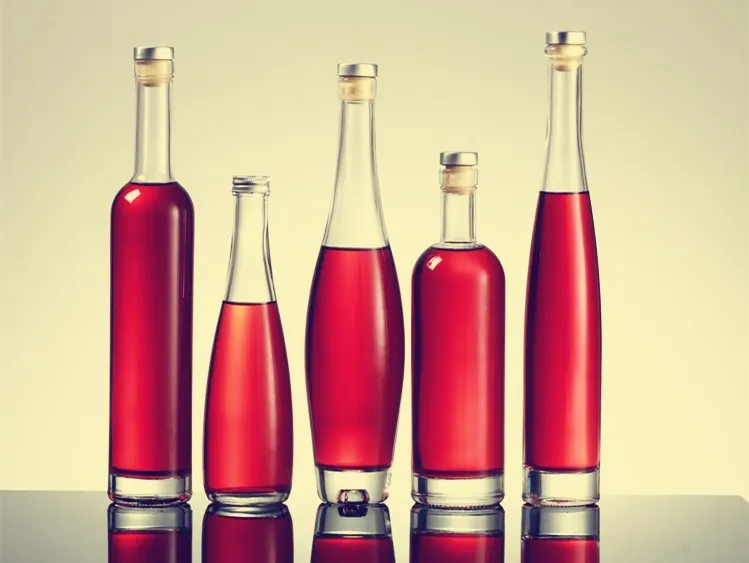
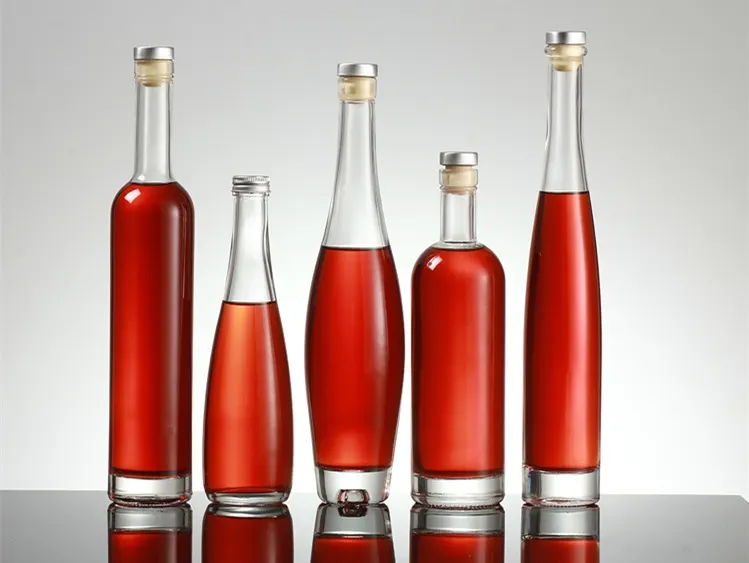
Part of our vodka and gin bottles range; the stock moulds are pictured at the end of this guide.
A handle of vodka is the 1.75-liter bottle, a half gallon, with a glass finger grip moulded into its neck or shoulder. The grip is blown with the bottle in one machine cycle, so the buying risk sits at the handle root: if that junction is poorly annealed it cracks months later. A sound specification therefore pairs the usual capacity, finish and closure details with stress inspection and load testing at the handle.
1.75L and 1L handle formats
The 1.75L jug is the North American size for fast-moving well spirits, vodka first and then the value tiers of rum, whiskey and tequila. Bars like it because it pours with control, stores compactly and reads as value at retail. The 1L handle is used in travel retail, in markets where 1.75L cannot be sold, and by brands that want the grip on a smaller, more upmarket bottle.
| Specification | 1.75L handle jug | 1L handle bottle |
|---|---|---|
| Main markets | USA, Canada, duty-free | EU, travel retail, LATAM |
| Typical empty weight | 1,050–1,250 g | 650–800 g |
| Common finish | 33-400 / 33.5mm bar-top | 28-400 / 31.5mm bar-top |
| Usual closure | Screw cap or T-cork | Screw cap or T-cork |
| Cases per 40ft HQ, approximate | 1,600–1,800 x 6-pack | 2,400–2,700 x 6-pack |
| Typical buyer | Bars, clubs, value retail | Higher-tier retail, gifting |
The two are formed the same way but fill and ship differently, so plan them as separate SKUs. Glass weight is a commercial choice within each. A heavy-wall 1.75L at 1,200+ grams feels more expensive and stands up to rough bar use, while a lightweighted version near 1,000 grams lowers the freight carried by every case.
For how these sit against the rest of the range, compare our tables of vodka bottle sizes and liquor bottle sizes. If the grip is not essential, 1-liter liquor bottles without a handle are the nearest alternative.
Where each size can be sold
In the United States 1.75 liters is a standard of fill for spirits. The EU also permits it: its list of spirits sizes runs 100, 200, 350, 500 and 700 ml and 1, 1.5, 1.75 and 2 liters. Check every target market before paying for tooling all the same, because the lists do not match. The EU does not allow 750 ml for spirits, so a European companion to a US range should be the 1L handle or a 700 ml bottle, not a 750ml liquor bottle.
Two further points belong in the design stage. The curved shoulder of a handle jug leaves little room for a back label, so lay out the mandatory information against TTB rules for the US, or the destination market's rules, while the decoration is still being drawn. And bar-top closures bound for the US must be tamper-evident, which a standard T-cork with a capsule satisfies.
How the handle is made and where to place it
Nothing is glued or welded on. On an IS (individual section) machine, a gob of molten glass drops into a blank mould that includes a cavity for the handle. During the press-and-blow or blow-and-blow sequence, glass flows into that channel and forms a hollow loop open to the inside of the bottle. Being hollow and part of the bottle wall, the handle adds little glass, typically 40–70 grams, yet carries the load of a one-handed pour.
The weak point is the junction between handle and shoulder, which concentrates stress. Tension left there by uneven cooling is where a crack starts later. The annealing lehr, the cooling oven after forming, has to take the whole bottle through the annealing range evenly, thicker handle root included. That makes annealing control more important on this format than on any other spirits bottle. Our page on custom glass bottle projects describes how mould cavity design and lehr control work together on complex shapes.
Placement affects how the bottle pours. A shoulder-mounted handle, the vodka jug standard, puts the grip above the liquid's centre of gravity and balances the pour. Neck-mounted handles suit smaller bottles. Put the grip aperture in writing: the opening should clear 25–30 mm so that large or gloved hands fit during bar service.
Screw cap or bar-top cork
Aluminum ROPP or CT screw caps are the norm for high-volume well spirits. They go on quickly on an automated line, reseal dependably behind the bar and carry a tamper-evident band. A bar-top T-cork, meaning a natural or synthetic cork stopper under a wood, plastic or aluminum cap, gives up line speed for presence on the shelf and fits craft and higher-tier positioning.
Whichever you choose, the finish has to be gauged to the closure maker's tolerances. A 33.5mm bar-top bore that drifts by a few tenths of a millimeter produces leakers. Torque, liner and tamper-evidence choices for both families are compared in our guide to closures for vodka bottles.
Decoration options on a handle jug
The wide shoulder and flat panels take decoration well. Three methods cover most programs:
- Ceramic decals, fired at 560–620°C so that multi-colour artwork fuses into the glass surface. They withstand dishwashing, ice buckets and bar abrasion, which is why long-running SKUs use them.
- Organic spray coating, which turns clear flint glass matte black, frosted white, metallic or gradient. It is the quickest way to make a stock mould look like your own.
- Screen printing in ceramic or UV ink, for bold graphics of one to three colours and neck text. It carries the lowest decoration cost per bottle.
Methods are often layered. A matte-black sprayed jug with a fired gold decal and an embossed shoulder medallion looks far above its stock-mould origins. Embossing needs a private mould, but once that is paid for the logo adds nothing to each bottle.
Colour matching, firing curves and durability tests are covered under decorating vodka bottles, and combined programs across methods under glass bottle decoration services.
Quality checks specific to handle bottles
A handle jug needs every test a plain spirits bottle gets, plus checks at the handle.
- Stress at the handle root. Inspect under a polariscope, set a maximum stress grade and ask for the plant's lehr records. A careful producer runs this as a permanent station, and the data should be available to you.
- Handle strength. A workable protocol combines a static load, for example a filled bottle hung by its handle for 24 hours, with a pendulum impact at the middle of the handle, representing a bottle dropped onto a bar mat.
- Internal pressure and thermal shock. Standard spirits-bottle methods apply, but examine the handle root on the samples after each test.
- Dimensions. Finish bore, height and verticality as usual, then handle aperture and a wall-thickness map at the junction.
Without a lab of your own, write these points into a pre-shipment inspection protocol. The audit questions on our vodka and gin bottle sourcing page help expose weak annealing practice before an order is placed.
Packing and container loading
A filled 1.75L handle weighs close to 2.9 kilograms, and the empties need careful packing too. The export norm is a 6-pack corrugated case with full-height dividers and a reinforced bottom. Bottles must not rest shoulder to shoulder, since one bottle's handle puts a point load on the wall of the next.
Column-stack the pallets, fit corner boards and top sheets, and stretch-wrap them. Keep mixed-weight stacks off the top of handle-jug pallets in the container. Ask each supplier for its breakage history on this format, where a well-run plant stays under 0.3 percent in transit, and confirm that cartons pass a 1.2-meter drop test on corner, edge and face. Put all of this in the purchase specification next to the bottle drawing.
For planning, a 40HQ of 1.75L handles in 6-packs holds roughly 10,000–11,000 bottles.
Who buys handle bottles and how to brief the order
Three kinds of buyer account for most volume, and each briefs differently:
- Bar groups and hospitality distributors buy empties for house bottling and infused spirits. Consistent finish gauging and tough case packs matter more to them than decoration.
- Spirits brands adding a value-tier SKU buy decorated stock moulds by the container, the usual route into a custom vodka bottle at this size.
- Co-packers and private-label producers take mixed pallets across sizes, with the handle jug as one line among liquor glass bottles.
To get quotes that can be compared across plants, state capacity, weight, finish, closure, decoration and packing in the same terms to each. Our quote form collects those points.
Frequently asked questions
Why is a 1.75L bottle called a handle?
The name comes from the moulded glass grip that lets a bartender pour the heavy bottle with one hand. In American trade usage it now means the 1.75-liter size in general, even for bottles made without the grip.
Will the glass handle stand up to daily bar use?
It will if forming and annealing were done properly. The handle is a hollow extension of the bottle wall and lasts for years behind a bar. When one fails, the cause is nearly always poor annealing at the junction, which is what the stress and load tests above are for.
What is the minimum order for decorated handle bottles?
Minimums are quoted per project. They depend on whether the mould is stock or private, on the decoration method and on the production line involved.
How much does decoration add to the cost of each bottle?
That is also quoted per project. The method, the number of colours, the quantity and the freight terms all move the figure.