One part of the work behind our custom glass bottle development service — drawing, mould, samples and sign-off are covered in order there.
Six decoration processes cover almost every glass bottle project: screen printing, spray coating, acid-etch frosting, hot stamping, decals and electroplating. Choose by where the bottle will be used. Fired ceramic print, fired decals and frosting are permanent, while hot stamping is durable on shelf but will not survive a dishwasher. We review the artwork and the use environment at RFQ, match the process to both, and arrange the work with a suitable decorator.
Processes compared by durability and use
| Process | Durability | Suits |
|---|---|---|
| Screen print (per color) | Ceramic ink: permanent. UV ink: high | Logos, text, bold graphics |
| Spray coating | High; add a topcoat where abuse is expected | Brand color, gradients, matte |
| Acid-etch frosting | Permanent, because it is the glass surface itself | Matte look for spa and candle lines |
| Hot stamping | Holds on shelf, not in a dishwasher | Metallic logos, medallions |
| Decals | Permanent when fired | Photographic and multi-color artwork |
| Electroplating | High when lacquered | Mirror and gold finishes, gift programs |
What each process does and where it stops
Screen printing
Ink is pushed through a mesh screen onto the glass and then cured. There are two ink families. Ceramic enamels are glass-based inks fired in a lehr (the annealing oven) at 550–620°C; they fuse to the bottle, so dishwashers, ice buckets and abrasion do not remove them, which makes them the usual choice for beverage and refill programs. UV-cured organic inks need less energy and reach a wider range of colors, bright Pantones included. They last through normal retail life but can scratch if abused.
The process works on any shape the screen can reach. Deep recesses and sharp shoulder curves are where it runs out. On round bottles, registration between colors holds to ±0.3–0.5 mm, which is adequate for most designs and worth checking for tight geometric ones.
Spray coating
Automated lines lay down opaque, translucent, metallic or gradient color across the whole bottle or across masked areas. Masking is an extra cost item, and it is what makes two-tone effects possible; a sprayed body with a clear window that shows the fill level is common on spirits and diffusers. Sprayed surfaces resist handling and moisture but may chip under a sharp knock, and a fired protective topcoat improves that considerably.
Acid-etch frosting
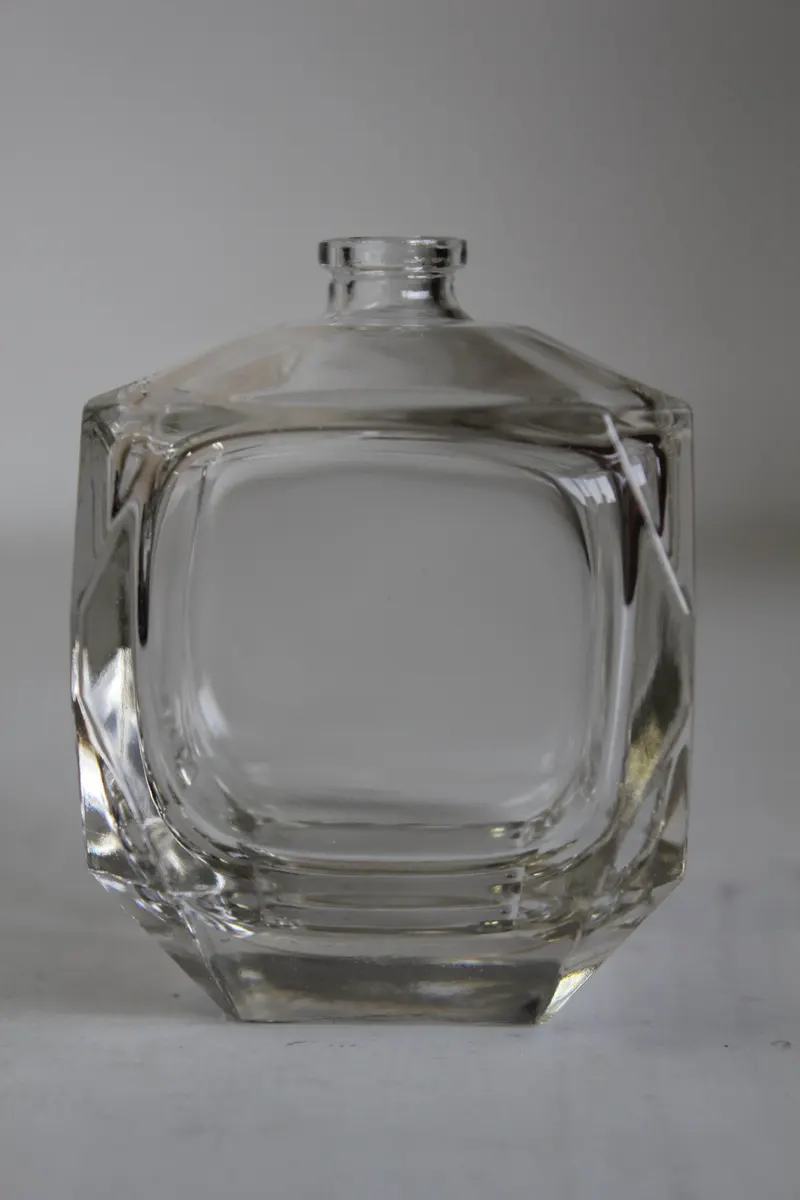
The frost can cover the full bottle or follow a mask, for example a frosted body with a clear logo window. It also conceals the small surface variation that clear flint glass shows, so a standard flint bottle can carry a more upmarket look. Colors printed over frost come out slightly softer, and frost alters how a spray layer beneath it reads.
Hot stamping and decals
Hot stamping applies a surface foil. It is the route for logos, medallions and fine borders, and it is exposed to scratching as well as to dishwashers. Decals are fired in the same way as ceramic print, so they are just as permanent while carrying photographic detail. Once artwork goes beyond two colors or contains gradients, a decal usually beats multi-pass screen printing on quality and cost, since every color is printed in one impression and fired once.
Electroplating and specialty finishes
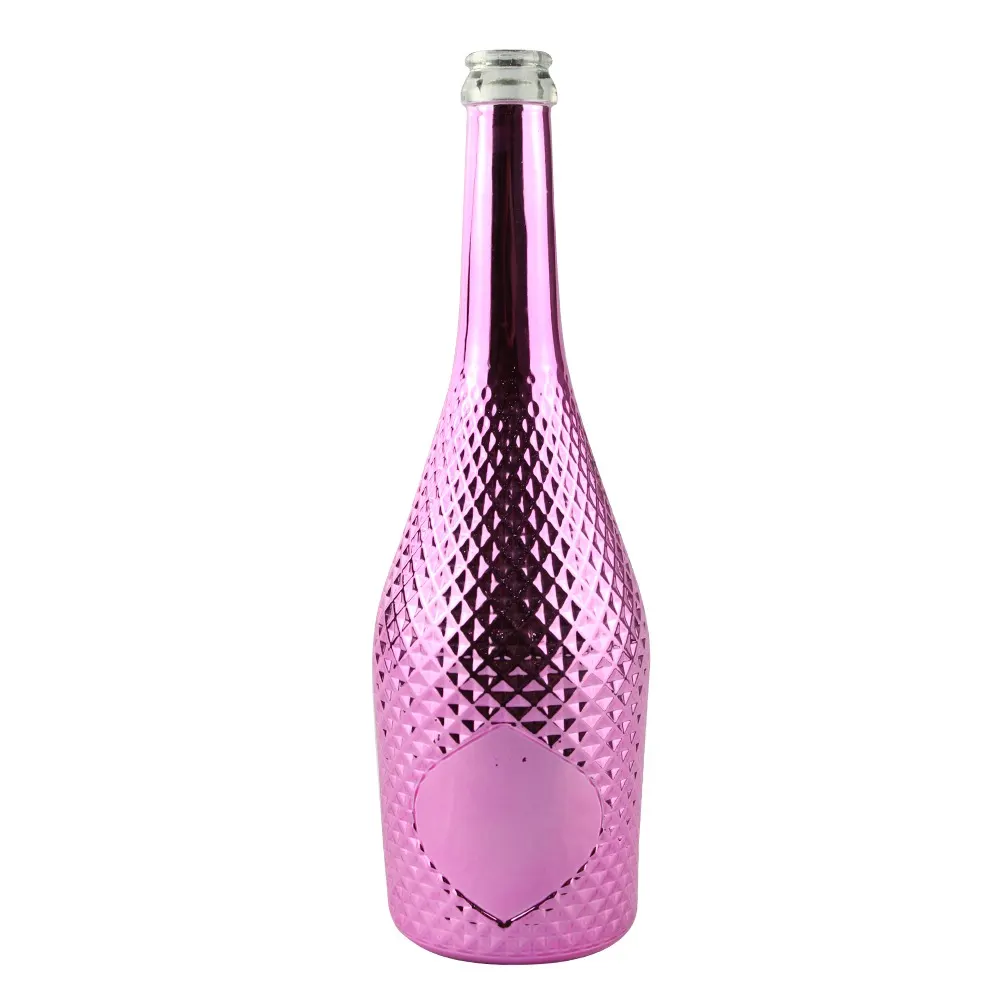
Vacuum metallization and electroplating give mirror chrome, gold, rose gold or tinted metallic surfaces, the finish associated with gift sets and fragrance. On candle jars the plating is often applied inside as well, so the glass glows when lit. Related specialties include crackle finishes, soft-touch rubberized sprays, iridescent coatings and hand-applied elements, all scoped project by project.
Matching color to a Pantone reference
Spray coatings and organic inks follow Pantone references closely. A drawdown sample is made against your chip, you sign a master, and production is held to a window against it, typically ΔE ≤ 2.0 for sprayed work. The signed master is retained and each batch is color-checked against it.
Ceramic inks have a narrower gamut because firing chemistry rules out some bright organic shades, so an exact match is confirmed color by color during sampling. Metallic effects cannot be done in ink; they need hot stamping or electroplating. Whatever the combination, sample the complete stack of layers together, never each layer alone.
How much decoration each bottle route needs
| Bottle route | Role of decoration |
|---|---|
| Stock mold | Decoration does all the differentiating |
| Modified stock | Embossing combined with a spray or print stack |
| Full custom mold | The silhouette leads and decoration adds accents |
Two habits keep the decoration budget under control. Group SKUs so they share a batch on each process. And stop at two layers when two already give the shelf effect, because a third adds real cost and usually little visible gain. Category-specific choices are worked through in guides such as the one on decorating vodka bottles.
What to send for a decoration brief
- The bottle or jar mold, or a capacity range, for each SKU
- Artwork files or references: logo, colors, Pantones
- The processes you are considering and their coverage (full, partial or windowed)
- The use environment: dishwasher, ice bucket, refill
- Quantity per SKU and the target launch date
With those in hand we can check the artwork against each process and prepare a figure through the quote request form. For a closer look at print alone, see the comparison of screen printing routes for glass bottles.
Frequently asked questions
Which process gives the best effect for the money?
That depends on the project, and costs are quoted case by case. The drivers are the mold, the decoration stack and its coverage, the quantity and the freight terms.
What minimum quantities apply to each process?
Minimums are set per project. They follow from the mold and the line the job runs on.
How many colors can be printed?
Screen printing is counted per color, each one a separate pass. Past two colors, ask us to compare a decal, particularly for photographic or gradient artwork.
How long do sampling and production take?
Timing is confirmed per project after the mold, the decoration and the line schedule are fixed.