Hand blown glass bottles make sense when the bottle is part of what the customer pays for and the run is small: roughly 500–5,000 units of perfume, ultra-premium spirits, art glass or a limited release. Below that ceiling a glassblower gives you shapes and surface character no forming machine can reproduce. The cost of that freedom is capacity that varies by about ±5% and output of only a few hundred bottles per shift, so machine production takes over once you need tight fill tolerance or a run larger than 50,000.
Mouth-blown, semi-automatic and IS machine compared
An IS (individual section) machine is the automated forming equipment behind almost every volume bottle. Semi-automatic production sits between it and the blowpipe. The three differ most on the attributes below.
| Attribute | Mouth-blown | Semi-automatic | IS machine |
|---|---|---|---|
| Capacity tolerance | ±5% | ±2% | ±1% |
| Wall uniformity | Variable, and valued for it | Good | Excellent |
| Mould seam | None, or faint when mould-blown | Visible | Visible |
| Shape freedom | Almost unlimited, off-round included | Moderate | Limited by machine geometry |
The first row matters most for anything sold by declared volume. With ±5% between pieces, a regulated product needs either generous headspace in the fill specification or capacity grading, where every bottle is water-tested and sorted into narrower bands. Grading is an extra handling step with its own charge, and we can arrange it when the fill declaration requires it.
Products that justify hand-blown glass
Four categories account for nearly all commercial demand. What they share is a shelf price high enough for the packaging cost to read as value, not overhead.
- Perfume flacons. Sculpted shoulders, thick bases and off-round sections that play with light on a dressing table.
- Ultra-premium spirits. XO brandy, limited whisky releases and baijiu gift bottles, where a heavy hand-finished base tells the buyer which price tier the liquid belongs to.
- Art and gallery pieces. Carafes, decanters and signed objects, where piece-to-piece variation is the appeal.
- Small-batch launches. Runs of 500–5,000 units, too short for a machine mould to earn back its cost.
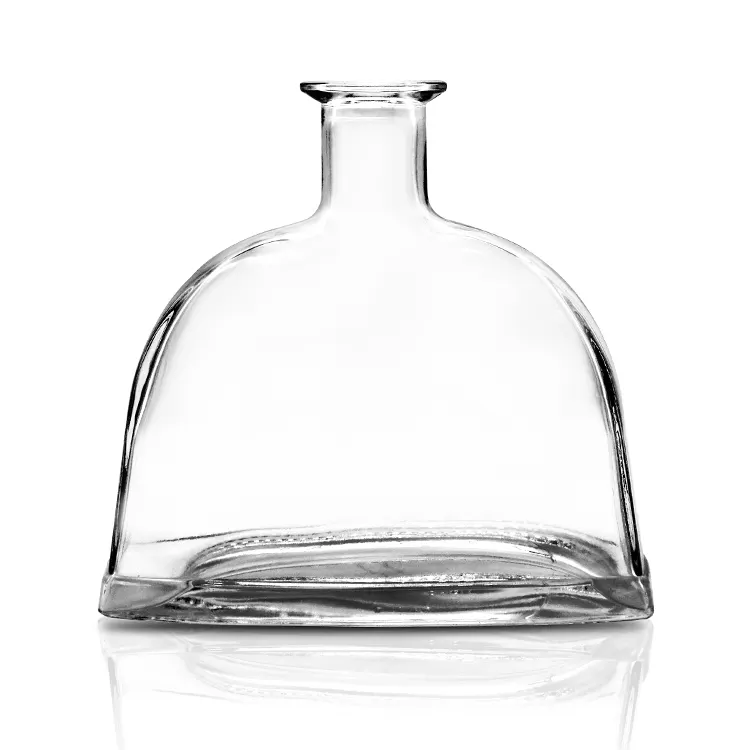
How a mouth-blown bottle is made
The glassblower, or gaffer, collects molten soda-lime glass on a blowpipe at around 1,100–1,200 °C and rolls it on a flat surface (marvering) until the gather is symmetrical. It is then inflated in one of two ways. Free blowing produces organic, unrepeatable forms; blowing into a hinged mould produces a bottle shape that can be repeated across a run.
To finish the mouth, the piece moves to a second iron called a punty rod, and the rim is fire-polished. Breaking it off the punty leaves the polished pontil mark on the base that collectors check for. Each bottle then passes through an annealing lehr, a controlled cooling oven, because handwork does nothing to remove residual stress in glass.
What to write into the specification
Craft does not replace a purchase specification. These are the points we fix on paper before a mouth-blown order goes to a workshop:
- Annealing checked under a polariscope to ASTM C148.
- Thermal shock resistance to ASTM C149 if the bottle will hold hot liquid.
- Cosmetic limits for stones, cords, seeds and blisters, agreed against physical boundary samples and not a written description alone.
- Capacity grading plan for any product filled to a declared volume.
- Glass composition. Lead-free soda-lime is the default. Crystal and barium formulations are possible where the destination market's rules allow them.
Decoration is also done by hand and costed per piece: applied decals, gold or platinum bands, acid etching and hand painting.
Pairing a hand-blown flagship with a machine-made range
Plenty of brands use both methods. A limited release of 500–2,000 mouth-blown bottles carries the story, and a machine-made bottle with the same silhouette carries the volume. We draw the machine mould so its profile follows the hand-blown one, which lets the two sit on a shelf as one family.
If the project turns out to be all volume, our overview of how glass bottle manufacturing is sourced is the better starting point. A machine-made custom wine bottle shows what a bespoke mould involves, and the stock bottle collections cover standard shapes bought in bulk.
Frequently asked questions
What is the minimum order for hand blown bottles?
It is set per project. The shape, whether a hinged mould is needed, the decoration and the workshop's schedule all move it, so we confirm a figure once we have seen the design.
Are hand blown bottles lead-free and safe for food and drink?
The standard material is lead-free soda-lime glass, fully annealed, and it should be specified to FDA 21 CFR food-contact requirements and EU 1935/2004. Crystal containing lead or barium is reserved for decorative decanters where regulations permit, and it has to be stated in the specification.
How much do size and capacity vary?
Plan for about ±5% on capacity plus slight asymmetry. Both come with the method. Where a legal fill volume applies, water-test grading sorts the bottles into tighter bands so the declaration holds.
Can a specific colour be matched?
Yes. Colour comes either from oxides dosed into the melt or from coloured frit picked up on the gather, and it is matched to a physical sample or a Pantone reference within a delta-E tolerance agreed beforehand. Small coloured melts are workable at hand-blown quantities, whereas changing the colour of a full machine furnace for a short run is not economic.
How long does a hand blown order take?
Timing is confirmed per project, after the mould, the decoration and the workshop's schedule are known. The quote form is the place to send the design and quantity.
Hand blown or machine-made?
Go hand blown when the bottle is part of the product's story, or when you need fewer than about 5,000 units. Go machine-made when tight capacity tolerance or the lowest cost per bottle matters more, or when the run is larger than 50,000. A matched pair of the two covers brands that need both.