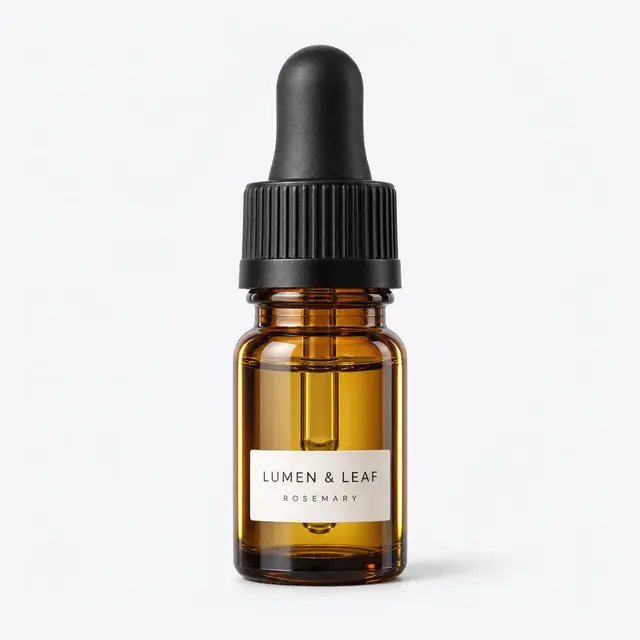
The Series 5567 is the compact workhorse of our amber dropper family: a short, straight-sided cylinder in the 10 ml class — deep amber glass, clean cylindrical walls, a gently eased shoulder, and a continuous-thread neck sized for standard dropper assemblies. This page is written for aromatherapy blenders, essential-oil brands, and contract manufacturers whose products are measured out drop by drop. When your customer follows a recipe that calls for three drops of this and two drops of that, the bottle and its dropper assembly stop being packaging and become a dosing instrument. The 5567 is engineered with that instrument role in mind.
Dosing Precision Starts with the Bottle
Drop-count accuracy is usually discussed as a property of the pipette, but the bottle contributes more than most buyers realize. Internal diameter determines how pipette insertion displaces the liquid level; wall straightness determines whether the pipette tip travels vertically or drags against glass; and internal height defines the working stroke of the bulb. The 5567’s straight cylindrical bore gives a matched pipette a clean, centered path from first fill to final dose, so the user draws a full pipette column every time instead of the half-draws that frustrate customers near the end of a bottle. The flat, low-profile base keeps residual volume minimal — an honest detail your customers notice when the last drops of an expensive blend actually come out.
For blenders who formulate by drop count, we can supply calibrated pipettes marked at fractional millilitre intervals, matched to the 5567’s internal height. If your product ships with usage instructions in drops, ask for drop-size consistency data with your samples: orifice geometry, pipette tip polish, and oil viscosity all interact, and we validate the assembly as a system rather than selling you a cap and hoping.
The 10 ml Format in Aromatherapy Commerce
Ten millilitres is the classic unit of the essential-oil trade for good reasons. At typical usage rates of a few drops per session, a 10 ml bottle delivers months of use while keeping the per-unit price at an impulse-friendly level. For blenders selling synergies and roll-on refills, the compact 5567 footprint means a full range of a dozen SKUs fits in a small retail display or a single e-commerce shipping carton tier. The low centre of gravity also matters in practice: short cylinders resist the tip-overs that plague tall narrow bottles on bathroom counters and massage trolleys, and they survive the one-metre drop onto tile that every oil bottle eventually experiences.
The short body does change label strategy. The label panel is compact, so brands typically run a front brand mark with a wrap or a secondary back label for ingredient and safety text. Our decoration team can advise on legible type sizes for the available panel and produce printed samples so you can judge readability before committing.
Closure Options and Neck Finish Details
The continuous-thread neck finish on the 5567 is in the DIN 18 class, opening the standard ecosystem of dropper hardware: glass pipettes with silicone, nitrile, or natural-rubber bulbs; tamper-evident dropper caps for retail channels; child-resistant dropper closures for blends flagged by retailers or regulators; and orifice reducers with plain screw caps for pour-by-drop dispensing. For aromatherapy use, the orifice reducer option deserves special mention — many essential-oil brands prefer reducer-plus-cap over pipettes because it controls pour rate without introducing an elastomer bulb into the formula’s headspace at all. We supply both configurations and can ship samples of each so your team can compare user experience side by side. Thread dimensions and neck tolerances are confirmed on the technical drawing at quotation, and existing closure inventory can be validated against that drawing on request.
Quality Control and Compliance Documentation
Each production lot of the 5567 is released against a documented inspection protocol. Annealing stress is verified by polariscope per ASTM C148, so bottles survive capping torque and transit handling without delayed stress failure.Brimful capacity, verticality, and wall-thickness distribution are gauged on cavity-by-cavity statistical samples, which is what keeps pipette fit consistent across the whole run rather than just the golden sample.
Cosmetic and aromatherapy buyers receive material declarations and glass composition documentation to support product information file obligations under EU Cosmetics Regulation (EC) No 1223/2009. UV transmission data for the amber glass is available with the quotation package for brands documenting light-protection claims. The same QC discipline applies across our catalogue, from 5 ml sample vials to 100 ml refill formats.
Ordering, MOQ, and Customization
The 5567 runs from a stock mould, keeping minimum order quantities accessible for growing brands and contract fillers; the interaction of quantity, decoration, and unit price is explained on our glass bottle MOQ page. Free samples with your chosen closure — pipette dropper or orifice reducer — ship within days so dosing and label fit can be validated before production. Decoration options include silk-screen printing, hot stamping, and frosting, plus matched pipette and bulb colours. First-time importers can plan lead times and freight with our guide to importing glass bottles from China. Send your annual volume, closure preference, and artwork through the contact page and we will return a complete quotation with technical drawings, typically within one working day.
Frequently Asked Questions
Can I get consistent drop sizes for aromatherapy blending with this bottle?
Yes. Drop consistency comes from the matched system of bottle bore, pipette tip geometry, and orifice size. We supply calibrated pipettes and orifice reducers validated with the 5567, and can share drop-size consistency data with your samples. Note that oil viscosity also affects drop size, so test with your actual formula.
Pipette dropper or orifice reducer — which should I choose?
Pipette droppers suit facial oils and serums where users draw a measured column of liquid. Orifice reducers suit essential oils dispensed by the drop, and avoid any elastomer bulb contact with the formula headspace. Many aromatherapy brands prefer reducers; we ship samples of both so you can compare.
What is the MOQ for the 10 ml Series 5567?
As a stock-mould item, plain amber bottles typically start at 10,000 pieces, with trial quantities negotiable for first-time buyers. Decorated orders may carry a higher MOQ per design. Contact us with your volume and we will confirm exact figures in the quotation.
How do I verify the dropper fits before mass production?
We ship free samples with your chosen closure within 3-5 working days (courier cost on you). All thread dimensions are confirmed on the technical drawing at quotation, and if you hold existing dropper inventory, send us a sample and we will verify fit against our drawing.
Is the 5567 compliant for cosmetic products sold in the EU?
The amber soda-lime glass supports compliance with EU Cosmetics Regulation (EC) No 1223/2009. We provide material declarations and composition documentation for your product information file; the final formula-packaging compatibility assessment is part of your safety evaluation.
What are the lead times and shipping options?
Plain bottles from the stock mould ship about 25-35 days after deposit and drawing approval; decoration adds roughly 10-15 days. Sea freight to major US/EU ports adds 25-40 days; air freight is available for urgent launches. We confirm lead times per order.