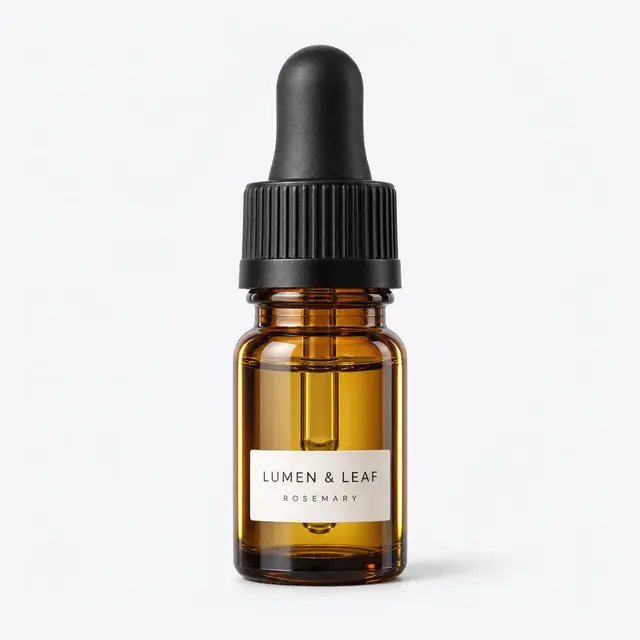
The Series 5570 sits in the middle of our amber dropper family: a 15 ml-class bottle with the softly rounded shoulder and compact proportions that apothecary buyers instantly recognize. The mould itself is a compact one — rich amber glass, a short cylindrical body melting into a curved shoulder, and a continuous-thread neck sized for standard dropper assemblies. This page is written for brand owners and formulators choosing primary packaging for reactive actives: vitamin C serums, retinol oils, acid exfoliants, and concentrated botanical blends. If your formula is the kind that fails stability testing in the wrong container, the 5570’s combination of amber UV filtering, inert soda-lime glass, and closure flexibility is the practical answer.
The 15 ml Sweet Spot for Active Formulations
Fifteen millilitres is not an arbitrary size — it is the capacity that formulators of high-activity products gravitate toward, for sound chemical reasons. L-ascorbic acid, retinoids, and many botanical antioxidants begin degrading from the moment the bottle is first opened and oxygen enters the headspace. A 15 ml fill gives a typical facial-serum user four to eight weeks of daily application, which is close to the realistic in-use stability window of an un-preserved or lightly preserved active. Selling the same formula in a 50 ml bottle does not just risk customer dissatisfaction; it generates the returns and one-star reviews that quietly kill a SKU. The 5570’s compact body also keeps unit cost and shipping weight low enough to support mid-range pricing on products with expensive actives.
Formula Compatibility: Glass Where Plastic Fails
The reason serious active formulations ship in glass rather than plastic comes down to permeation and interaction. Essential-oil components such as limonene and pinene can stress-crack certain plastics, plasticizer migration from low-grade polymer droppers can contaminate a clean formula, and oxygen transmission through plastic walls quietly oxidizes the very actives the customer paid for. Amber soda-lime glass is effectively impermeable to oxygen and water vapour, chemically inert against oils, alcohols, glycols, and the weak organic acids used in exfoliating toners, and it adds no extractables beyond trace ions that any competent stability protocol will screen for. The amber colour itself is functional: it filters the UV and short-wavelength visible light that accelerates photodegradation of retinol, ascorbic acid, and many essential-oil constituents.
That said, no responsible packaging supplier claims universal compatibility. High-concentration acid peels, undiluted phenolic oils, and high-pH formulas each deserve a real compatibility test: fill the 5570 with your bulk, store at elevated temperature for four to twelve weeks, and check appearance, assay, odour, and closure torque retention. We support this with free samples precisely because passing your own stability protocol is the only evidence that matters to your safety assessor under EU Cosmetics Regulation (EC) No 1223/2009.
Closure and Pipette Selection
The neck finish shown is a continuous-thread design in the DIN 18 class, which accepts the full range of standard dropper hardware. For active serums, we typically pair the 5570 with a glass pipette and a silicone or nitrile bulb — both elastomers resist swelling in oil-based formulas better than natural rubber. Tamper-evident dropper caps add a visible safety band for retail channels, and child-resistant closures are available for blends that regulators or retailers flag. Pipette length and tip style (straight, bent, or calibrated) are matched to the bottle’s internal height so users can draw the final dose without the tip jamming into the base. All thread dimensions are confirmed on the technical drawing at quotation, and we recommend validating any closure you already own against that drawing.
Quality Control You Can Audit
Each production lot of the 5570 is released only after passing a documented inspection protocol. Annealing quality is checked by polariscope to ASTM C148 so bottles survive capping torque and transit drops without delayed stress failure.Cosmetic buyers receive material declarations and compliance documentation to support their product information file obligations, and UV transmission data for the amber glass ships with the quotation package. Our broader quality approach applies the same discipline across the catalogue, whether you order this bottle or a 100 ml refill format.
Positioning the 5570 Inside a Product-Line Ladder
Smart oil brands rarely sell a single size. A typical ladder runs from a 5 ml trial vial through a 15 ml mid-size to a 30 ml retail hero, and the 5570 owns that middle step. The mid-size is where sampling converts to loyalty: a customer who finished a trial vial buys the 15 ml to test a full course of treatment, and only then commits to the larger refill. Because the 5570 shares the same amber glass, neck finish family, and decoration options as its larger and smaller siblings, the whole ladder can carry one coherent visual identity on shelf and in thumbnails. That consistency matters more than most founders expect — marketplaces and retail buyers read a matched size range as the mark of a serious brand rather than a one-product experiment.
Commercial Terms and How to Start
The 5570 runs from a stock mould, which keeps minimum order quantities accessible for growing brands; the logic behind our MOQ structure is laid out on the glass bottle MOQ explained page. Samples with your chosen dropper assembly ship within days so you can begin compatibility testing immediately. Decoration options include silk-screen printing, hot stamping, and frosting — the rounded shoulder takes one-colour screen prints particularly well. For brands planning their first import, our guide to importing glass bottles from China covers lead times and shipping. Send your annual volume estimate and closure preference via the contact page and we will return a full quotation with drawings.
Frequently Asked Questions
Is the Series 5570 suitable for vitamin C or retinol serums?
Yes, this is one of its primary use cases. Amber glass filters UV light that degrades retinoids and ascorbic acid, and the inert glass wall adds no extractables. We still recommend running your own 4-12 week stability test on filled samples, since formula-specific factors (pH, solvents, preservatives) determine real-world shelf life.
What is the MOQ for the 15 ml Series 5570 bottle?
As a stock-mould item, plain amber 5570 bottles typically start at 10,000 pieces, with trial quantities possible for new customers. Decorated versions (printing, frosting) may require a higher MOQ per design. Contact us with your volume and we will confirm exact terms in the quotation.
Can I test samples with my formula before ordering?
Absolutely. We provide free bottle samples fitted with your chosen dropper assembly; you cover only courier cost. Samples ship in 3-5 working days, giving you time to run compatibility, dosing, and label-fit checks before the production order.
Which closures are available for this bottle?
The DIN 18-class continuous-thread neck accepts glass pipette droppers with silicone or nitrile bulbs, tamper-evident dropper caps, child-resistant dropper closures, and orifice reducers. For oil-based actives we recommend silicone or nitrile bulbs over natural rubber. Pipette length is matched to the bottle during quotation.
Does the amber glass meet EU cosmetic packaging requirements?
Our amber soda-lime glass supports compliance with EU Cosmetics Regulation (EC) No 1223/2009. We provide material declarations and migration-relevant documentation for your safety assessor’s product information file. The final compatibility assessment between formula and packaging remains part of your product safety evaluation.
How long does production and shipping take?
Plain bottles from the stock mould ship approximately 25-35 days after deposit and drawing approval; decoration adds about 10-15 days. Sea freight to major US or EU ports typically adds 25-40 days. We quote lead times per order and can discuss air freight for urgent launches.