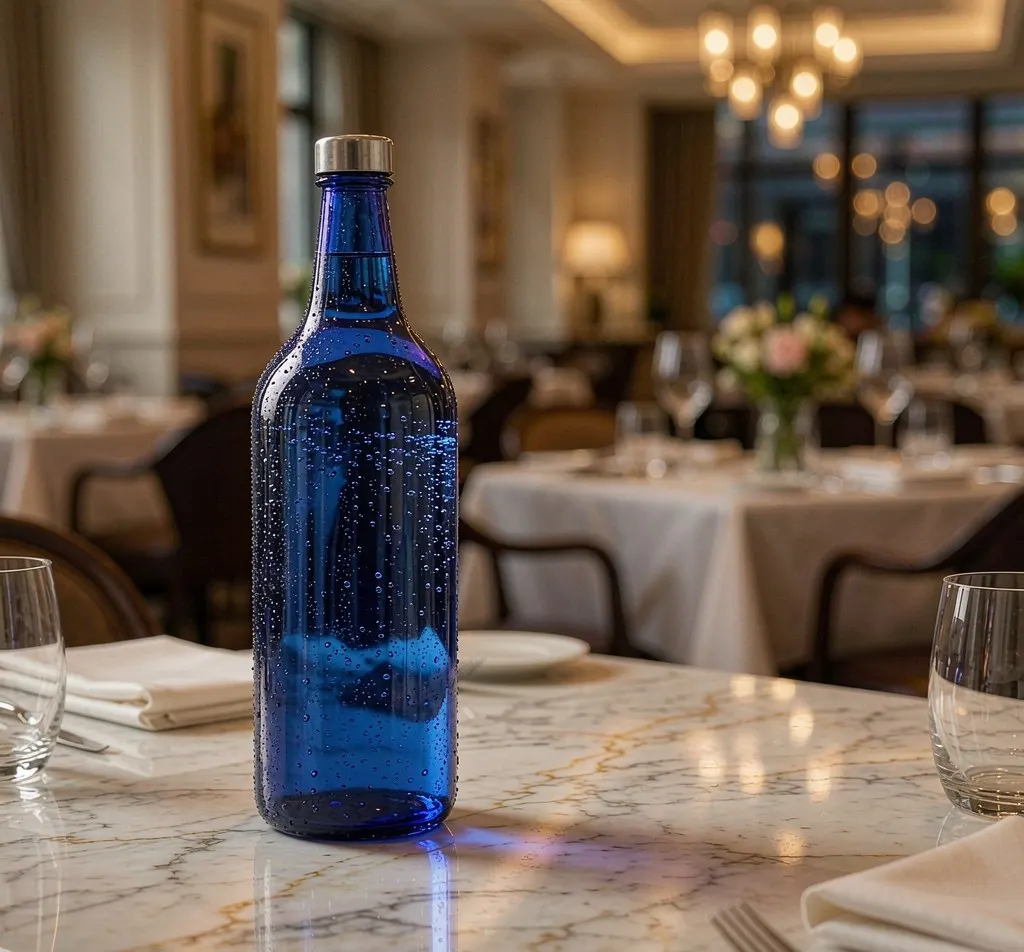
For a blue glass water bottle, the first thing to fix in the specification is how the glass gets its colour: cobalt oxide melted into the batch (in-mass colouring) gives a blue that cannot wear off, while a blue coating on clear glass can. In-mass cobalt glass at a 3mm wall blocks approximately 97% of UVB and 85% to 90% of UVA, yet still lets through 20% to 30% of visible light. After colour, the decisions are capacity (250ml to 1 liter), closure (ROPP screw cap, 26mm crown or swing-top) and how far the glass weight can come down before the bottle stops feeling substantial.
In-mass cobalt or a blue coating
Two blue bottles can look the same on the day they are packed and behave very differently a season later. The difference is where the colour sits.
In-mass colouring means cobalt oxide, typically 0.02% to 0.05% of the batch by weight, is dissolved into the molten glass at approximately 1,500°C. The cobalt ions sit inside the glass network, so the colour is the material itself. It does not scratch, peel, fade or leach, and a bottle left in a display window for 20 years stays the same blue. This is the route to take whenever bottles will be washed and refilled, for example a hotel room-service programme where each bottle goes through a commercial dishwasher 200 or more times per year.
The cost of in-mass colour is paid at the glassworks. The whole furnace runs blue, so the plant has to dedicate a campaign to the colour or go through a changeover that produces transition glass, which is recycled as cullet. That is why cobalt projects are scheduled around a plant's colour campaigns rather than slotted in at will.
Surface coating starts with a clear flint bottle that is sprayed or dipped in an organic or ceramic-based blue layer after forming. The weaknesses show up in use. Coatings scratch during case packing and transit, break down under alkaline dishwasher chemistry, and vary in shade from batch to batch because the layer thickness depends on spray settings. In a refrigerated display with condensation, or in nightly hotel washing, wear can appear within 3 to 6 months.
Coating is still a reasonable choice for promotional or cost-sensitive runs, provided it is chosen knowingly. On custom glass water bottle projects we specify in-mass colour for cobalt by default and write it into the purchase order, since "blue glass" on its own does not tell a plant which process you expect.
How cobalt compares with amber, green and flint on light
Light protection is judged in two bands: ultraviolet, roughly 280nm to 400nm, and visible light, roughly 400nm to 780nm. A water brand wants enough UV blocking to support a stability claim and enough visible transmission that the bottle does not look like a medicine container. The figures below are typical spectrophotometer readings for 3mm-wall container glass.
| Glass colour | UVB blocked (280–320nm) | UVA blocked (320–400nm) | Visible light transmitted | How it reads on shelf | Typical water use |
|---|---|---|---|---|---|
| Cobalt blue | ≈97% | ≈85–90% | ≈20–30%, peaking in the 450nm blue band | Pure, cool, heritage | Mineral and sparkling water, hotel and fine-dining service |
| Amber | ≈99% | ≈95–98% | ≈10–15% | Pharmaceutical, functional | Functional or infused water, light-sensitive formulations |
| Green | ≈80% | ≈60–70% | ≈60–75% | Natural, traditional, European | Sparkling water, mid-range mineral water |
| Flint (clear) | ≈10–20% | ≈5–10% | ≈90–92% | Clean, minimalist | Purified water, design-led brands |
Cobalt comes close to amber on UVB and stays well ahead of green on UVA, while keeping the glow that comes from light passing through the 450nm band. Water is far less sensitive to light than beer or wine, so the benefit matters most for alkaline water, spring water with a delicate mineral profile and water with botanical infusions. For in-mass cobalt glass, a label claim of "up to 90% of UV radiation blocked" is consistent with these readings; it is not a claim to make for a coated flint bottle without testing it.
Capacities and glass weights
Each size belongs to a serving occasion, and most blue-bottle water ranges run two to four sizes side by side. The weight ranges below run from lightweight designs at the low end to traditional heavier ones at the top.
| Capacity | Where it is used | Glass weight |
|---|---|---|
| 250ml (8.4oz) | Airline and hospitality single serve: tray service, minibars, conference catering | 180g to 210g |
| 330ml (11.2oz) | The European restaurant size and the most common cobalt water bottle worldwide | 240g to 280g |
| 500ml (16.9oz) | Crosses between on-premise and retail | 310g to 360g |
| 750ml (25.4oz) | Fine-dining table bottle, the size tied to the Saratoga-style cobalt silhouette | 420g to 520g |
| 1 liter (33.8oz) | Family-style dining and retail | 520g to 680g |
All five sizes exist as standard moulds, which you can see in the glass water bottle range, and any of them can be run in in-mass cobalt with embossing, debossing or screen printing.
Choosing the closure by sales channel
The neck finish is decided together with capacity, because it fixes how the bottle is filled, opened and reused.
ROPP screw cap, 28mm or 30mm
An aluminium roll-on pilfer-proof cap is tamper-evident and resealable, and it runs on high-speed filling lines at 200 to 600 bottles per minute. Caps can be coloured to order; matte blue or silver on cobalt glass is common. Grocery and e-commerce shoppers expect to reseal the bottle, so this is the usual retail choice.
Crown cap, 26mm
The 26mm crown is the sparkling water finish. It is rated for internal pressure of 6 bar and beyond, which covers carbonation of 4 to 8 grams of CO2 per liter. It needs an opener, so it suits restaurants and bars more than on-the-go drinking.
Swing-top
A porcelain or plastic stopper with a rubber gasket on a wire bail is the standard for refillable hotel and restaurant bottles. It costs more than a crown, but hotels running swing-top programmes report 150 to 300 reuse cycles per bottle before it is retired for cosmetic reasons, and the closure cost is spread across those cycles.
Specifications by type of programme
Three kinds of buyer account for most cobalt water bottle enquiries, and each puts a different line of the specification first.
- Still mineral and spring water brands tend to follow the pattern set by Saratoga-style bottles: 330ml and 750ml sizes, in-mass cobalt, a small paper label or direct screen print, and a silver or white closure. How the bottle fits with filling and co-packing is covered in our overview of glass bottled water.
- Sparkling and carbonated mineral water brands need pressure-rated crown finishes in 330ml and 750ml, with the glass designed for 6-bar service pressure plus a safety margin. Bubbles show up strongly through blue glass, which helps the product photograph well.
- Hotels, resorts and fine-dining rooms usually run refillable swing-top bottles in 500ml or 1 liter, filled on site with filtered or mineralised house water. These call for a reinforced heel and glass that tolerates commercial dishwashing at 65°C to 82°C.
Reducing glass weight without losing the feel
For empty bottles shipped by sea, the glass is what you pay to move. At the legacy weight of 520g, a 750ml cobalt bottle loads at roughly 38,000 to 42,000 pieces in a 40-foot high-cube container before the 26-tonne payload limit is reached. Taking weight out of each bottle is the most direct way to lower freight per piece and the carbon figure that hotel chains now ask for in procurement scorecards.
Narrow-neck press-and-blow forming makes this possible. Average wall thickness comes down from a traditional 3.2mm to 3.5mm to 2.2mm to 2.6mm, while vertical load strength stays above 180kg, enough for 6-high pallet stacking. On a 750ml bottle that means 420g to 460g against 520g; on a 330ml bottle, 240g against 280g, a saving of 40g per unit.
The risk is a bottle that feels thin in the hand, which works against everything the colour is doing for the brand. The usual answer is to thin the sidewall and keep the punt and heel heavy, so the bottle still lands on a table with a solid sound and feels weighted at the base. Before approving a lightweight drawing, ask for vertical load test results and put samples in the hands of people who were not in the design meetings.
What to write into the specification
Subjective words like "high quality" give a plant nothing to be held to. When we check drawings and match a cobalt project to a plant, these are the parameters we ask to have stated:
- Colouring: in-mass cobalt oxide at 0.02% to 0.05% batch loading, with ΔE colour variation held within 1.5 across production lots.
- Capacity: 250ml, 330ml, 500ml, 750ml or 1L, with brimful capacity tolerance of ±3%.
- Wall and strength: 2.2mm to 3.5mm wall depending on the lightweighting grade, and a vertical load rating of 180kg to 250kg.
- Thermal performance: annealed for a thermal shock differential of 42°C, and suitable for hot-fill up to 60°C where the product needs it.
- Shipping terms: FOB Shanghai or Ningbo is the usual basis.
Decoration is specified at the same time. Screen printing runs from single-colour to four-colour and can be rated for 100-plus dishwasher cycles; acid etching gives a frosted surface; embossing or debossing is cut into the mould and lasts as long as the bottle. Settle the closure and the label layout before the mould is signed off, since the neck finish and the label panel geometry are the two most expensive things to change once tooling exists.
FAQ
Does the blue colour wear off?
Not if the glass is coloured in-mass. The cobalt is part of the glass, so hundreds of commercial wash cycles and decades of light leave it unchanged. A coated bottle is a different product and can show wear within 3 to 6 months of aggressive washing.
What is the minimum order quantity for cobalt blue water bottles?
Minimums are quoted per project. They depend on whether you use a standard mould or a new one, the plant's cobalt furnace campaign, the decoration and the total quantity.
How long do production and shipping take for a first order?
Timing is also quoted per project, once the mould, decoration, the plant's colour schedule and the freight terms are confirmed.
Is cobalt glass safe for sparkling water under pressure?
Yes, when it is specified for it. Cobalt does not alter the mechanical strength of glass; pressure performance comes from wall design and annealing. Sparkling-rated 330ml and 750ml bottles are designed and pressure-tested for service at 6 bar with a safety margin. Confirm the rating in writing and compare it with your own carbonation specification.
Which decoration survives commercial dishwashing?
Mould embossing or debossing, fired ceramic screen printing rated for 100-plus wash cycles, and acid etching. Organic inks and applied labels break down in dishwasher chemistry at 65°C to 82°C, so keep them for single-use retail bottles rather than refill programmes.