For the full range, see empty glass bottles wholesale: liquor, wine, beer, oil and cosmetic bottles plus food jars, all quoted per project.
Bulk glass bottles with caps should be bought as one sealed system: the cap has to be validated against the bottle's actual finish drawing, and each lot should arrive with a torque and vacuum test report for the pair. Production tolerance on the thread outer diameter is typically ±0.2mm, so a bottle and a cap from unrelated suppliers can both be in tolerance and still leak. The closure family follows from the fill process, and the finish standard follows from the closure.
Closure families and the finishes they need
Three closure types cover most capped glass bottles and jars, and each demands its own neck finish (the moulded top of the bottle that the closure grips).
| Closure | Size range | Material | How it seals | Typical use |
|---|---|---|---|---|
| Continuous-thread (CT) screw cap | 18–70mm | Polypropylene or aluminum shell | Screws onto a GPI/SPI 400-series finish and compresses a liner | General purpose |
| Lug twist-off cap | 38–82mm | Tinplate with plastisol lining | Three to six lugs lock under the lugs on the finish; under steam the plastisol flows into the finish and forms a hermetic vacuum seal, shown by a safety button | Hot-filled jams, pickles and sauces |
| Tamper-evident ROPP aluminum cap | 18–31.5mm | Aluminum | Rolled onto the finish under pressure, which cuts a pilfer band that shows first opening | Spirits, wine under Stelvin, pharma-adjacent products |
For hot-fill at 85–92°C, the lug twist-off with plastisol lining is the default, because the compound flows to make the vacuum seal and the button confirms it. CT caps with heat-rated liners suit cooler fills below 70°C.
Example bottle and cap pairings
The sets below show how capacity, glass weight, finish and closure usually go together. Crown and swing-top formats appear here as well, since they are common on beverage bottles.
| Bottle | Capacity | Glass weight | Finish | Closure |
|---|---|---|---|---|
| Round sauce bottle, flint | 300ml | 220g | 38mm lug | Tinplate twist-off, plastisol, button |
| Preserving jar, flint | 500ml | 300g | 63mm lug | Tinplate twist-off, plastisol |
| Beverage longneck, amber | 330ml | 280g | 26mm crown | Crown with PVC-free liner |
| Swing-top bottle, flint | 500ml | 420g | Swing finish | Wire bail and gasket assembly |
| Spirit bottle, extra-flint | 100ml | 130g | 28mm ROPP | Aluminum pilfer-proof cap |
| Syrup bottle, amber | 250ml | 200g | 28-400 CT | PP cap with induction liner |
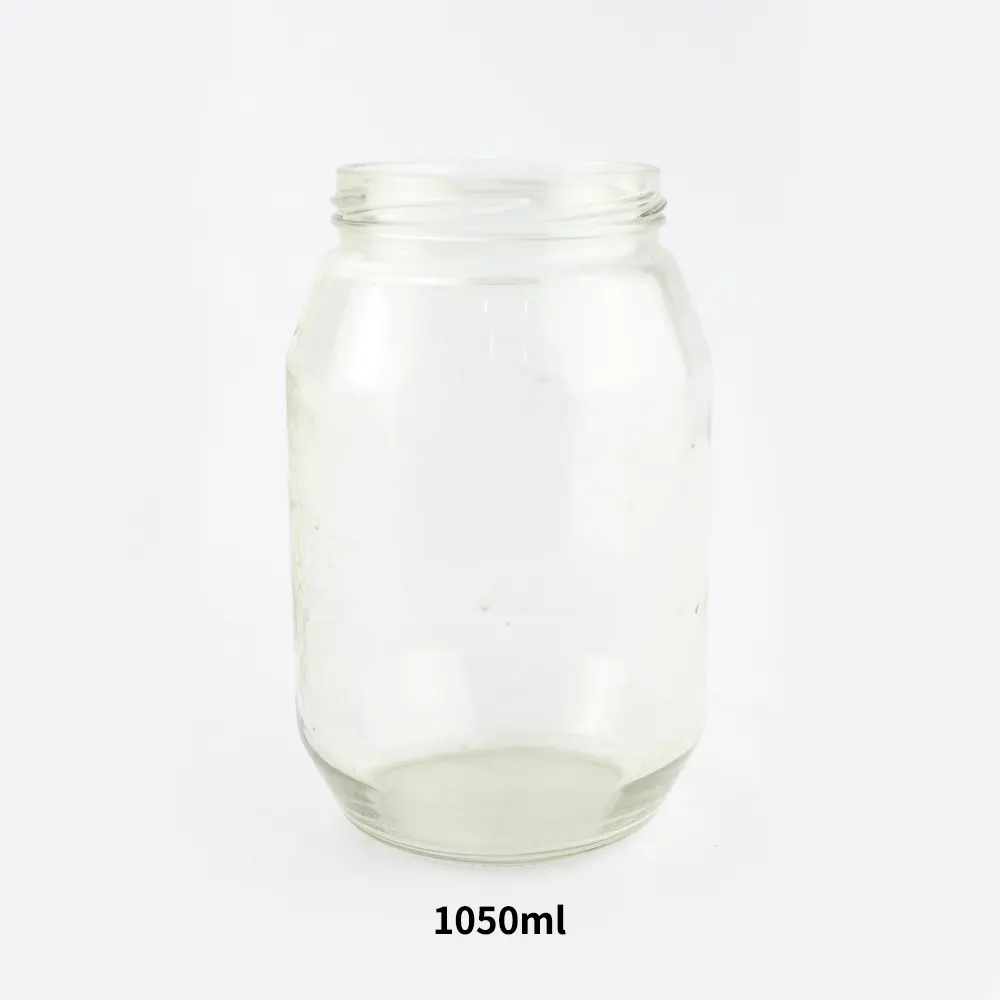
Wide-mouth formats are covered in the glass jars with lids collection. Wine and spirit projects that use stoppers instead of caps belong with bulk glass bottles with corks, and the base glass options are set out under flint glass bottles.
Finish dimensions and tolerance stacking
A glass finish is defined by a GPI or SPI drawing with four controlled dimensions:
- T — the outer diameter of the thread
- E — the diameter at the thread root
- H — the height of the finish
- the bore
The cap maker designs liner compression around that same drawing. Trouble starts when the bottle comes from one plant and the cap from another. A finish at the top of its tolerance band, paired with a cap at the bottom of its own, leaves the liner under-compressed. The result is a slow leak that may only show after three weeks in a warm warehouse, long after incoming inspection has passed the goods.
Torque values to put in the specification
Application torque depends on cap diameter. For CT caps the working ranges are roughly:
| CT cap diameter | Application torque |
|---|---|
| 28mm | 8–12 in-lbf |
| 38mm | 10–16 in-lbf |
| 48mm | 14–20 in-lbf |
Retention matters more than the application figure. Measure removal torque after 24 hours and require it to stay above 60% of the application torque. A cap that loses more than that is relaxing on the finish, which points to a liner or dimension mismatch.
Reasons to ship bottle and cap together
Buying both parts through one supply route brings three practical gains.
- Testing as a pair. Caps are applied to sample bottles from the same production lot, and the torque window and vacuum retention are reported for the combination, not for each component alone.
- Better use of the container. Caps are dense and travel in flat cartons that fit the void above nested bottle pallets. This recovers 8–15% of container cube that a bottle-only load leaves empty.
- One party to answer for a seal failure. There is a single corrective action, not a bottle maker and a cap maker blaming each other across time zones.
For co-packers, we can also arrange caps kitted per pallet of bottles, so a line changeover needs no counting.
What to include in the enquiry
- Name the closure family and finish standard, for example GPI 400 28mm, TO-43, 26mm crown or 30×60 BVS. A photo alone is not a specification.
- Describe the fill process: hot-fill temperature, carbonation, vacuum requirement, retort. These choose the liner system.
- Ask for the finish drawing with T, E and H dimensions, and require the cap to be validated against it with a torque report per lot.
- Request disclosure of the liner material (PVC-free plastisol, PE foam, induction foil) and confirm it suits your product chemistry.
Send the finish drawing or a bottle photo, the fill process and the quantity through the quote request form. We answer with the closure options, a liner recommendation, the torque window and a combined container plan.
Buyer FAQ
How can I identify the finish on a bottle I already use?
Measure the T dimension with calipers, then count the thread turns and the lugs. Send those figures with a photo of the finish profile. We match them to the GPI/SPI drawing and confirm the result in writing before any caps are quoted.
Will one cap fit bottles from two different plants?
Sometimes, but it is a gamble. Both bottles can be within tolerance while stacking in opposite directions, which gives 20–30% variation in liner compression across your stock. If dual-sourcing the bottle is unavoidable, have the cap validated on the worst-case finish from each plant.
Are caps counted in the bottle minimum order?
Minimums are quoted per project. They depend on the mould and on the line the bottle runs on.
How long do bottles and caps take together?
Timing is quoted per project once the mould, the decoration and the line schedule are confirmed.