The library holds eight working documents: a product catalog, a bottle size reference, a specification checklist, a closure matching table, inspection report templates, a custom development guide, a packing and export documentation pack, and a sample request template. If you take only one, take the specification checklist, because it fixes the eleven fields that let you compare quotes line by line. The short references are linked directly, and the larger files are sent on request so that you receive the edition for your product family and destination market.
Which document to use at each project stage
| Stage | Document | What you do with it |
|---|---|---|
| Discovery, before the first RFQ | Product catalog | Shortlist candidate models and note their finish codes |
| Product development and line extensions | Bottle size reference | Fix capacities on standard sizes before they are locked |
| RFQ | Specification checklist | Give every supplier the same complete brief |
| Evaluation, before physical testing | Sample request template | Order the right samples the first time |
| Sampling | Closure matching table | Validate bottle and closure as one interface |
| Moving from stock to a proprietary shape | Custom development process guide | Prepare for the first custom project meeting |
| Pre-shipment and receiving | Inspection report templates | Inspect against the same format as the supplier side |
| Logistics planning | Packing and export documentation pack | Brief the forwarder and the warehouse |
Catalog and size reference for choosing a package
The catalog arranges the range we source into six families: spirits and liquor bottles from 50 ml minis to 1.75 L; wine and sparkling formats in Bordeaux, Burgundy and flute shapes; crown-finish and swing-top bottles for beer and beverages; food jars for honey, preserves and canning; cosmetic and fragrance glass; and heat-verified candle vessels. Every entry gives capacity, weight, finish code and the colours available. It follows the online product collections, so any model printed in it can be sampled.
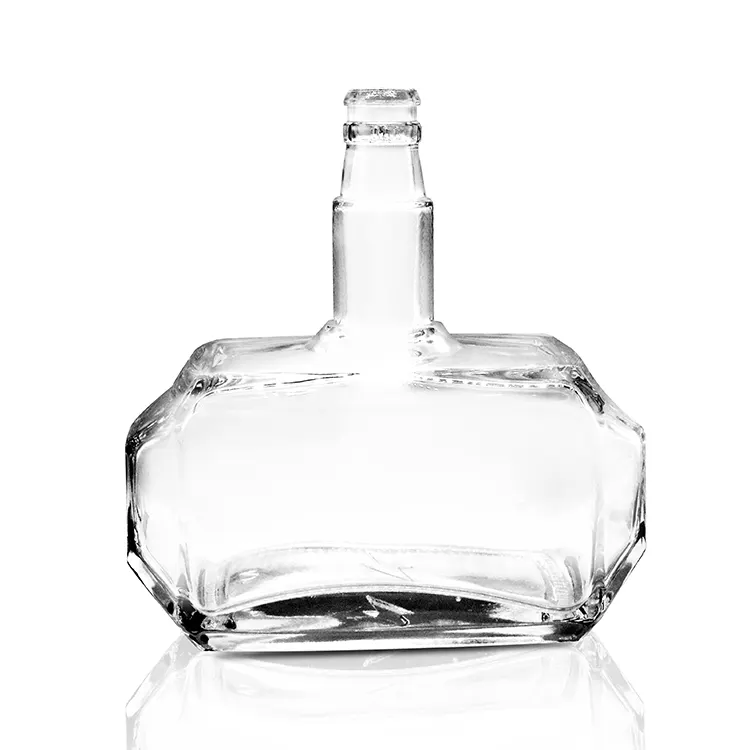
A practical way to work is to pick two or three candidates for each product and write down their finish codes for the closure table. If your project sits in one family, ask for that section alone. The extract is usually more useful than the full volume.
The size reference is a conversion chart of standard container-glass capacities, running from 30 ml and 50 ml through 375 ml, 500 ml, 700 ml and 750 ml to 1 L and 1.75 L, each with its US fluid ounce equivalent. It also shows which uses each size dominates:
- 50 ml for miniatures and perfume
- 375 ml for half-bottle wine and higher-end spirits
- 750 ml for wine and liquor
- 1 L for value spirits and syrups
Use it to move your fill volume to the nearest standard capacity. An odd size means a new mould, while a standard one keeps you on tooling that already exists. The online size guide covers the trade-offs between capacity, weight and shelf presence in more depth.
Specification checklist and sample request for briefing suppliers
The checklist is a single page with eleven fields: product family, capacity, brimful volume, weight, finish type and code, glass colour, decoration, closure, quantity per order, destination port and packing preference. It is the document behind our RFQ checklist for bottles and jars.
Fill it in once, which takes about ten minutes, and attach it to each RFQ, whether it goes to us or to another supplier. With all eleven fields answered, nobody has to guess, and every offer you receive describes the same item.
The sample request template is a ready-to-send form with the details needed to pull the correct samples: model numbers or reference photos, quantity per type, closure preferences, courier account details and a delivery address laid out the way express carriers require. Complete it and paste it into an email or the contact form.
Closure matching table
This table cross-references standard neck finishes with the closures that fit them. The finishes covered are GPI 400 and 410, MCA, PP28, ROPP 28×15 and 30×60, twist-off 38/43/48/53/58/63/70/82, cork-mouth bores and dropper finishes. The closures are aluminum screw caps, plastic caps, tamper-evident bands, natural and technical corks, bar-top stoppers, lotion pumps and glass droppers.
After shortlisting bottles, look up each finish code and note two closures you would accept. When the bottle and closure requirements arrive together, we can send matched sets in the first sample shipment instead of testing the two parts in separate rounds. For the sealing mechanics behind the table, read the guide to choosing a closure.
Inspection report templates
These follow the pre-shipment format we use on production lots. They set sampling levels under AQL 2.5 for major defects and 4.0 for minor ones, and cover:
- dimensional checks on capacity, height, diameter and finish
- visual defect categories: seeds, stones, blisters, checks and bird swings
- annealing verification
- functional tests for closure torque and, where relevant, thermal shock
You can adopt the template as your receiving checklist or give it to a third-party inspector. It is written in standard AQL sampling language, so any professional inspection company can carry it out, and the resulting report lines up item for item with the one produced on our side. Shared criteria remove most of the ground for quality disputes. The method is set out on the quality inspection page.
Custom development process guide
This PDF is for brands replacing stock packaging with their own shape, a step that usually comes at the second or third reorder. It explains how the cost of a mould program is structured, who owns the tooling and on what terms, and the points in the process where a change of direction is still possible.
Read it before the first custom project meeting. It turns a general wish for a proprietary bottle into an ordered series of decisions. The technical detail is on the mould development page.
Packing and export documentation pack
The pack contains the standard packing specification: carton and divider formats, pallet patterns, and container loading plans with piece counts per 20 ft and 40 ft container for common bottle families. It also lists the export documents a first-time importer should expect, namely the commercial invoice, packing list, bill of lading, certificate of origin and, where required, a fumigation certificate.
Pass it to your freight forwarder and warehouse team before the first shipment lands, so racking, pallet handling and customs clearance are arranged in advance. The packing specification page covers the same ground online.
Frequently asked questions
Is there a charge for any of these files?
No. Nothing in the library is charged for. The full catalog, the custom process PDF and the documentation pack are sent by our team instead of being linked, so that the edition matches your product family and destination market.
How up to date are the files?
The capacity, finish and closure references describe industry standards that rarely change. The catalog is revised as models are added or retired. If your copy is more than a year old, ask for a new one before you settle a shortlist.
How do I request the full set?
Tell us your product family and project stage through the contact form. We reply with the matching catalog extract, checklist and templates together.