A glass bottle or jar RFQ that can be quoted firmly covers six groups of fields: container geometry, glass and colour, neck finish and closure, decoration, packing and logistics, and compliance with commercial terms. A one-line request such as "please quote 500ml bottles" forces a supplier either to guess with a safety margin or to send back a long list of questions. The fields below are category-neutral, so they apply to any bottle or jar. Fill in what you know and mark the rest "to be confirmed".
The six fields to put in a first message
If you only have time for a short inquiry, these are the items that let a supplier place your project in the right mould family and the right shipping lane:
- Product and fill process, with both nominal and brimful capacity
- Dimensions, or a photo or drawing of the container you have in mind
- Neck finish standard and closure type
- Quantity per SKU, as a first order and as an annual volume
- Destination port and Incoterm
- Compliance market (EU, US or other) and what decoration you intend
A rough brief with these points is enough to start. You can send it through our quote request form, which is also where the spirits-specific fields for a vodka bottle project are collected.
Section A: container geometry
Geometry decides which mould library your request reaches, so measure it instead of describing it.
- Product and fill process. Still, carbonated, hot-fill, pasteurized, cosmetic or candle. This fixes whether ISO 7458 pressure resistance or ISO 7459 thermal-shock resistance applies, and it has to be known before pricing means anything.
- Nominal and brimful capacity, in milliliters. A "500ml bottle" can be a 500ml fill with 530ml brimful, or 500ml brimful. That is a 6-percent difference in glass weight, and the two readings call for different moulds.
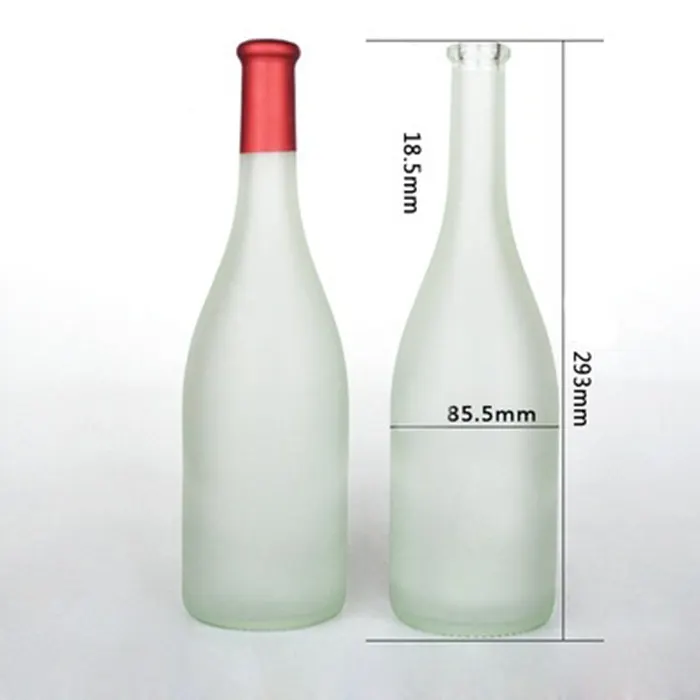
- Dimensions. Height and maximum diameter, plus the shoulder profile, sketched or described.
- Target glass weight. A figure in grams or an acceptable range.
- Drawing, sample or reference product. One photograph with a ruler in the frame does more than three paragraphs of description.
- Filling-line constraints. If a co-packer fills for you: the maximum diameter the conveyor guides accept, the finish height the capping chucks need, and the label panel dimensions.
Section B: glass and colour
- Glass colour. Flint (clear), extra-flint (low-iron, chosen for clarity), amber, antique green, dead-leaf green, cobalt blue or black. Batch cost and stock availability differ for each.
- Surface. Standard fire-polish, or the higher polish used for fragrance work.
- Recycled content or lightweighting targets. Cullet ratios typically run 30 to 60 percent. Lightweighting gives up some ISO 7458 pressure margin in exchange for less glass, so state your target and let the engineers propose the balance.
Section C: neck finish and closure
A finish that does not match the closure is the costliest mistake an RFQ can carry. "Screw cap" is not a specification.
- Finish standard. Give the exact designation: GPI 28-400, 38mm twist-off lug, 63mm lug, FEA 15 crimp, 18-415, or a cork finish with its bore diameter.
- Closure type and source. Say whether the closure comes from the glass maker, from your own closure vendor, or should be quoted. If you already hold closures, send samples or the drawing.
- Sealing requirements. Vacuum seal for hot-fill, pressure retention for carbonation, child-resistant or tamper-evident features, and the liner or compound type.
- Application torque and retention. Include these where your co-packer's line defines them.
If you are still choosing between closure families, our closure selection hub sets out the reasoning behind each of these fields.
Section D: decoration
- Processes, in order of application. Screen printing (with the number of colours), frosting or acid-etch, spray coating, hot stamping, metallization, decals, and embossing in the mould.
- Artwork status. Print-ready vector files, a design in progress, or a concept only. This tells the supplier whether decoration development can run alongside sampling or has to follow it.
- Colour references. Pantone codes for prints and coatings, and whether you will approve a physical limit panel. You should.
- Coverage area. Full body, shoulder band, or label panel only. Decoration is costed per layer and per unit of coverage, so "some decoration" cannot be quoted.
Section E: packing and logistics
- Packing. Preferred pieces per carton, retail-ready or bulk, and export grade. Carton ECT and divider requirements are set out in the packing specification for glass bottles.
- Destination. Country and port, with your preferred Incoterm (FOB, CIF or DDP).
- Timeline. A target ex-works or arrival date written as a date. "ASAP" gives a planner nothing to work with.
- Palletization. Standard export pallets, presswood, or any racking limits in your warehouse.
Section F: compliance and commercial terms
- Food-contact market. EU (a 1935/2004 Declaration of Compliance with migration reports), US (FDA 21 CFR documentation), or another market. Note destination certificates here too, such as SABER for Saudi Arabia; the export documentation guide lists what each market asks for.
- Quality agreement. State whether you bring your own defect catalog and AQL plan or will accept the supplier's standard. The one we work to is described under quality inspection for glass packaging.
- Payment terms. The terms you normally work under, and whether letters of credit apply.
- Quotation format. Ask for a structured quote: ex-works, decoration per layer, packing, and mould costs if any.
Extra fields for modified stock and custom moulds
The mould route changes what the RFQ has to contain. Decide which route you are asking about, or ask for more than one to be quoted side by side.
| Route | Extra RFQ fields | Stage it suits |
|---|---|---|
| Stock mould | None beyond sections A to F | Market test |
| Modified stock | Modification spec (finish, embossing) | Differentiation at volume |
| Full custom mould | 3D concept or drawing package, design-ownership terms | Flagship design program |
What a complete RFQ returns
Against a stock format, a complete RFQ comes back as data in the shape below. The values are representative, for planning only, and are confirmed against project drawings.
| Quoted field | Example: 750ml wine bottle | Example: 370ml food jar |
|---|---|---|
| Capacity (nominal / brimful) | 750 / 770 ml | 370 / 390 ml |
| Weight | 300 g ±10 | 280 g ±10 |
| Dimensions (H × max D) | ~293 × 76 mm | ~115 × 91 mm |
| Neck finish | Cork, 18.5 mm bore | 82 mm twist-off lug |
| Export packing | 12/carton, dividers, palletized | 24/carton, dividers, palletized |
| 40HQ loading | ~50,000 pcs | ~96,000 pcs |
| Unit price, decoration, freight | Quoted per project; decoration per layer, freight per lane | |
If an offer cannot be broken down into these lines, treat it as a number, not yet a quotation.
Sending the RFQ and comparing replies
Copy sections A to F into your inquiry template and make it your standard first message. Where you have no answer yet, write "to be confirmed" instead of deleting the field. An explicit TBC shows the supplier where you are flexible; a missing field gets filled with an assumption that tends to resurface later as a dispute.
Send every candidate supplier the identical document, because the whole purpose is that the replies can be compared. Before ranking them, convert each one using the landed-cost comparison in our glass packaging sourcing checklist.
Frequently asked questions
How do I specify a neck finish if I do not know the standard name?
Send the closure you plan to use: a physical sample, a drawing, or the closure supplier's part number. The finish designation (GPI 28-400, 63mm lug, FEA 15 and so on) can be identified from that and matched on the glass side.
Should prices be broken down or given as one landed number?
Ask for the breakdown: ex-works price, decoration per layer, export packing, mould or tooling costs if any, and freight to your port as a separate line. Structured offers can be compared line by line and show where one has been padded. A single landed figure hides how the cost is allocated. Work out landed cost yourself for the final ranking.
Can minimum quantity and timing be stated before the RFQ is complete?
No. Both are quoted per project, because they depend on the mould route, the line the mould runs on, the decoration and the freight terms. Giving your first-order quantity, annual volume and a target date in the RFQ is what allows them to be answered.
Is this checklist different from the vodka bottle RFQ guide?
Yes, on purpose. This checklist holds the universal fields that any bottle or jar needs. The vodka guide adds a spirits layer on top: the choice between bar-top and GPI finishes, heavy-base weight classes, decoration suites for spirits shelves, and the regulatory documents specific to alcohol packaging.