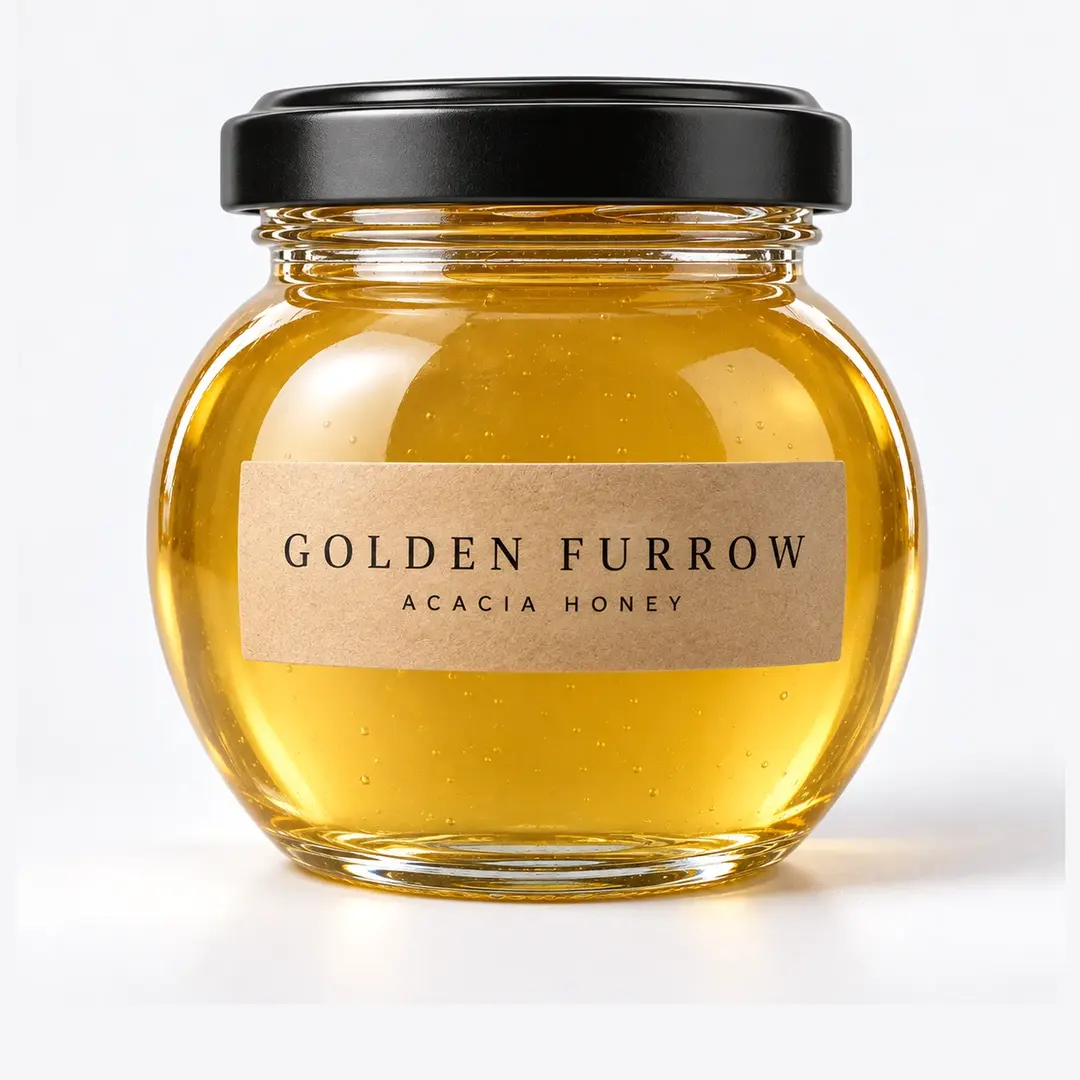
The 353 series is a round globe glass jar with a wide lug-finish mouth, built for honey packers, apiary brands, and specialty food companies that need packaging which protects honey quality in the warehouse and flatters it on the shelf. The spherical body shows off color and clarity like a lens, while the glass itself provides the inert, impermeable barrier that honey demands through months of storage, temperature swings, and the crystallization cycles every honey buyer eventually asks about.
Glass and Honey Crystallization: What Packers Should Know
Crystallization is natural: glucose separates from the supersaturated sugar solution and forms crystals. No container prevents it, but the container strongly influences how gracefully honey handles it. Glass is impermeable to moisture vapor, so water activity in the jar stays stable and the honey does not pick up humidity that accelerates fermentation at the surface. Glass is also chemically inert, adding no flavor and extracting nothing, which keeps the floral notes your customers paid for intact through the full shelf life.
When crystallization does occur, glass wins again. The consumer can stand the jar in warm water and re-liquefy the honey without worrying about plastic softening, warping, or leaching. The globe shape of the 353 series helps here too: there are no sharp corners where crystals lodge and seed further crystallization, and the smooth curved wall lets re-liquefied honey pour completely. For creamed honey, the wide mouth allows clean whipping, filling, and spooning of the fine-crystal product.
A Globe That Showcases Color and Clarity
Honey sells on appearance. Pale acacia, golden wildflower, deep amber buckwheat: each varietal has a color story, and the spherical wall of the 353 series acts like a display case. Light passes through the curved glass and the honey glows, an effect flat-sided jars only approximate. On a market stall or a gourmet shelf, a row of globe jars reads as premium apiculture rather than commodity packing.
The wide mouth is practical for the packer as well. Warm honey flows cleanly without stringing across a narrow neck, strainers and settling-tank spigots dose easily, and comb chunk or cut-comb products drop in without damage. Consumers appreciate the same opening at the table: a honey dipper or spoon enters and exits without touching the rim.
Sealing for Long-Term Storage
The lug (twist-off) finish on the 353 series takes metal caps with plastisol liners, forming a hermetic seal that locks out ambient humidity, the single biggest external risk to stored honey. For creamed and liquid honey sold at ambient, the vacuum-cap system also delivers the tamper-evident button that retailers increasingly require. Cap colors and printed lids are available to match your label palette, and we supply jars and matched caps from one order so neck-fit questions disappear. Exact neck dimensions and brimful capacity are confirmed on the technical drawing at quotation.
For hot-pack honey lines, the annealed soda-lime body handles normal warm-fill practice; your technologist should validate thermal-shock margin against your actual fill temperature, and we provide the wall-thickness map for that calculation.
Quality Control and Food-Contact Compliance
Each production run passes automatic dimensional gauging and camera inspection for seeds, blisters, and stones, backed by laboratory sampling. Thermal-shock resistance is verified per ASTM C149, annealing quality and residual stress are examined per the ISO 7459 polariscopic method, and internal-pressure resistance is sampled per ISO 7458 where required. The glass is food-contact soda-lime with no added lead or cadmium, and heavy-metal migration reports can accompany the shipment for EU and US regulatory files. Mouth concentricity and finish height are held tightly so your capper maintains vacuum consistency across the whole run.
MOQ, Packing, and Export Practice
The 353 series runs from a stock mold in standard flint glass, so there is no tooling charge. Jars ship in divider cartons on shrink-wrapped export pallets, with the container loading plan issued alongside your quotation. Before you brief purchasing, our glass jar MOQ explained page shows how furnace scheduling and decoration set minimum quantities for plain and printed jars.
If honey is your first import program, the practical guide to importing glass bottles and jars from China walks through Incoterms, marine insurance, and customs documents in plain language, so your first container arrives without surprises.
Beyond Honey
The globe format also suits premium jams, nut spreads, dessert sauces, bath salts, and candle programs that want a soft rounded silhouette. Many honey brands extend into these adjacent lines using the same jar family, keeping one procurement channel and a consistent brand block on the shelf.
Storage Guidance for Your Customers
Brands that educate buyers about honey storage reduce complaints and returns. On your label or insert, advise storing the jar at cool room temperature away from direct sunlight, keeping the cap tight between uses, and never introducing wet spoons, which raise local moisture and can seed fermentation. If crystals appear, a warm water bath restores liquidity without harming flavor; microwaving glass jars with metal caps is never recommended. These small notes turn a natural process into a trust-building conversation, and the 353 series globe jar is the right stage for it, because the glass forgives repeated gentle warming across the product’s whole life in the pantry.
Request Samples and Pricing
Send us your honey type, target fill weight, closure color, and annual volume, and we will return the technical drawing, a matched cap recommendation, and a packing plan. Samples from current production are available for fill and seal trials. Contact the export team via the contact us page and reference the 353 series.
Frequently Asked Questions
Does a glass jar prevent honey from crystallizing?
No container prevents crystallization, which is a natural process. Glass helps manage it: it is impermeable to moisture vapor, keeping water activity stable, and the jar can be stood in warm water to re-liquefy crystallized honey without any risk of the container warping or leaching.
Is the 353 globe jar good for creamed honey?
Yes. The wide mouth allows clean filling and spooning of fine-crystal creamed honey, and the smooth curved wall has no corners where crystals lodge, so the product empties completely.
What closure fits the 353 series?
A lug (twist-off) neck finish matched to metal caps with plastisol liners, giving a hermetic seal that locks out ambient humidity during storage. Neck dimensions are confirmed on the technical drawing, and printed or colored caps can be supplied with the jars.
Can I pack warm or hot honey in this jar?
Yes, within normal warm-fill practice. The annealed soda-lime body is sampled for thermal-shock resistance per ASTM C149, and we provide wall-thickness data so your technologist can validate the margin against your fill temperature.
What is the MOQ and is there a mold fee?
The 353 series runs from a stock mold, so there is no tooling charge. MOQ depends on furnace scheduling and decoration; see our MOQ explained page for how quantities are calculated for plain and printed jars.
What other products suit the globe shape?
Premium jams, nut spreads, dessert sauces, bath salts, and candles all use this silhouette. Many honey brands extend adjacent product lines in the same jar family to keep one procurement channel and a consistent shelf presence.