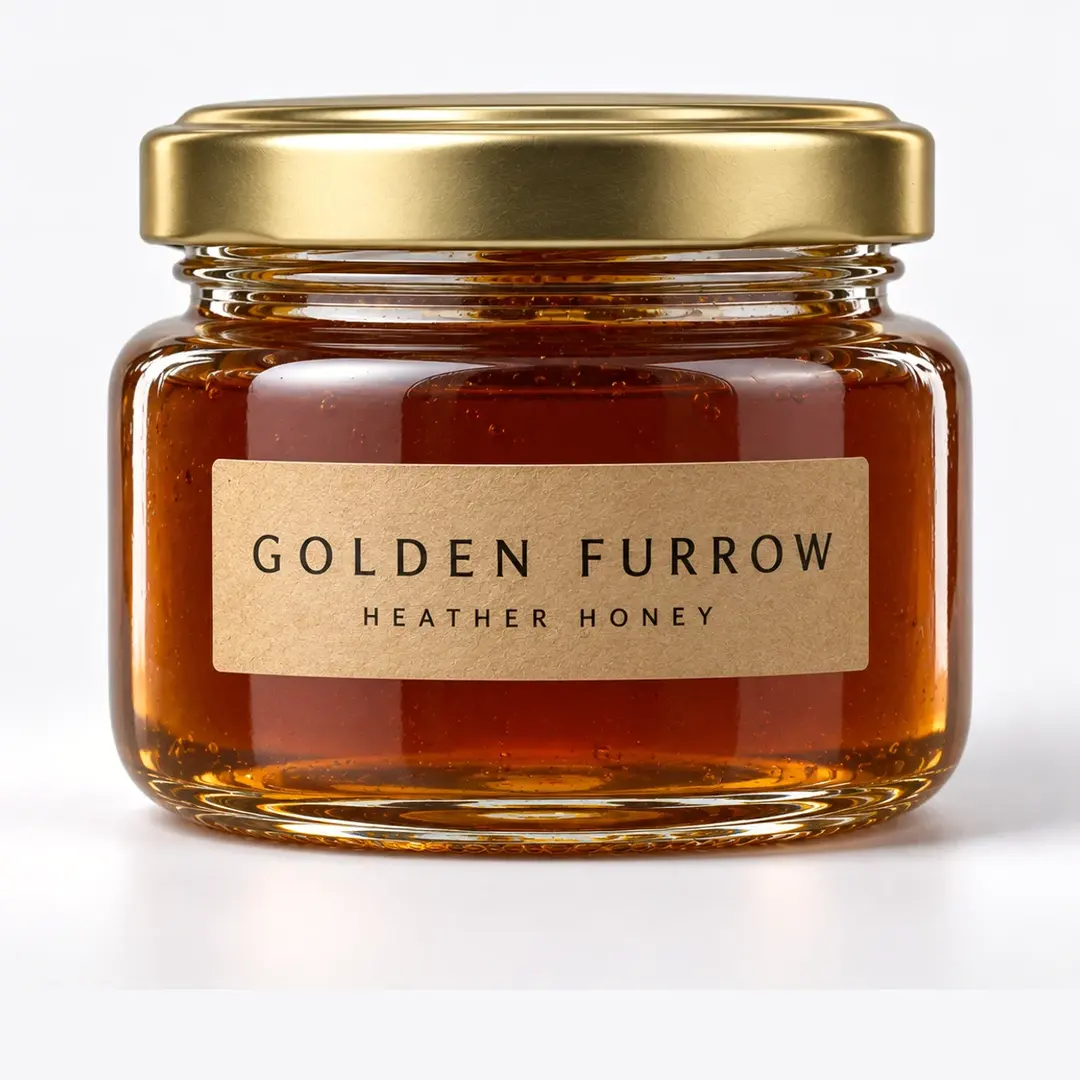
These 120ml wide-mouth honey glass jars are designed for honey sellers who think beyond the squeeze bottle: apiaries building premium retail lines, specialty food brands assembling tasting flights, and gift producers who need a small jar that feels generous in the hand. The wide mouth is the defining feature here. It admits a wooden dipper cleanly, lets a spoon reach the bottom without scraping the shoulders, and makes the jar as pleasant to use at the breakfast table as it is efficient on the filling line. Clear flint glass shows off honey color and clarity, which is often the first quality signal a buyer reads. Neck finish, weight and closure dimensions are confirmed on the technical drawing at quotation.
A Jar Shaped Around the Dipper
Honey is one of the few foods consumers routinely serve with a dedicated utensil, and jar geometry decides whether that ritual feels graceful or frustrating. A narrow neck forces the dipper in at an angle, smears honey up the threads and leaves a sticky rim that attracts dust in the cupboard. The wide mouth on this 120ml format lets a standard dipper enter vertically, twirl freely and come out clean, which keeps the jar rim tidy through the whole life of the product.
The same geometry pays off during filling. Viscous honey flows reluctantly through small openings, and narrow jars slow piston fillers or force higher fill temperatures. A wide mouth shortens fill cycles, reduces drips on the finish and gives operators a clear view of fill level, which matters when you are packing a premium monofloral honey where every gram of giveaway costs real money.
Sizing for Premium and Single-Origin Lines
At 120ml, this jar holds roughly 170 grams of honey, a size that sits naturally in the premium tier. It is large enough to justify a serious label and a quality closure, small enough to price as an accessible indulgence, and perfectly proportioned for varieties that sell on scarcity: single-apiary harvests, monofloral crops like acacia or orange blossom, and raw or creamed specialties that consumers buy in smaller quantities but replenish often.
The format also works hard in multi-SKU strategies. Honey brands commonly run three or four varietals in the same jar, differentiating with label color and cap finish. One drawing, one carton and one cap inventory then support an entire tasting range, which keeps packaging costs predictable as the line grows.
Closures and Liners for a Low-Moisture Product
Honey is forgiving in some ways and demanding in others. Its low water activity makes it microbiologically stable, but it is hygroscopic and will pull moisture from the air if the closure breathes, gradually raising water content toward the fermentation threshold. A well-seated twist closure with an appropriate liner keeps the interior dry through distribution and cupboard life, protecting both quality and regulatory compliance on moisture limits.
For creamed or whipped honey, the closure choice also affects appearance: a liner that seals cleanly prevents the surface darkening that consumers misread as spoilage. We recommend validating cap and liner combinations against your actual product during sampling, especially for export markets with long, warm transit routes. Our team will propose closure options matched to the jar’s neck finish and your filling process.
Gift Sets, Wedding Favors and Tasting Flights
Few food packages convert to gifting as naturally as a small honey jar. The 120ml format is a favorite for wedding favors, hotel welcome amenities and corporate gift boxes because it looks substantial without pushing parcel weight or per-unit cost. Decorators can add a hang tag, a fabric cap cover or a printed lid, and the wide mouth leaves room for a dipper to be tied on as part of the presentation.
Tasting flights are the other strong use case. Three or five varietals in identical 120ml jars make an attractive retail set and an effective way to introduce customers to a range before they commit to full-size jars. For gift and flight programs, consistency between jars matters as much as the jar itself, and we hold tight cosmetic tolerances on the production mold so sets look uniform on the shelf.
Quality Control and Compliance Testing
Each production lot is inspected against a defined plan before packing. Annealing quality is verified with reference to ASTM C148 so the glass carries no harmful residual stress, thermal shock performance is evaluated against ISO 7459 for buyers who fill warm or run a gentle melting step for creamed honey, and internal pressure resistance is checked with reference to ISO 7458. Neck finishes are gauged to keep cap application torque consistent, which is what protects the moisture seal over shelf life.
The soda-lime flint glass is suitable for direct food contact with honey and similar low-moisture foods, and supporting declarations are available for import compliance files. Third-party pre-shipment inspection can be arranged when your program requires it.
Wholesale Supply and Export Packing
Jars ship in divided export cartons, palletized and shrink-wrapped for sea or land freight. Small jars pack densely, so freight cost per unit stays low even on long routes, and carton layouts are confirmed at quotation so you can calculate landed cost precisely. Our guide on importing glass bottles from China explains container loading, moisture protection in transit and the documents your broker will need.
To price this jar for your program, tell us your honey type, filling process, closure preference and annual volume. We will return a quotation with the technical drawing and sampling options. Minimums depend on mold and decoration choices, and our MOQ explainer shows how smaller starting runs are structured. Questions about dippers, gift-box fit or mixed loads with other jar sizes are welcome through our contact page.
Frequently Asked Questions
How much honey does a 120ml jar actually hold?
Honey is denser than water, so a 120ml jar typically holds around 170 grams of honey, depending on the variety and fill temperature. The exact brimful and fill volumes are confirmed on the technical drawing at quotation so you can set label declarations accurately.
Does the wide mouth fit a standard wooden honey dipper?
Yes. The wide-mouth opening is designed to admit a standard wooden dipper vertically, so it can twirl freely without smearing honey on the threads. If you plan to bundle a dipper with the jar, share the dipper dimensions and we will confirm the fit during sampling.
Is this jar suitable for creamed or whipped honey?
Yes. Creamed honey fills cleanly through the wide mouth, and a well-matched cap liner prevents the surface darkening that can occur when the closure breathes. We recommend validating the cap and liner combination against your actual product before the first production run.
Can I use this jar for wedding favors and gift sets?
Absolutely. The 120ml size is a popular favor and gift format. It accepts hang tags, fabric cap covers and printed lids, and cosmetic tolerances are held tightly so multi-jar sets look uniform. Ask about lid printing and decoration options when you request a quotation.
What quality testing is done before shipment?
Annealing is verified with reference to ASTM C148, thermal shock performance is evaluated against ISO 7459, and internal pressure resistance is checked with reference to ISO 7458. Neck finishes are gauged for consistent cap application. Reports are available on request.
What is the MOQ, and can I mix this jar with other sizes in one shipment?
MOQ depends on mold availability and decoration. Mixed-container loads with other jar sizes from our range are possible and common for honey brands building a product line. Our team will propose a loading plan and confirm minimums at quotation.