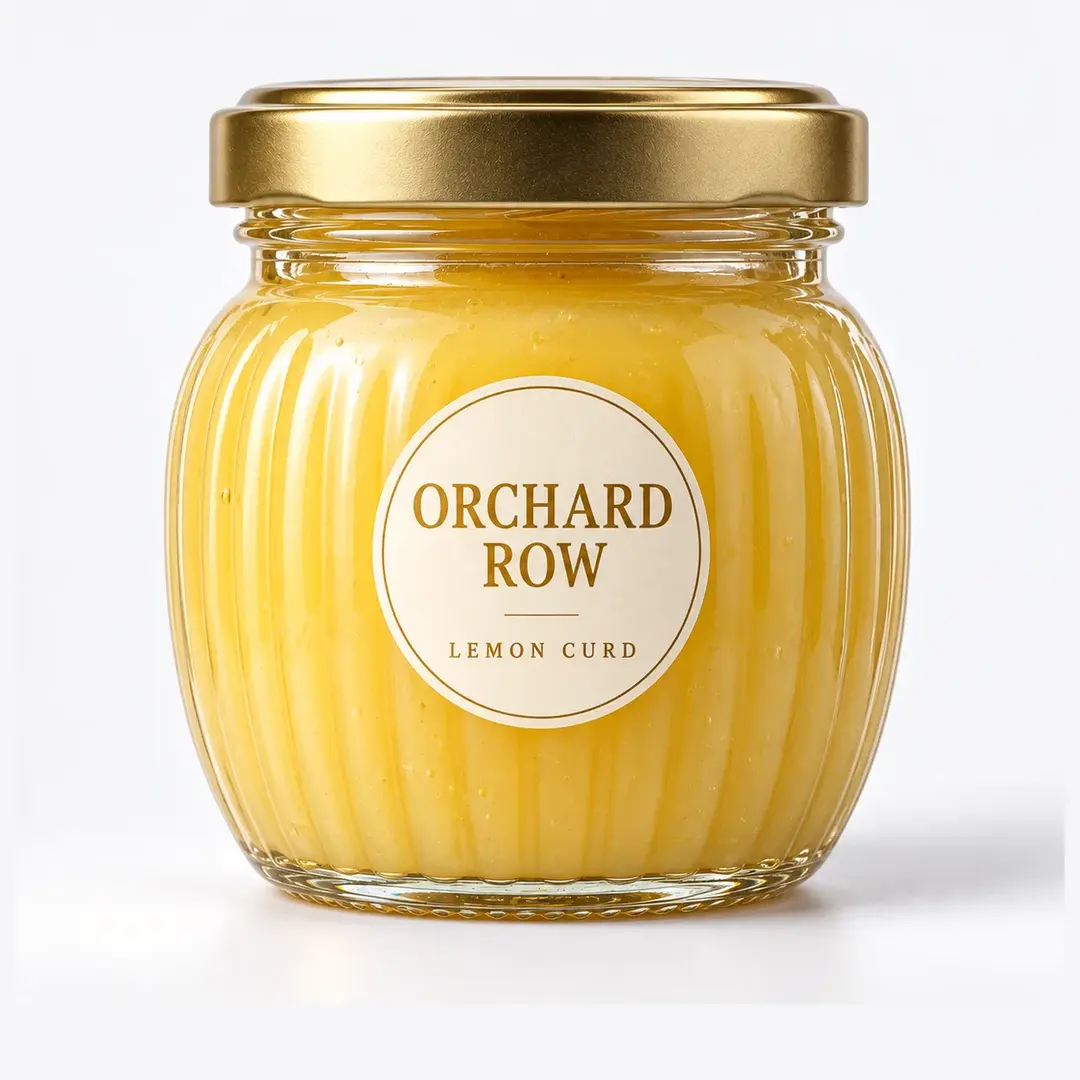
The 442 series is a small round-belly glass jar with fine vertical ribbing and a wide lug-finish mouth, photographed here in the 185ml fill class. It is built for farm brands, apiaries, jam kitchens, and private-label food companies that want a jar which looks handmade on the shelf but runs on a standard filling and capping line. If your buyers shop with their eyes first, this fluted round jar gives you the artisan look without giving up industrial consistency.
Ribbed Round-Belly Design That Sells the Contents
The defining feature of the 442 series is its continuous vertical fluting. Those ribs do three jobs at once. Visually, they catch and refract light, so golden honey, deep-red strawberry jam, or amber chutney seems to glow from inside the pack. Tactilely, the fluted surface gives the consumer a secure grip, which matters for a small jar that is often held in one hand at the breakfast table. And structurally, the ribbing stiffens the round belly wall, so the jar tolerates the internal vacuum that forms after hot filling without paneling.
The low, wide silhouette sits stable on the shelf and presents a generous label area for its size. A small wrap label or a front-and-back paper label both work; the ribs frame the flat front panel nicely. For farmhouse and cottage-core brand identities, this shape reads as traditional kitchen storage rather than industrial packaging, which is exactly the cue premium grocery buyers look for.
Kitchen Storage Aesthetics for Artisan Food Brands
Small ribbed jars occupy a special place in food retail: they signal preserves made in small batches. The 442 series leans into that perception. On a pantry shelf or a farm-shop display, a row of these jars in graduated fills looks curated rather than mass-produced. The wide mouth means the product surface is fully visible from above, so a honeycomb chunk, a layer of fruit, or an herb garnish becomes part of the presentation.
The same aesthetic carries into the consumer’s home. A ribbed glass jar is far more likely to be washed and reused as a spice pot or a tea caddy than a plain container, and every reuse keeps your brand’s jar in the customer’s kitchen. For direct-to-consumer brands, that reuse loop is free marketing.
Filling, Sealing, and Lid Options
The mouth on the 442 series is a lug (twist-off) finish, sized for the metal lug caps commonly used on 185ml preserve jars. The wide opening relative to the body makes dosing easy: piston fillers handle honey and jam cleanly, and even spoon-filling operations for chunky chutneys stay fast because there is no narrow neck to bridge or clog. Exact neck-finish dimensions and cap lug count are confirmed on the technical drawing at quotation, so please send your closure spec or let us match one for you.
Metal lug caps with a plastisol liner give a hermetic vacuum seal suitable for hot-fill and water-bath pasteurization processes. The jars are annealed soda-lime glass and tolerate normal hot-fill practice; your process engineer should still validate thermal-shock margin against your actual fill temperature and cooling tunnel profile. Cap colors, printed lids, and tamper-evident button tops are all available as decoration options on the closure side.
Quality Control and Food-Contact Compliance
Every production run of the 442 series passes dimensional gauging, visual inspection, and thermal-shock sampling at the factory. Thermal-shock resistance is verified per ASTM C149, internal pressure and annealing quality are checked against ISO 7459 polariscopic stress examination, and resistance to internal pressure is sampled per ISO 7458 where the application requires it. The glass is food-contact soda-lime, free of added lead or cadmium in the batch, and heavy-metal migration test reports can be supplied with your shipment for EU and US import files.
Seed, blister, and stone limits follow the agreed AQL in your purchase contract. Because the ribbed wall is a design feature, we pay extra attention to rib definition and wall-thickness uniformity during mold changeover, so consecutive cartons look identical on the shelf.
Logistics, MOQ, and How to Order
The jars are packed in export cartons with dividers, palletized, and shrink-wrapped for container loading. The compact round-belly format nests efficiently, so a 40HQ container holds a commercially attractive quantity for small-format jars. For realistic per-unit pricing, review our glass jar MOQ explained guide, which walks through how mold occupancy and decoration choices affect minimum order quantities.
If this is your first time sourcing glass packaging from China, our step-by-step page on importing glass bottles and jars from China covers Incoterms, container planning, and customs paperwork. Stock molds like the 442 series keep tooling cost at zero; you pay only for production, decoration, and freight.
Where the 442 Series Fits Best
The 185ml class is the workhorse size for single-serve and small-family preserves: gourmet jams, raw honey, fruit curds, pesto, tapenade, chili crisp, and specialty mustards all sell well at this volume. The ribbed body also photographs beautifully, which matters more every year as food brands sell through marketplaces and social commerce where the pack shot does the persuading. A fluted jar catches highlights in studio lighting in a way a smooth wall simply cannot.
For co-packers, the wide lug mouth keeps changeover simple. The same capper chucks used for other twist-off preserve jars usually handle this finish, and the stable low center of gravity reduces tip-overs on conveyor curves and in the retort basket. If you run several small SKUs, keeping one jar family across flavors simplifies both procurement and line settings.
Start Your Project
Tell us your fill volume, product type, closure preference, and annual quantity, and we will return a quotation with the technical drawing, cap recommendation, and a packing plan. Samples from the current production line are available so you can test filling and sealing before committing. Reach our export team through the contact us page and mention the 442 series.
Frequently Asked Questions
What capacity is the 442 series jar shown in the photo?
The photographed jar is in the 185ml fill class. Related molds in this ribbed round-belly family may offer adjacent capacities; confirm the exact brimful and nominal fill volumes on the technical drawing at quotation.
Which lid fits the 442 series jar?
The jar uses a lug (twist-off) neck finish matched to metal lug caps with plastisol liners, the standard closure for 185ml preserve jars. Lug count and neck diameter are confirmed on the drawing, and we can supply caps in printed or plain colors together with the jars.
Is this jar suitable for hot-fill jam or honey?
Yes. The annealed soda-lime glass and rib-stiffened round wall are designed for typical hot-fill and water-bath pasteurization practice with a vacuum-forming lug cap. Thermal-shock resistance is sampled per ASTM C149; validate the margin against your own fill temperature before production.
Can I get the ribbed jar with my own label and printed lid?
Yes. The flat front panel between the ribs accepts wrap or front-and-back paper labels, and lids can be printed with your logo. Decoration MOQs differ from plain-jar MOQs; see our MOQ guide or ask the export team for the current thresholds.
What is the minimum order quantity for the 442 series?
The 442 series runs from a stock mold, so there is no tooling cost. Production MOQ depends on furnace scheduling and decoration, typically starting from one container-load equivalent for plain jars. The MOQ explained page on our site breaks down how quantity is calculated.
How are the jars packed for export?
Jars are packed in divider cartons, stacked on export pallets, and shrink-wrapped. We provide the carton count, pallet layout, and container loading plan with your quotation so you can calculate landed cost accurately.