French square bottles are flat-faced glass bottles with chamfered corners and a continuous-thread neck, and the standard range runs from 1 oz to 32 oz on six GPI neck finishes between 18-415 and 43-400. Buyers choose them over round bottles for density: on a 1200 mm by 1000 mm pallet a 60 mm square packs 320 bottles per layer against 270 for a 65 mm round. The specification work that matters is agreeing neck finish, wall thickness, base geometry and liner before sampling, so one bottle family can run juice, sauce and honey with only a closure change.
Sizes, neck finishes and dimensions
The range is built as one family so a brand can put several pack sizes through a single capping line. Sizes from 1 oz to 4 oz suit samplers, hot sauces, bitters and food oils. The 8 oz to 16 oz bottles carry most cold-pressed juice and iced tea. The 25 oz and 32 oz sizes are for family packs of syrup, barbecue sauce and honey.
All finishes in the table are continuous-thread (CT), and weights are nominal for flint glass.
| Capacity (oz) | Capacity (ml) | Neck finish (CT) | Neck ID (mm) | Body (mm) | Height (mm) | Weight (g) | Closure |
|---|---|---|---|---|---|---|---|
| 1 oz | 30 ml | 18-415 | 13.5 | 33 x 33 | 71 | 38 | CT screw, plastisol |
| 2 oz | 60 ml | 22-400 | 16.5 | 40 x 40 | 85 | 58 | CT screw, plastisol |
| 4 oz | 120 ml | 28-400 | 21.0 | 48 x 48 | 105 | 92 | CT screw, plastisol |
| 8 oz | 250 ml | 28-400 | 21.0 | 60 x 60 | 135 | 145 | CT screw, plastisol |
| 12 oz | 355 ml | 33-400 | 25.5 | 66 x 66 | 165 | 188 | CT screw, plastisol |
| 16 oz | 473 ml | 38-400 | 30.0 | 72 x 72 | 195 | 225 | CT screw, plastisol |
| 25 oz | 750 ml | 38-400 | 30.0 | 82 x 82 | 230 | 318 | CT screw, plastisol |
| 32 oz | 1000 ml | 43-400 | 34.5 | 90 x 90 | 255 | 385 | CT wide-mouth screw |
Three pairings in that table are worth planning around. The 4 oz and 8 oz bottles share the 28-400 neck on purpose: a sampler and a main size can take the identical 28 mm cap, which halves the closure qualification work. The 16 oz and 25 oz share 38-400, a very common CT finish in North American food packaging, so existing 38 mm lid stock and capping chucks carry over. The 32 oz moves up to a 43-400 wide mouth for products with particulates, such as honey with comb or seeded barbecue sauce, that would fill slowly through a 38 mm opening.
Glass weight is controlled at the feeder by automatic gob weighing to plus-or-minus 5 percent. That tolerance is about fill height more than glass cost. A bottle whose weight drifts further has a different internal volume, and the fill line then wanders visibly along the shelf. A weight distribution report per lot lets your quality team trend it against the fill-height specification.
Wall thickness, corner radius and squareness
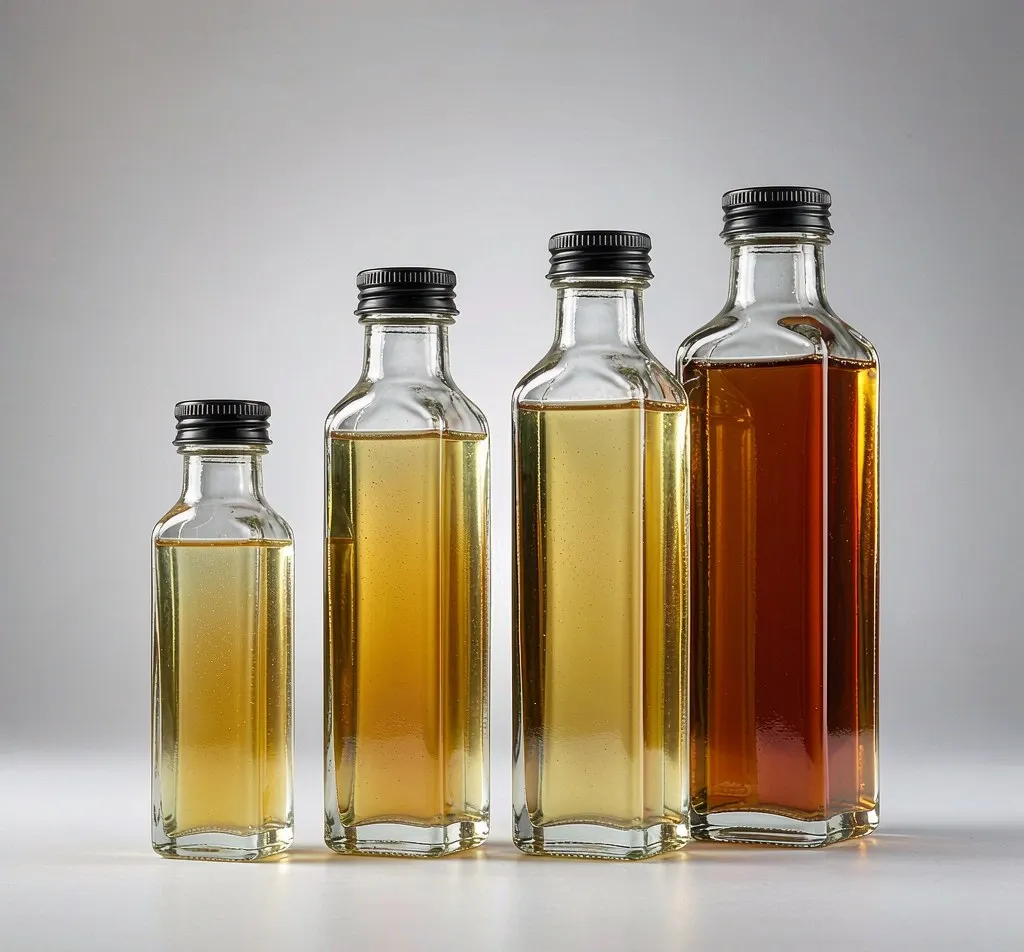
A French square has four flat faces, four chamfered corners and a slightly tapered shoulder below the neck. What separates it from a wide-panelled apothecary jar is the tight corner, typically 4.0 mm to 6.0 mm on the 8 oz to 32 oz sizes. That is small enough for bottles to sit wall to wall, and large enough to clear a standard fill nozzle and a bottle washer.
Thickness is specified by section, not as one nominal figure. On the 8 oz and 16 oz sizes the targets are:
- side wall 2.4 mm to 2.8 mm
- shoulder 3.0 mm to 3.4 mm
- base 3.6 mm to 4.2 mm
The base is the heaviest section because it carries the stack above it and takes the knocks of automatic depalletising. An 8 oz bottle with a 2.6 mm side wall weighs approximately 145 g in flint soda-lime glass. The same mould in amber comes out 3 to 4 g heavier, owing to the iron and sulphur colourants that cut UV in the 290 nm to 450 nm band.
Face flatness and squareness are set on the IS (individual section) forming machine and confirmed on a coordinate measuring machine at first-article inspection. Flatness across a face is held within 0.6 mm. Squareness, the difference between the two face-to-face dimensions, is held within 0.8 mm. Those two figures decide whether the bottle runs cleanly on a linear filler at 120 to 180 bottles per minute or catches a lane guide and jams.
Corner radius also affects washing. A 5 mm chamfer lets an inline washer brush reach the corner and stops a film of liquid sitting there, which matters to contract fillers who receive, wash and fill within one shift. We suggest an internal radius of 5.0 mm to 6.0 mm on 4 oz and 8 oz bottles that will be washed at high throughput, and the tighter 4.0 mm on the 1 oz and 2 oz, where shelf density counts for more than wash speed.
Pallet and shelf density against round bottles
Round bottles leave triangular gaps between neighbours, in the shipper and on the shelf. A square body closes those gaps, and the gain can be worked out from the footprint alone.
| Measure | 65 mm round | 60 mm square |
|---|---|---|
| Layer on a 1200 mm by 1000 mm (48 in by 40 in) pallet | 18 columns by 15 rows, 270 bottles | 20 columns by 16 rows, 320 bottles |
| Stable layers in a 6-foot wrapped load | about 12 | 14 |
| Bottles per pallet | roughly 3,240 | roughly 4,480 |
| Facings on a 1219 mm (48 in) shelf | 18, with a 49 mm gap left over | 20, with a 19 mm gap |
The round load stops at about 12 layers because shear between layers becomes a concern; flat faces resist that shear, which is where the extra two layers come from. Taken together, the pallet holds about 38 percent more bottles on the same footprint. At the shelf the gain is about 11 percent more facings without widening the planogram.
Flat faces also change the secondary packaging. The wall of a corrugated shelf-ready shipper braces a flat surface instead of taking point loads where round bottles touch, so it can be thinner. Square bottles also roll less and scuff their labels less in a vibrating bulk shipper. And the flat panel gives a larger, planar label area than a round bottle of equal volume, useful when regulatory text has to stay legible at arm's length.
Matching the bottle to the fill process
Cold-pressed juice and HPP
Juice and iced tea in the 8 oz to 16 oz sizes are usually preserved by high-pressure processing (HPP), a cold hydrostatic press at up to 600 MPa (about 6,000 bar). Glass is incompressible and is essentially unaffected by uniform pressure, so the body is not where an HPP pack fails. The seal is. The closure, plastisol-lined or vacuum-sealed, has to stay tight through the press cycle and the cold chain that follows, and it should be specified at the RFQ stage instead of being left to the filler. Compatible closures and liner stacks are set out in our juice glass bottle range.
For chilled drinks that are not HPP treated, square bottles standing face to face leave less air between them to warm by convection in a display. Treat that as a side benefit and not as a preservation claim.
Hot-fill sauces
Barbecue sauce, ketchup-style condiments and fruit coulis go into the 12 oz to 32 oz sizes at 85 to 92 degrees Celsius. Properly annealed soda-lime glass takes that load if the temperature difference between glass and product is managed. The working tolerance is approximately 40 to 60 degrees Celsius for gradual transitions. Allow at least a 30-second equilibration before capping, and keep freshly filled bottles off cold surfaces.
Shape helps a little here as well. A square bottle stands on its base and offers even faces to the cooling air, whereas a round one in a hot-fill tunnel develops hot spots along its line of contact with the conveyor. Hot-fill configurations and closure torque figures for these sizes are covered under BBQ sauce bottles and the wider glass sauce bottle range.
Syrup and honey
Coffee-service and table syrups run in the 8 oz to 25 oz sizes on a 28 mm or 38 mm CT closure with a dispensing or tamper-evident liner. Honey and honey blends use 12 oz to 32 oz. The 32 oz with its 43-400 wide mouth is the usual honey choice because a viscous product flows out of the wider opening without bridging.
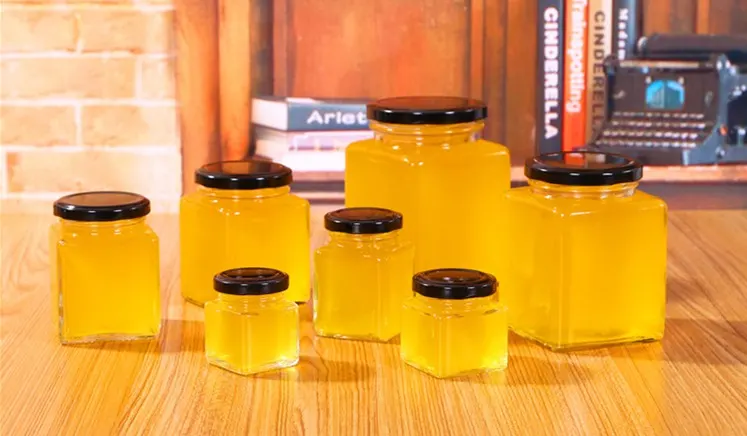
Wide-mouth jars for chunkier fills sit alongside these bottles in our food glass packaging overview.
Closures, liners and capping torque
On a continuous-thread finish the cap spins on, and the seal is made when the liner is compressed against the land, the flat top rim of the neck, at a set torque. Food packers favour CT because consumers can reseal it, fillers can run it at speed, and the finishes are standard GPI dimensions, so lids can be bought from more than one vendor.
The liner does the sealing. Three food-grade types cover most projects.
| Liner | How it seals | Typical use |
|---|---|---|
| Plastisol | Softens under hot-fill or steam-vacuum heat, then cures to a bonded seal with a vacuum button | Barbecue sauce, fruit preserves, vacuum-capped juice |
| Pressure-sensitive foam (PS-22 style) | Adheres on contact | Ambient, low-moisture goods such as dry rubs and cocoa powder |
| Foil-laminate induction | Induction-sealed on the line for a hermetic, tamper-evident seal | Syrups and markets with strict tamper-evidence law |
Vacuum screw capping is the main method for hot-fill and for HPP-assisted cold fill. The capper applies a target torque, typically 10 to 18 in-lb on a 38 mm CT closure depending on the liner, and the cooling product draws a partial vacuum that holds the lid down and shows the seal is good. Too little torque leaves a leak path. Too much strips the thread or cracks the finish land. We provide a torque recommendation for each neck size and liner so the capper can be set without trial and error.
Caps come in tinplate and aluminium at 28 mm, 33 mm, 38 mm and 43 mm, finished in gold, silver, matte black or print. Aluminium is lighter, which counts when freight weight is being watched. Tinplate resists dents better in bulk transit and is the usual pick for the 32 oz honey bottle. PP and PET caps cover cold-fill and child-resistant needs. Closures are supplied with food-contact compliance documents, and the plastisol compound is odour-neutral so it does not taint a delicate juice.
Qualify the bottle and the cap as a pair. A 38-400 bottle and a 38-400 lid from different suppliers will usually screw together, yet thread engagement length and land flatness can differ by fractions of a millimetre. That difference can separate a clean vacuum seal from a slow leak that shows up three months later. When we source both parts, they are checked together and shipped as a matched set.
Embossing, decoration and colour
Private-label and regional brands tend to ask for an embossed logo because it outlasts dishwashers, ice baths and the back of the fridge, where a label alone does not. One route suited to contract fillers is a removable embossing chip: a small mould insert that can be swapped between brands without re-cutting the cavity.
Beyond embossing, the options are ceramic frit printing, spray frosting and full-body tint. Ceramic frit is fused into the surface in a second firing, so it will not peel and is unaffected by dishwashing. It is the most durable choice for brands that want the nutrition panel on the glass, but the extra furnace pass adds time. It is rarely justified on a 1 oz sampler and often is on a 16 oz lead SKU.
Colour comes from the glass batch, not a coating, so it cannot scratch off. Flint, amber and green are standard. A custom shade such as cobalt or smoke needs a furnace commitment, since the colourant has to be flushed through the forehearth, and it is quoted as a separate line. For light-sensitive juices and oils displayed on a sunny end-cap, amber or a UV-attenuating green is worth considering.
Artwork approval is the step where launches most often stall, so it comes first. You send vector artwork, we return a 3D render of the emboss on the real face geometry, and steel is cut only after position and depth are approved. Fix the emboss before committing to the closure and the carton, because a change after cutting means a new mould.
Checks to make before placing an order
Leaking seals, out-of-square bodies and drifting weights tend to appear months after launch, when changing supplier costs the most. These are the points we verify when matching a project to a plant, and you can use the same list on any quotation.
- Forming control. Ask for the gob-weight tolerance, the CMM first-article report and the annealing lehr profile. A plant that cannot show an annealing curve is not controlling internal stress, and stressed glass cracks in the field.
- Closure fit as a system. Get a capper torque table for your exact neck and liner, and run ten bottles plus ten lids on your own line before releasing the order.
- Food-contact compliance. Request the lead and cadmium release test per FDA 21 CFR, the EU 94/62/EC or (EC) 1935/2004 declaration, and a glass composition statement. We keep these on file for five years so a recall trace is a document pull.
- Logistics figures. Ask for count, weight and cube per pallet for each size, then run your own freight and duty model. A cheaper bottle that packs 18 percent fewer units per pallet costs more landed.
- Capacity and backup. Confirm daily furnace tonnage, the number of cavities on your mould and where a second mould is held. A single cavity on a single furnace becomes a stop-ship risk when that furnace is rebuilt.
- Decoration workflow. Find out whether the plant runs its own decorating furnace or subcontracts and queues behind other jobs, and get the timing commitment in writing.
Inspection terms belong in the commercial paperwork. Lots are checked to AQL 2.5 on critical dimensions: finish diameter, thread integrity and minimum wall thickness. Minor seed, meaning tiny trapped gas bubbles, below an agreed count per square centimetre is inherent to soda-lime forming and does not affect food safety or function, so the tolerance should be written down in advance to avoid a dispute at the dock.
Shipments can be arranged FOB for buyers managing their own freight, or CIF to a named port. Glass is heavy and freight is a large part of landed cost, so we give weight and cube per pallet for every size. Pallets are ISPM-15 heat-treated timber, or recyclable plastic on request.
Frequently asked questions
Will our existing capper work with these bottles?
In most cases, yes. The finishes are GPI-standard CT dimensions, so a capping head and chuck already set up for the matching diameter transfer without modification. Check your size against the table above and set the torque from the recommendation for that neck and liner.
What is the minimum order quantity?
Minimums are quoted per project. They depend on the mould, the line it runs on, the glass colour and any decoration.
What do tooling and embossing cost, and how long do they take?
Both are quoted per project once the mould type, emboss depth, decoration and quantity are known. Freight terms and destination shape the landed figure.
Are the bottles free of lead and cadmium?
Each lot is documented with an FDA 21 CFR food-contact declaration, an EU compliance statement, a heavy-metals release test and a glass composition statement.
Can the same bottle be used for hot-fill and for HPP juice?
The glass can. What changes is the liner and the capping set-up, which is why the closure is agreed for each product before sampling.