A glass sauce bottle for an 85–95°C fill has to be specified together with its cap: body walls of 2.5–3.5 mm, annealing checked to ASTM C148, a thermal-shock pass at ΔT 42°C minimum under ISO 7459, and a plastisol-lined twist-off lug cap that holds 25–35 kPa of vacuum once the product cools. Stock profiles run from a 5 oz woozy on a 38 mm lug finish to a 720 ml marinara round on 70 mm, usually packed 12 per case. Most failures come from the line rather than the glass: a cold bottle, a harsh cooling tunnel, or a liner that was never matched to the recipe.
Glass specification for an 85–95°C fill
Sauce at 90°C poured into a bottle at 25°C puts a difference of roughly 65°C across the wall in an instant. Quench data for annealed container glass puts the safe single-side shock at about 42°C, so the process only works because the liquid heats the inside surface progressively rather than all at once. Ketchup, sriracha, BBQ and pasta sauce lines typically work with a fill-to-glass difference of 60–70°C, and the drawing has to leave room for it.
These are the points we write into a hot-fill bottle specification:
- Wall thickness: 2.5–3.5 mm on the body, and no heel radius tighter than 8 mm, because sharp heels concentrate thermal stress.
- Annealing: residual stress under 50 nm/cm optical path difference, read on a polarimeter per ASTM C148. Annealing is the slow cooling after forming that relaxes stress in the glass; an under-annealed bottle tolerates far less temperature difference.
- Thermal shock: a pass at ΔT 42°C minimum to ISO 7459. Hot-fill items routinely pass ΔT 60°C when tested by gradual immersion.
- Headspace: 5–8% of the volume, so the steam above the product condenses and draws 25–35 kPa of vacuum.
ISO 7459 dips samples in hot and then cold water across a set difference and counts breakages. It can be run single-side, with one face quenched, or as full immersion. The single-side version is closer to what a filler does, since the inner wall meets 90°C product while the outside is still near room temperature.
For acid sauces (pH < 4.6) the hot-fill-and-hold step is what kills spoilage organisms. Apply the lug cap with the product at ≥85°C and hold the capped bottle for 3–5 minutes before it enters the cooling tunnel. Low-acid sauces that need retort sterilisation at 121°C are a separate brief: they call for heavier walls and retort-rated closures.
Stock profiles, capacities and neck finishes
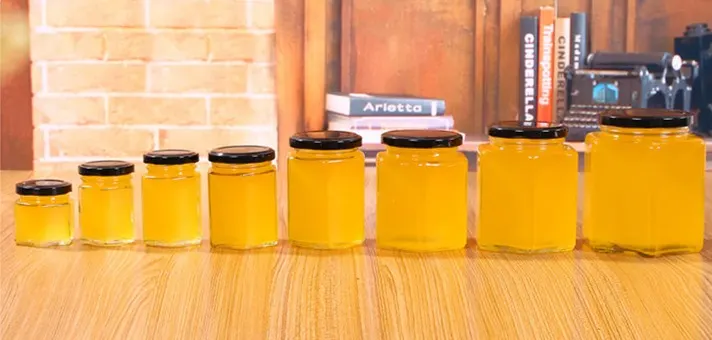
Woozy bottles are the hot-sauce standard, rounds and squares cover BBQ, pasta and table sauces, and the hexagonal jar is the gift-shelf option. The metric range below lists glass weights. Capacities are nominal, with brimful volume 3–5% higher.
| Profile | Capacity | Finish | Glass weight |
|---|---|---|---|
| Round woozy for hot sauce | 150 ml / 5 oz | 38 mm lug twist-off | 135 g |
| Round sauce | 250 ml | 43 mm lug twist-off | 190 g |
| Round sauce for BBQ or pasta | 300 ml | 53 mm lug twist-off | 240 g |
| Hexagonal | 314 ml | 58 mm lug twist-off | 255 g |
| Round sauce | 500 ml | 63 mm lug twist-off | 330 g |
| Round marinara | 720 ml | 70 mm lug twist-off | 480 g |
Buyers working in fluid ounces usually start from the second table, which adds colour and case pack. Treat every entry as a starting range: decoration, colour and the exact finish are fixed on the drawing for each project, not read off a web page.
| Size | Typical contents | Finish | Closure | Glass colour | Case pack |
|---|---|---|---|---|---|
| 5 oz woozy (148 ml) | Hot sauce, pepper sauce | 38 mm lug | Vacuum lug cap | Flint, amber, cobalt | 12–24 |
| 5 oz round, non-woozy | Samples, small batches | 38 mm lug or CT | Vacuum lug or CT | Flint, amber | 12–24 |
| 8 oz woozy (237 ml) | Hot sauce, wing sauce | 38–43 mm lug | Vacuum lug cap | Flint, amber | 12–24 |
| 8 oz square | Dressing, dip, sauce | 43 mm lug | Vacuum lug or CT | Flint | 12–24 |
| 12 oz round (355 ml) | BBQ, pasta sauce, salsa | 53–58 mm lug | Vacuum lug cap | Flint, amber, green | 12 |
| 12 oz square | Sauce, dressing | 53 mm lug | Vacuum lug cap | Flint, amber | 12 |
| 16 oz round (473 ml) | Pasta sauce, marinara, dressing | 63–70 mm lug | Vacuum lug cap | Flint, amber | 12 |
| 24 oz round or woozy (710 ml) | Marinara, salsa | 70 mm lug | Vacuum lug cap | Flint, amber | 12 |
The 8 oz woozy is the most common retail hot-sauce size. Square bodies save shelf width, and the 16 oz and 24 oz bodies carry enough thermal mass that they need a slower cooling zone than the small formats. If the finish you need is not listed, send the cap diameter and we will check which tooling exists before you plan around it.
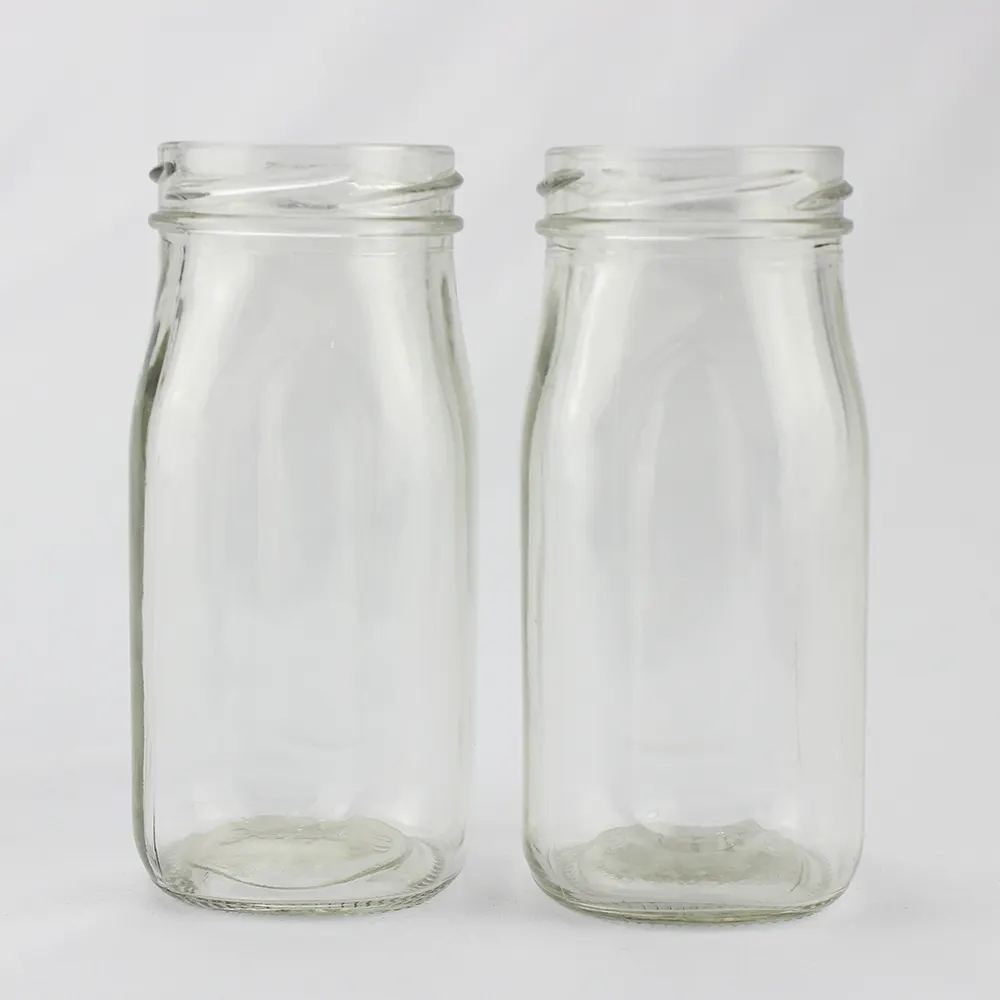
Lug caps and how the vacuum seal forms
The closure for hot-fill is a tinplate twist-off lug cap with a food-grade plastisol liner, available in 38, 43, 48, 53, 58, 63 and 70 mm. A continuous-thread (CT) screw cap with a PE liner does not hold hot-fill vacuum reliably. CT finishes are an option on the same bottle families for cold-fill dressings, but that is a separate specification.
The cap does not create the vacuum; it traps one. Hot product leaves a small pocket of steam under the cap. In the tunnel that steam condenses, its volume collapses and pressure inside falls below atmospheric. Meanwhile the plastisol, which softened when the cap went on at ≥85°C, sets hard against the glass finish and locks the low pressure in. What remains is roughly 25–35 kPa of vacuum that can be read with a gauge. From then on the only task is keeping liner and finish in contact, which is why a flat finish and correct torque matter as much as the cap.
Safety-button lids
For retail, order the cap with a safety button, also called a vacuum button. Outside air pressure pulls the centre of the lid down when the vacuum is good, so a flat button tells the line operator the seal held and tells the shopper nobody has opened the jar. That gives tamper evidence without a shrink band.
A button that springs back up after cooling means the seal was lost and the pack should be pulled. The usual causes are a fill temperature too low for the plastisol to flow, too little headspace to produce steam, torque outside the window, a scratched or worn finish, or a faulty liner. A sensible routine is a 100% button check at start-up and a sampled check on every run.
Opening feel
A lug cap opens when the lugs under the cap ride off the matching lugs on the glass, so the contact point is the lug and not the skirt. Worn or out-of-tolerance lugs make a cap feel loose, which shows up as early weeping, or tight, which shows up as complaints. Opening torque should let an average adult open the jar without a tool while a child cannot pop it by accident. Liner compression and applied torque set that band, and it is settled for the liner grade on each project. We can pass the finish-lug drawing to your cap supplier so both sides work to one tolerance.
Matching the liner and cap coating to the recipe
Soda-lime glass is stable against acid condiments at hot-fill temperature and does not corrode the way a metal can would, which is why it stays the default for sauces below pH 4.6. The liner and the lacquer inside the metal cap are not inert. Specifying the bottle and leaving the liner to chance is the most common reason a sauce stains, weeps or tastes off after months on the shelf, and because the damage is slow it appears in shelf-life trials, not on filling day.
| Recipe load | What it does to the closure | What to specify |
|---|---|---|
| Acid | Hydrolyses or swells a liner compound that is not acid-rated, leading to a weep at the finish | Acid-rated plastisol liner |
| Oil | Extracts plasticiser from an unsuitable liner; the cap can also scalp flavour top notes | Oil-compatible liner |
| Capsaicin | A solvent-active oleoresin that speeds ageing of some liner compounds | Compound selected for oleoresin contact |
| Red and orange pigment from chili or paprika | Stains a porous liner and can migrate into it | Pigment-resistant liner and an inner coating the colour cannot penetrate |
The cap shell is tinplate, so its inside needs a barrier of its own. Acidic condensate on a bare or thinly coated interior corrodes the metal and can tint the sauce at the neck. The standard protection is a food-grade lacquer, typically epoxy or organosol, applied at a stated film weight and cured to survive the fill temperature. High-salt and high-acid recipes justify a heavier or more resistant coating.
Declare the acid, oil and pigment load when you ask for caps and we will match the liner grade and coating to it; an extraction or stain test can be arranged on request. Whether the combination suits your brand is decided by your shelf-life trial, not by a data sheet.
Food-contact compliance by destination
Glass, liner and cap coating each fall under food-contact rules, and the United States, the European Union, the United Kingdom and other regions keep their own positive lists and limits. We can pass on material declarations and, where they exist, test data for all of these components. Confirming that the finished pack is acceptable in the country you ship to remains the buyer's job, because it depends on your recipe, your process and your market. Treat the documents as evidence for your regulator or importer to verify, not as a certificate of approval.
Where hot-fill bottles crack on the line
Cold glass meeting hot sauce
The worst case is a bottle from a winter warehouse at 5–10°C meeting sauce at 90°C. The difference is near 80–85°C, beyond what even well-annealed glass tolerates. The result is a vertical check or a star crack on the body, sometimes invisible until the vacuum loads the panel.
The remedy is to warm bottles to 35–45°C on the infeed. A pre-heat tunnel, a warm holding room or a heated depalletiser all do the job. Plan for one if glass temperature on your line falls below 20°C in winter, and log bottle temperature at the filler as a process parameter during the first qualification run. Where pre-heating is impossible, the fallback is a smaller, thinner-walled container that equalises faster.
Cooling too hard, too early
On a well-run line the bottle survives the fill and breaks later, in the tunnel. Hot product expands the inner wall while the outer wall lags, leaving the outside surface in tension. Cold tunnel water at that moment adds a second, opposing shock. Let the packs stand in still air or warm mist for the first minutes, then bring the tunnel down towards ambient in stages. The 3–5 minute hold before the tunnel helps here too, because it lets the liner flow fully and the vacuum establish cleanly.
Geometry changes the answer. A thin woozy equalises quickly; a 700 ml marinara round does not, so a tunnel profile that suits one can over-shock the other. Validate the cooling profile for each bottle size, not for each recipe. Give us your fill temperature, tunnel inlet temperature and target cool-down time and we will point out which profiles need a slower zone.
Fitting the bottle to the filler, capper and labeller
Finish and capping head. The lug finish must offer a flat, true sealing surface at the correct diameter for the chuck. An out-of-round finish or one with a low spot seals on one side and weeps on the other. A 38 mm woozy and a 70 mm marinara jar need different capping heads although both are lug finishes, and the bore has to suit the filling valve. Each stock item comes with a finish drawing, and we check its critical dimensions against your capper's specification before a run.
Torque. Too little and the liner never compresses enough to seal; too much and the plastisol is crushed, the lugs gall or the cap becomes impossible to open. Liner grade, cap diameter, finish flatness and application temperature set the window. Start from the window supplied with the caps, verify it with a torque meter on your own capper, and measure again after the tunnel, since vacuum shifts the effective hold. Record it on every run: drift is the first sign of finish wear.
Labels and sleeves. Pressure-sensitive labels put on warm glass can bubble or lift as the bottle contracts. A shrink sleeve applied too early distorts its print. Warm glass also softens wet glue on paper labels before it should. Label downstream of cool-down, or use an adhesive rated for the temperature at the applicator, and compare the label supplier's rating with your tunnel outlet temperature.
Line speed. The heaviest bottle sets the pace unless the tunnel is profiled by size. Large rounds need a longer dwell and a gentler cool, and will check or panel if run at woozy speed. A bottle hurried out before its headspace has fully condensed may not reach full vacuum and leaves a soft button. Confirm cool time and vacuum hold for every size during qualification.
Test evidence to request before committing volume
"Hot-fill safe" is not an answer. Ask for the method and read it before reading the result:
- an ISO 7459 thermal-shock report that states the variant used, the temperature difference, the sample count and the pass criterion, with single-side results carrying more weight for hot-fill;
- an ASTM C148 annealing report from a polarimeter, giving residual stress as optical path difference and the acceptance limit;
- an ISO 7458 internal-pressure report if the bottle is also pressurised or carbonated in your process;
- a release document or certificate of analysis for each batch, so every lot is shown to have been sampled and not only the first;
- physical samples for a fill trial at your real fill and tunnel temperatures, including a deliberately cold-bottle run to locate the failure edge;
- third-party laboratory verification where the recipe or the market is sensitive.
The reports show that testing was done, on how many bottles and at what difference. The safe margin for your own recipe comes only from your fill trial, which is why we coordinate a joint qualification instead of promising a figure in advance.
Case packs, container loads and what to send for a quote
Small formats ship efficiently. A typical pack is 12 bottles per case with dividers, and a pallet takes about 150-200 cases. A 40HQ container holds roughly 55,000–65,000 pcs of the 250 ml round, depending on pallet pattern. Larger orders move to palletised, shrink-wrapped export cartons.
Prices and minimum quantities are quoted per project. Order volume has the largest effect, followed by the mould, decoration, and freight terms to your port. Caps, decoration and the inner-coating grade are costed separately from the glass, so when comparing offers check whether a supplier has quoted bottles only or the complete pack.
A workable brief, sent through the quote request page, lists sauce type and pH, filling temperature, target capacity, preferred finish or cap diameter, annual volume, decoration and destination port.
Hot-fill sauce bottle FAQ
Will the glass survive a 90–95°C fill?
Yes, when the bottle is specified for it and the line is controlled. With annealing to ASTM C148, a batch thermal-shock test at ΔT 42°C minimum, 5–8% headspace and staged cooling, bottles filled at 90–95°C stay well inside their margin. The risk is cold glass, so pre-heat when bottles fall below 20°C.
Lug cap or screw cap for holding vacuum?
A plastisol-lined tinplate lug cap matched to a 38–70 mm finish. The liner flows at ≥85°C and seals as the vacuum develops. CT caps with PE liners are for cold-fill products.
What is the minimum order quantity?
It is set per project. The mould and the production line it runs on decide the figure, and custom colour or decoration changes it again.
How do I choose between a hot-fill and a retort bottle?
By the acidity of the sauce. Below pH 4.6 with a hot-fill-and-hold process, the bottles described here apply. Low-acid sauces sterilised in a retort at 121°C need heavier walls and retort-rated closures, so state the process in the brief.
Can caps, labels and decoration be sourced together with the bottles?
Yes. We coordinate safety-button lug caps, pressure-sensitive or wet-glue labels, and decoration by screen printing, decal, frosting or acid etching alongside the glass.
What shelf life can the pack support?
For acidified sauce in glass with the 25–35 kPa vacuum intact, 18–24 months at ambient temperature is the usual figure. Your own shelf-life trial confirms it for a given recipe and liner.