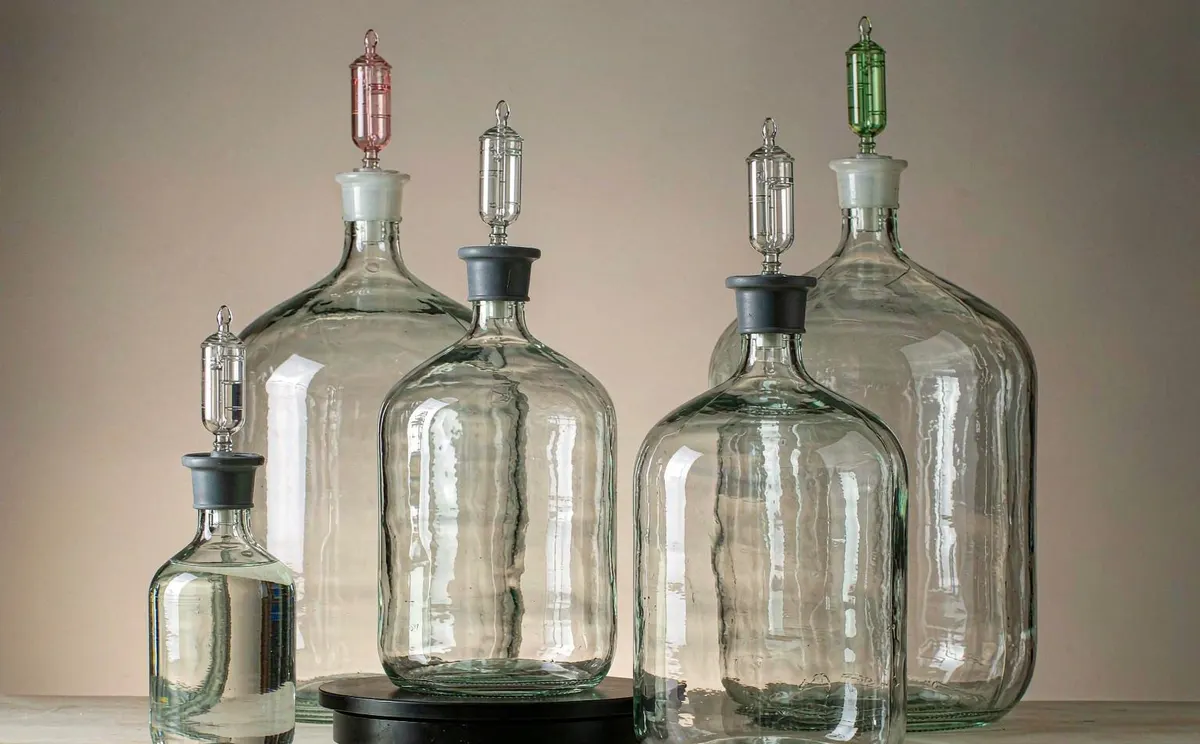
Narrow-mouth glass carboys for beer, wine and mead come in five wholesale sizes: 1 gallon (3.8 L), 3 gallon (11.4 L), 5 gallon (18.9 L), 6 gallon (22.7 L) and 6.5 gallon (24.6 L). Every size takes a #6.5 or #7 bored silicone stopper and a three-piece airlock, so the neck dimension is the specification to fix first and hold across reorders. The second choice is the glass: high-clarity soda-lime for most retail programmes, borosilicate where thermal shock resistance matters.
Sizes, dimensions and stopper fit
The figures below describe the standard range. Heights, diameters and weights are approximate, because they shift a little with the mould and with wall-thickness tolerance.
| Size | Metric capacity | Height (approx.) | Body diameter (approx.) | Net weight (approx.) | Stopper |
|---|---|---|---|---|---|
| 1 gal | 3.8 L | 320 mm | 170 mm | 1.6 kg | #6.5 bored |
| 3 gal | 11.4 L | 390 mm | 230 mm | 2.8 kg | #6.5 bored |
| 5 gal | 18.9 L | 480 mm | 270 mm | 4.1 kg | #7 bored |
| 6 gal | 22.7 L | 510 mm | 285 mm | 4.7 kg | #7 bored |
| 6.5 gal | 24.6 L | 525 mm | 290 mm | 5.0 kg | #7 bored |
The 5, 6 and 6.5 gallon carboys have a carrying handle moulded into the shoulder, so a full vessel can be moved without a separate harness. The 1 and 3 gallon sizes do without one and use a slim shoulder that is easy to grip by hand.
Which sizes to stock for which buyer
Size demand follows batch size, and batch size follows the end user. A hobby brewer works to a standard five-gallon batch, which is why the 5 and 6.5 gallon carboys carry most of the volume for homebrew supply distributors: one matches the batch, the other leaves headspace for a five-to-six-gallon primary fermentation.
- Homebrew supply distributors lead with 5 and 6.5 gallon. Their customers want a clear, reusable secondary fermenter with a handle and a stopper that fits the same way every time.
- Brewing equipment importers sell the carboy in a bundle with airlock, stopper, racking cane and brush. What they need is identical moulds across a shipment, with the neck diameter and stopper size written on the packing list, so every accessory fits every unit.
- Small wineries and meaderies favour 3 and 6 gallon for small-lot ageing and trial batches where stainless steel would be excessive. Splitting a harvest into several controlled lots is the usual reason, and borosilicate is the common upgrade.
- Private label and marketplace sellers depend on review ratings. The carboy has to photograph well in a starter kit and arrive unbroken, so glass clarity, clean shoulder lines and the carton matter more to them than a low price on a variable product.
Region changes the mix as well. North American retailers expect 5 and 6.5 gallon on the shelf because the homebrew scene is standardised on the five-gallon batch. In Europe, 3 and 5 gallon move well for wine and fruit wine, made in smaller households and often in the kitchen instead of the garage. Importers following the mead trend increasingly ask for 6 gallon in borosilicate, for slow fermentations that pass through temperature changes. Allocating container space by these patterns beats an even split across all five sizes.
Soda-lime or borosilicate glass
Two glass families are available. High-clarity soda-lime glass, also called high-white glass, is the standard: it gives the bright, transparent look retailers want and lets the user watch sediment settle during conditioning. Borosilicate is the upgrade for better resistance to thermal shock, and it suits wine and mead makers who rack between temperature zones.
Both glasses, and the silicone stopper, are selected for food contact. Documentation for the destination market can be supplied on request, and batch production records are kept for traceability. Amber-tinted glass can be requested as a custom option.
Why the narrow neck and glass suit secondary fermentation
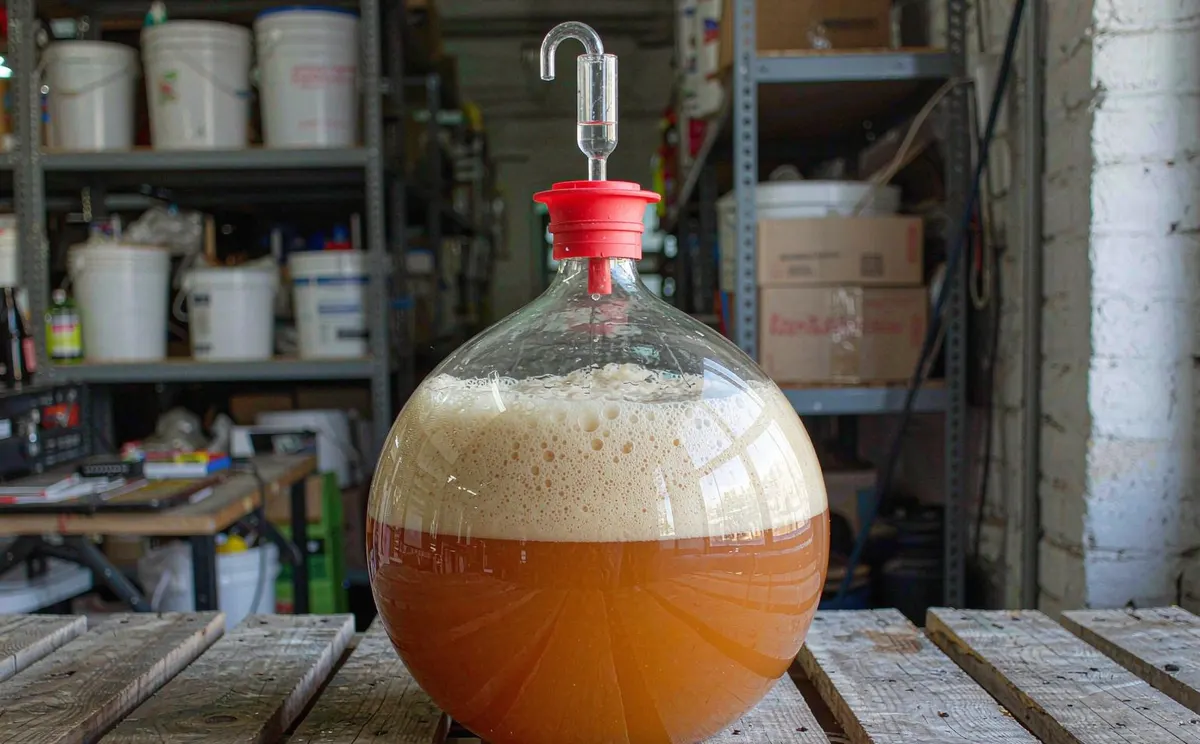
A carboy is a closed system made of three parts: a narrow neck, a bored silicone stopper and an airlock. Carbon dioxide leaves through the airlock while oxygen and contaminants stay out. The small opening also keeps the surface exposed to air low during racking and topping up, and holds volatile aromatics in the vessel through the long conditioning phase.
That is the difference from a wide-mouth fermentation vessel. Wide openings are for scooping and cleaning out solids such as sauerkraut, kimchi or hot sauce mash, and belong to the lacto-fermentation crock family. If that is the brief, the comparison to make is with wide-mouth glass fermentation jars, not with a carboy. A carboy is also not a storage jug: glass gallon jugs are built to hold and transport finished liquid, while the carboy is built around the airlock seat.
Against plastic fermenters the case for glass is practical. Glass is inert and does not scratch, and scratches in plastic are where bacteria and off-flavours collect. It carries no aroma from one batch to the next, so mead can follow beer in the same vessel, and it stays clear enough to watch the liquid drop bright. The cost is weight and fragility, which is why wall thickness, the handle and the carton deserve attention in the specification.
Forming and quality checks to ask about
Carboys are formed on automatic IS (individual section) machines that press and blow the body in one controlled cycle. The aim is even wall thickness and a smooth inner surface with nowhere for yeast or bacteria to lodge. The glass is then annealed in a lehr to relieve internal stress.
When we review a plant for a carboy project, these are the checks we look for in its inspection records:
- Dimensional inspection of wall thickness, base flatness and neck concentricity on each piece.
- Neck tolerance tight enough that the stopper seats firmly and the airlock holds its seal through primary and secondary fermentation.
- Thermal shock sampling per production lot, moving sample carboys between hot and cold water baths to mirror the temperature swings of cleaning and sanitising.
- Seal check at the neck and stopper interface. A weeping airlock leads to oxidation, and oxidised batches lead to returns.
- Shoulder load test on handled models, confirming the grip holds when a full 6.5 gallon carboy is lifted. Commercial buyers and catalogue insurers ask about this point.
Mould stability across reorders
Stoppers, airlocks and racking canes are all designed to a fixed neck dimension. If that dimension drifts between production runs, accessories stop fitting and the bundle fails at the customer's bench. For that reason we treat a locked mould specification per SKU as a supply condition, and ask for the mould history to be kept so a reorder two years later yields an identical piece.
The same stability lets a distributor reuse catalogue copy and plan shelf space over several years without a silent specification change.
Custom branding, kitting and packaging
Both OEM work (made to your specification) and ODM work (a new design developed jointly) are possible on all five sizes, and can be combined with accessory bundles. As a sourcing desk in Shanghai, we match each project to a partner plant whose moulds, furnace schedule and decoration capability suit it.
| Area | Options |
|---|---|
| Logo and markings | Screen printing with ceramic firing on shoulder or body, for logos and batch markings; etched or embossed shoulder logos that survive years of sanitising |
| Stopper and airlock | Standard bored silicone stopper with three-piece airlock; alternatives are a double-bubble airlock, a solid stopper for long-term storage, or a coloured silicone stopper in a brand shade |
| Printed inserts | Multilingual care and sanitation cards |
| Cartons | Export cartons with your artwork, barcode and pallet configuration, using moulded pulp inserts that protect neck and handle |
| Geometry (ODM) | Neck or handle changes, subject to tooling and food-contact review |
Print screens and colour codes are held on file for importers who rotate several private labels, which keeps repeat orders consistent. Having the kit packed before shipment removes local assembly work and means each retail box holds the right parts. For compliance-sensitive destinations, decoration and glass recipe can be aligned with regional food-contact expectations and backed by the matching test reports.
There is a modest sustainability point too. A glass carboy is fully recyclable and made to be reused for years, and the carton is recyclable pulp. Presenting it as a buy-once vessel is a claim a catalogue can defend; anything stronger is better avoided.
Planning the order and shipment
Minimum quantities and production timing are quoted per project. They depend on the mould, the decoration, the quantity and the line schedule, and custom decoration or a tint change adds time, so set the order against your sales calendar. Sample, inspection and claims terms are agreed before the order is placed.
Shipments move FOB, CIF or DDP according to the incoterm you name. On DDP entries a freight partner handles clearance and delivery to your warehouse. The document set is a commercial invoice, packing list and bill of lading, plus a certificate of conformity for food-contact glass where the destination requires one.
Carboys rarely need to travel alone. They can share a container with other product families through our food glass jar programme, which simplifies customs entry. Buyers building a full fermentation range often add kombucha bottles alongside, and swing-top beer bottles for the bottling and serving stage of the same customer's process. Repeat buyers can also work to a rolling forecast, where a confirmed quarterly plan reserves mould time and raw glass before peak season.
Frequently asked questions about glass carboys
Which carboy sizes are available wholesale?
Five: 1, 3, 5, 6 and 6.5 gallon. The two smallest suit small-lot wine, mead and experimental batches; 5 and 6.5 gallon are the usual choice for a five-gallon homebrew batch.
How does a narrow-mouth carboy differ from a wide-mouth one?
The narrow neck is made for sealed secondary fermentation under an airlock, limiting oxygen contact with beer, wine and mead. A wide-mouth vessel is made for handling solids and is a different product family, so keep the two apart when planning a catalogue.
Can a glass carboy replace a plastic fermenter?
Yes. It will not scratch or carry flavour between batches. Expect more weight and more care in handling, which thick walls, a moulded handle and a protective export carton are there to offset.
Is the glass safe for food contact?
Both the soda-lime and the borosilicate glass are chosen for food-contact use, and the silicone stopper is food grade and odourless. Material and compliance documents are available for importers who must meet local requirements.
Can the carboy carry our logo and packaging?
Yes. Printed, fired or embossed logos, alternative stoppers and airlocks, amber tint and custom cartons with artwork and barcodes are all possible.
What are the minimum order and production time?
Both are quoted per project, since they follow from the mould, the decoration, the order quantity and the freight terms.
Should we test samples before a bulk order?
Yes. Use them to confirm that your stoppers and racking equipment fit before committing to a full container.