A glass fermentation jar is a process vessel, not a retail pack: it has to take bulky vegetables through a wide mouth, vent carbon dioxide while keeping oxygen off the food, and let the maker see the brine and the culture. The standard wholesale range runs from 1.0 L to 10.0 L in food-grade soda-lime glass, with inner mouth openings from 100 mm to 140 mm. The 1-liter jar comes with a cloth lid and band; every size from 2.0 L up comes with an airlock lid and a glass weight stone.
Sizes, mouth openings and default accessories
All figures below are nominal and taken on the finished, empty jar. Mouth diameter is the clear inner opening at the rim, which is the number to check against a whole cabbage quarter, a packing hand or a fermentation weight. Body diameter and height are there for shelf spacing, crate packing and label planning.
| Capacity | Mouth diameter (inner) | Body diameter | Height | Glass weight (approx.) | Default accessories |
|---|---|---|---|---|---|
| 1.0 L | 100 mm | 110 mm | 170 mm | 480 g | Cloth lid, food-grade rubber band |
| 2.0 L | 100 mm | 135 mm | 210 mm | 720 g | Airlock lid, glass weight stone |
| 3.0 L | 110 mm | 155 mm | 230 mm | 950 g | Airlock lid, glass weight stone |
| 5.0 L | 120 mm | 185 mm | 270 mm | 1,350 g | Airlock lid, glass weight stone |
| 7.0 L | 130 mm | 205 mm | 300 mm | 1,780 g | Airlock lid, glass weight stone |
| 10.0 L | 140 mm | 230 mm | 340 mm | 2,400 g | Airlock lid, glass weight stone |
Capacity is held to plus or minus three percent and mouth diameter to plus or minus one millimeter, close enough for lid systems applied on an automated line. Because the glass formulation and the wide-mouth design are shared across the range, a brand that starts with a 2-liter home kit and grows into 10-liter commercial batches keeps the same look and the same fermentation behavior.
Matching the jar to the ferment
Most wholesale demand falls into four uses, and each one weights mouth width, seal type and visibility differently. Settle which one describes your product before fixing a capacity and an accessory bundle.
| Use | Sizes usually chosen | Closure | What matters most |
|---|---|---|---|
| Kimchi workshops | 3-liter and 5-liter | Airlock lid with a heavy glass weight | Wide mouth for packing and tasting; top layer held under the brine line |
| Sauerkraut and salt-brined vegetables | 5-liter and 7-liter | Airlock lid with weight stone | Anaerobic from the first hour |
| Kombucha | 2-liter and 3-liter for scoby hotels and starters; 10-liter for continuous brew | Cloth lid with a secure band | Breathable, insect-proof cover |
| Restaurants and craft brands | 7-liter and 10-liter for volume; smaller sizes for recipe development | Depends on the ferment | One jar family for production and brand identity |
Kimchi
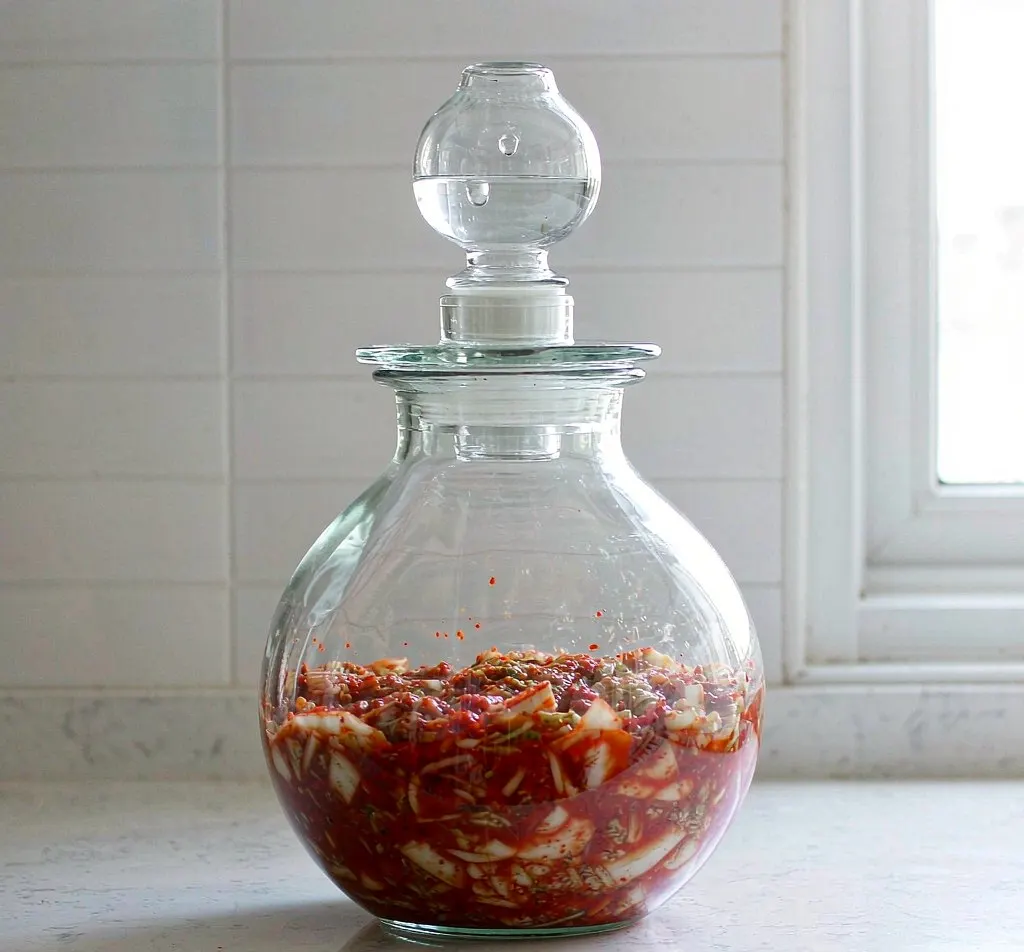
Cabbage quarters, radish strips and seasoning paste will not go through a narrow neck, and the maker has to press the mix down, taste it mid-ferment and confirm that everything sits under its own juices. Our wholesale kimchi jar range is specified around that: a wide opening plus a heavy weight that holds the top layer where oxygen cannot reach it. Workshops selling fresh kimchi by weight, or selling fermenting kits, tend to pick the two middle sizes because one person can still lift them full. Clear glass lets staff see the bubbling and the gradual color change that show the culture is working.
Sauerkraut and brined vegetables
If the cabbage is exposed to air early on, surface mold appears and the batch is lost. A dependable weight stone and a seal that vents gas but admits no air are what prevent that. These sizes give a worthwhile weekly batch while staying manageable on a prep table. Since the glass is non-porous, a maker can follow a caraway batch with a juniper or bay-leaf one without the earlier flavor lingering, which plastic pails cannot promise after a few cycles of scratching.
Kombucha
Kombucha ferments at the surface: the scoby forms a mat on top of sweet tea, so the vessel needs to breathe rather than seal hard. We suggest the cloth-lid setup, with a loose airlock as an option for the secondary stage. Brands that bottle the finished drink separately can take the packaging side from our kombucha bottle range and keep glass from brew to bottle.
Restaurants and craft food brands
Kitchens use these jars back of house for hot sauce mash, fermented hot honey, miso trials and seasonal vegetable ferments. Some also sell a signature kimchi or kraut and want the fermenting jar to be part of the brand. Once a ferment is stabilized and ready for sale, jam and preserve jars are the packaging companion for brands that sell finished preserves as well.
Lids, weights and decoration
The accessories decide whether a batch works, so specify them with the jar rather than afterwards.
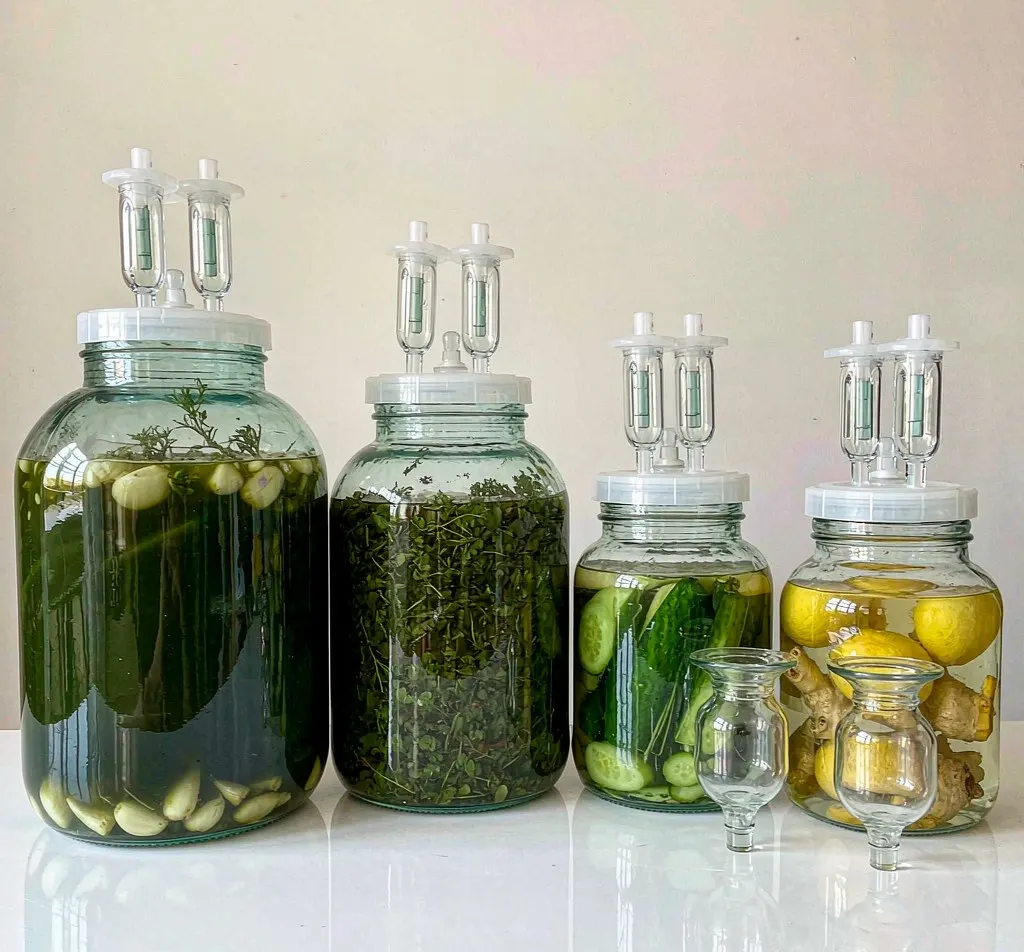
- Airlock (water-seal) lids. Gas bubbles out through a small water channel and outside air cannot return. It is a passive one-way valve with no moving parts, and the most requested accessory for anaerobic vegetable ferments. Two versions are available: a three-piece airlock that fits the 100 mm to 140 mm mouth range, and a single-piece immersed-tube type with fewer parts to sanitize.
- Glass weights. These are solid glass, not ceramic. Solid glass is denser, easier to sanitize and has none of the unglazed micro-pores that hide residue. Each weight is sized to its jar and shaped to sit flat so no air is trapped beneath it.
- Scale marks. Fired ceramic graduations in liter increments, or a paired measurement band, let a team record fill level and brine ratio on the jar itself. Fired marks stand up to dishwasher heat and acid far better than adhesive labels.
- Silk-screen printing. Logos, batch codes and usage instructions can be printed in one or several colors. The print is cured at high temperature, so it does not flake into food or wash off in commercial sanitation.
- Other lids. Metal lug lids suit short-term storage once fermentation is finished; bamboo or plastic-free composite lids give a natural look for retail display. Liners come in standard plastisol or a compostable plant-based compound.
Any of these can be re-bundled to suit a recipe and process, and the 1-liter jar can take an airlock in place of its cloth lid on request.
Why glass rather than ceramic or plastic
During fermentation the food sits against the vessel wall, often in acid, for days or weeks. Whatever the wall gives off or takes up ends up in the product.
| Material | Strengths | Weak points for live ferments |
|---|---|---|
| Soda-lime glass | No pores, odor-neutral, inert in acid, clear enough to monitor the ferment | Heavier than plastic |
| Ceramic crock | Traditional look, insulates well | Unglazed interiors are porous; glaze can chip and expose pores; hard to reset once contaminated |
| Plastic pail | Light and cheap | Scratches hold bacteria and carry flavor over; some plastics react with acid over long contact |
Fermented foods are frequently below pH 4.0, and some mashes are much more aggressive. Soda-lime glass does not leach or degrade in that range. The jars are made to food-contact standards aligned with U.S. FDA requirements for glass touching acidic and non-acidic food, and a certificate of compliance can accompany each shipment lot for your own audits and retailer onboarding.
Process jars and packaging jars are different purchases
A jar for finished pickles is passive. It holds an acidified, stabilized product and only has to keep it safe in storage and transit. A fermentation jar works alongside a living culture and has to manage gas, exclude oxygen and stay readable from outside. Picking the wrong type is a common reason a first sauerkraut goes soft, a scoby gets contaminated or kimchi varies from batch to batch.
If you are filling finished product for the shelf, look at our wholesale pickle jars and the wider wide-mouth food jar application page instead.
Briefing an order
Tell us the ferment, the batch size, the lid system and any printing, and we match the project to a suitable plant and check the drawing before sampling. Minimum quantity, unit cost and timing are quoted per project. They depend on the mould and the line it runs on, the decoration, the accessory bundle, the quantity and the freight terms. Printing and custom accessory sets are quoted as separate lines from the glass.
Frequently asked questions
Which size suits a small kombucha scoby hotel?
The 2-liter jar is the usual choice. It holds enough sweet tea to keep a culture healthy without taking over the counter, and the wide mouth makes it easy to move a scoby and to clean.
Is the glass safe for strongly acidic ferments such as sauerkraut?
Yes. It stays inert across the acidic range typical of fermented vegetables, which is why it is preferred to many plastics for long ferments.
Can I see a sample before a bulk order?
Yes. We coordinate samples so you can test the jar and lid with your own recipe before committing.
How should the jars be cleaned between batches?
Rinse out the solids, wash with a food-safe detergent and a soft brush, then sanitize with a no-rinse brewing sanitizer or a diluted heat treatment. Do not use steel wool: it can scratch the surface and create places for residue to collect over time.