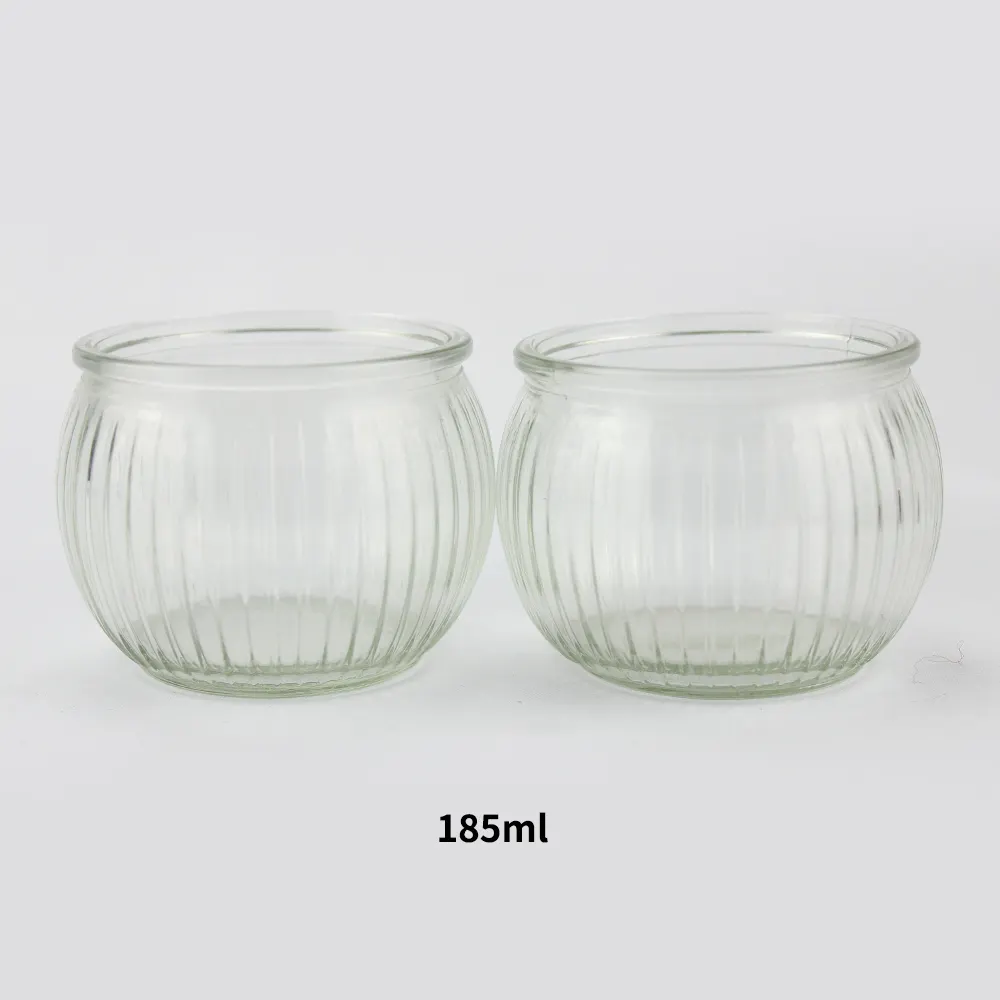
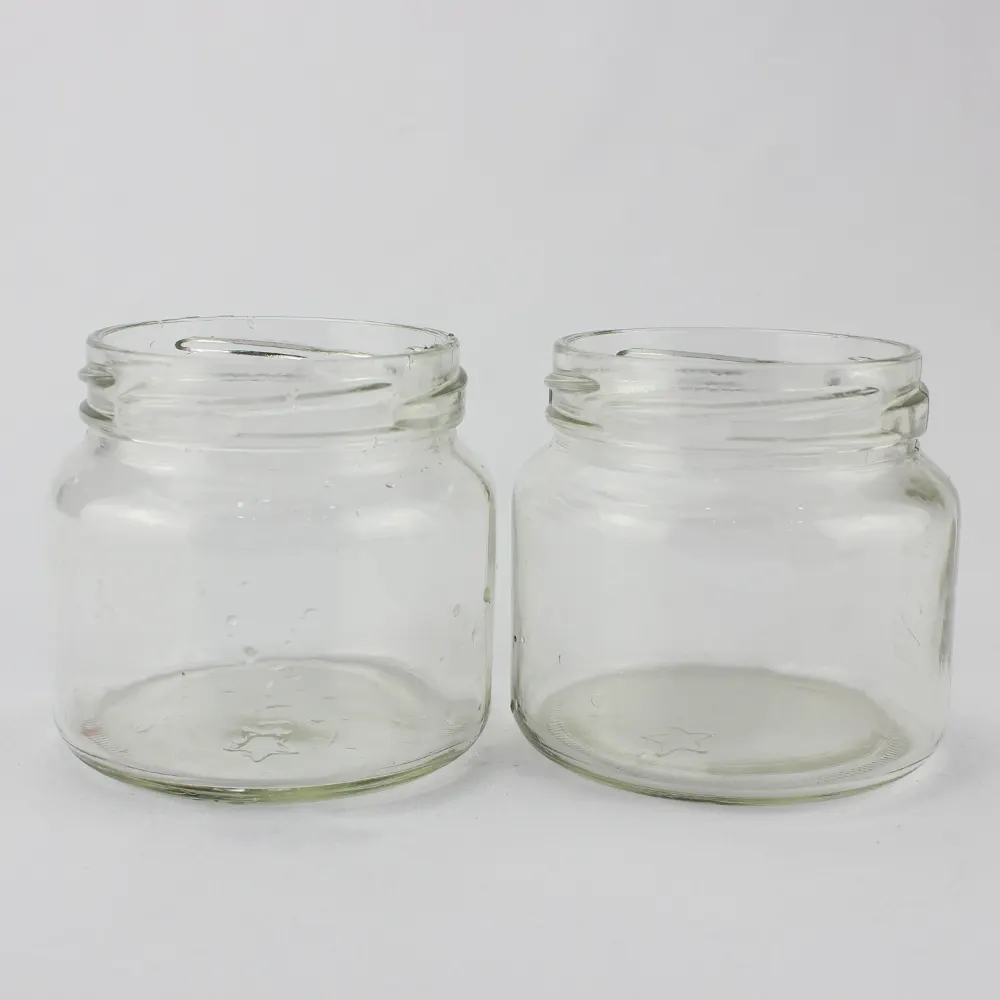
Part of our wide mouth glass jars range; the stock moulds are pictured at the end of this guide.
Wholesale pickle jars are round soda-lime glass twist-off jars in seven common sizes from 212 ml to 1,000 ml, closed with 63 mm, 70 mm or 82 mm lug caps. What makes one fit for brined food is less the shape than the annealing and wall thickness, because the jar has to take brine at 82–88 °C or a pasteurization tunnel and then a cold-water spray. The working rule for annealed soda-lime is to keep the temperature gap between jar and brine under 42 °C.
Sizes and the finish each one takes
A pickle range normally runs to between three and five capacities. The jar's finish, the moulded glass rim that the cap grips, follows from the size.
| Capacity | Twist-off finish | Typical use |
|---|---|---|
| 212 ml | 63 mm | Cornichons, cocktail onions and garnishes, airline and foodservice portions |
| 314 ml | 63 mm | Gherkins, relishes, small-batch retail lines |
| 370 ml | 70 mm | Small-batch retail, dill and bread-and-butter pickles |
| 500 ml | 70 mm | Main volume size in European and Middle Eastern retail |
| 580 ml / 720 ml | 82 mm | The North American 24 oz shelf size, Eastern European family jars |
| 1,000 ml | 82 mm | Club stores, horeca, sauerkraut sold by the kilo |
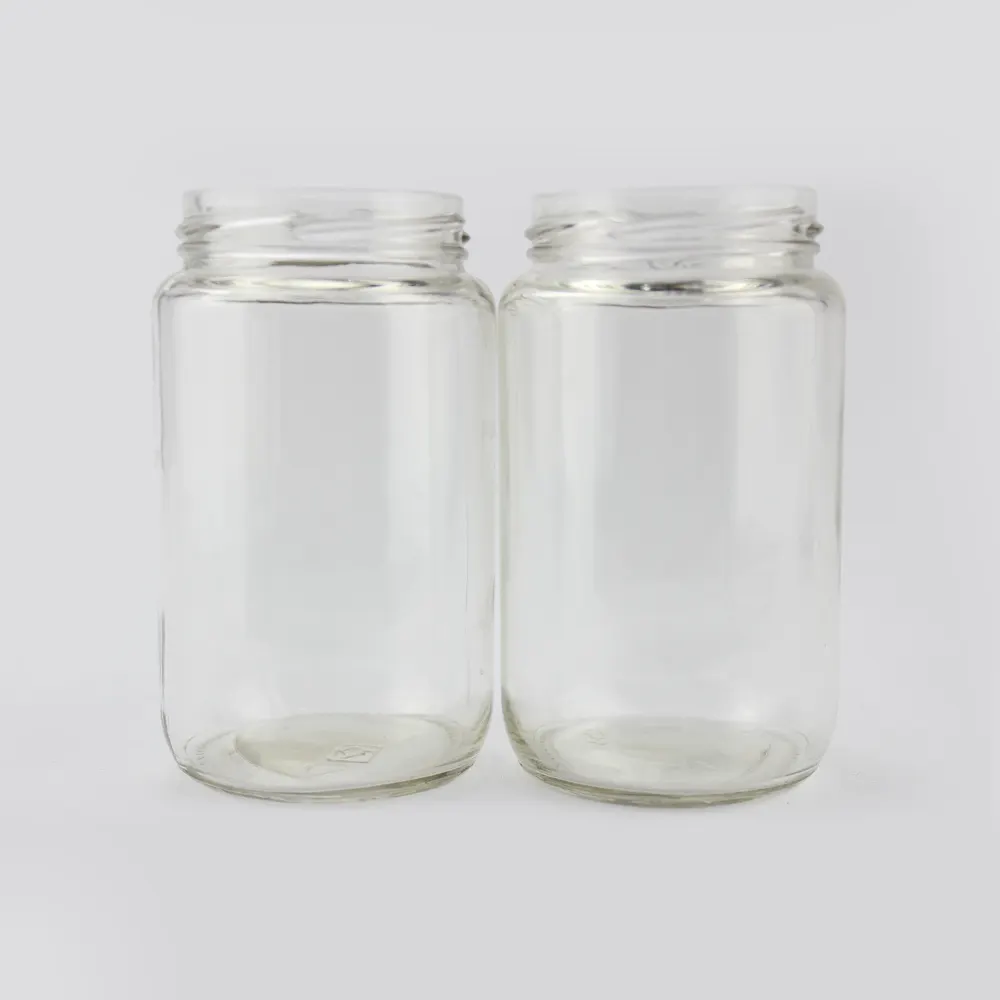
Round bodies are the norm. Hexagonal and faceted jars are mostly chosen by artisan brands that want to look different on the shelf. Two neighbouring products need their own specification: fermented vegetables such as kimchi raise headspace and venting questions, covered on our kimchi jar page, and jars for the home-canning channel use a two-piece lid, described under mason and canning jars.
Why pickles are hard on a container
Pickled vegetables combine a low pH, typically 3.2–3.8, with salt and acetic acid, and the process takes the pack from about 85 °C at filling to a cold spray in less than an hour. Tinplate corrodes under those conditions, and some plastics stress-crack or absorb flavour. Correctly specified soda-lime glass is unaffected by the chemistry, so the buyer's attention belongs on the thermal side.
Glass specification for hot-fill
Shelf-stable pickles are packed in one of two ways. In hot-fill-and-hold, product and brine go in at 82–88 °C, the cap goes on, and the jar is held or inverted so the heat sterilizes the headspace. In fresh-pack, the brine goes in cold and the closed jar is pasteurized afterwards.
The risk in hot-fill is thermal downshock at the filler, when hot brine meets a cold jar. ASTM C149 thermal shock testing and general industry practice both treat a ΔT of 42 °C as the safe limit for annealed soda-lime containers. Jars that have been stored cold therefore need warming before they reach an 88 °C fill, which is the reason pre-warming tunnels exist. A badly annealed jar can pass every check at the glass plant and still break on your filler, where a breakage costs the most.
Wall thickness is the other control. A standard 720 ml pickle jar has a sidewall of 2.8–3.2 mm and a base push-up shaped to spread the impacts of the filling line. The same jar can be lightweighted below 2.4 mm, but breakage climbs on lines running faster than 300 jars per minute. Trial a lightweight version on your own line before ordering a season's volume.
Glass specification for tunnel pasteurization
Fresh-pack pickles, relishes and many export products pass through a continuous tunnel that raises the product core to 74–82 °C, holds it, and steps it down through cooling zones. Acidified vegetables typically need PU values of 10–25. Cooling is the dangerous half of the cycle: the jar surface chills faster than its core, and the outer wall goes into tension.
Three requirements keep tunnel losses below 0.1%:
- Even annealing through the whole batch. One passing sample proves little. Ask for polarimeter readings by cavity and by shift.
- Clean sidewalls. No seeds or blisters larger than 1.5 mm, and automatic rejection of stones or cord near the finish.
- Controlled base thickness. A thin base flexes at conveyor transfers and develops checks at the heel. Heel radius and base distribution should stay within ±0.3 mm from cavity to cavity.
Twist-off finish, torque and vacuum
A dependable vacuum seal depends on the glass finish more than on the cap. Naming the nominal diameter is not enough; the specification should also state the lug geometry and the torque window between glass and cap.
We specify finishes to the GME/GMI dimensional standards with finish height held to ±0.2 mm. Each jar and cap pairing is then checked for application torque, typically 8–18 in-lb depending on diameter, and for removal torque after pasteurization. Caps come with plastisol or PVC-free compound liners.
Vacuum retention over 12 months at ambient temperature can only be proved with your brine, your cap and your process, so we arrange pre-production samples for that seal trial. Tell us in the RFQ if you run steam-vacuum cappers, since headspace and thread engagement requirements shift slightly.
Fit with the filling line and packing
Check three interfaces before the first container leaves:
- star-wheel pitch diameter against the jar body, which carries a ±1 mm tolerance on outside diameter;
- the height of the transfer dead-plate against the heel profile;
- the cap chute against the lug finish.
Plants that switch between products, pickles on one shift and hot sauce bottles or jam jars on the next, can ask for common-body designs so that several SKUs share change parts.
Jars ship on 1,000×1,200 mm export pallets with layer pads and a shrink hood. A 720 ml jar loads at roughly 1,100–1,300 units per pallet, the figure depending on bulk palletizing versus cartons with dividers. Bulk pallets with inverted layer pads suit magnetic or vacuum depalletizers. Hand-fed lines see less handling damage with cartons of six or twelve.
Documents to request with each lot
A lot should arrive with a certificate of analysis that states annealing grade, the thermal shock pass rate at ΔT 42 °C under ASTM C149, internal pressure (which matters if you plan a carbonated brine) and dimensional AQL of 1.0 on critical characteristics. For food contact, ask for heavy-metal and migration reports to EU 10/2011 and FDA 21 CFR. Your QA team will want both sets for BRCGS or SQF supplier approval.
Our page on pre-shipment inspection of glass packaging lists the checkpoints, and the bottle and jar RFQ checklist is a template for writing all of the above into an enquiry.
Notes for restaurant chains and co-packers
Chain and horeca buyers carry few SKUs at high volume, so freight density matters more to them than to a retail brand. A 1,000 ml jar with a 100 mm body loads noticeably worse than a slim 95 mm version of the same brimful volume. A well-planned load puts 22–24 tonnes of saleable glass into a 40HQ.
Co-packers working the cucumber season should plan early. Pickle jar moulds tend to run in concentrated campaigns from late summer through autumn, so glass plant capacity is easier to secure when it is reserved by May than when it is requested in August.
FAQ
What is the minimum order for wholesale pickle jars?
It is quoted for each project. The figure depends on the mould, the machine it runs on, the cap and the packing format.
Can I hot-fill at 88 °C without pre-heating the jars?
Only if the jars are already warm enough to keep the differential with the brine under 42 °C. For jars coming out of cold storage, add a pre-warming stage.
Should I run a trial before the season starts?
Yes. For fresh-pack products, run a seal and breakage validation with your own brine and PU profile before the first full production. Samples are arranged for that purpose.