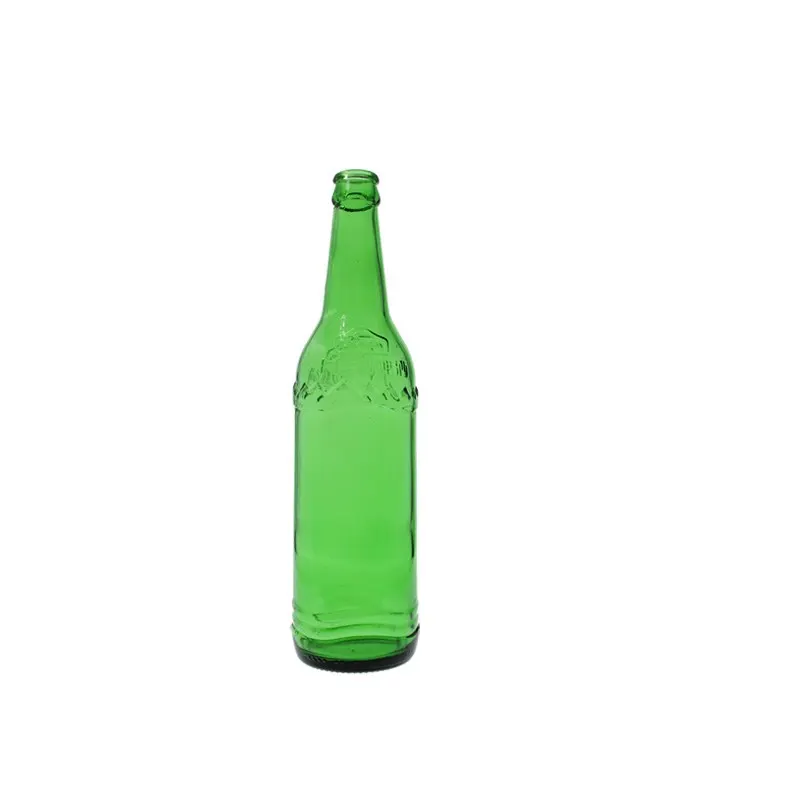
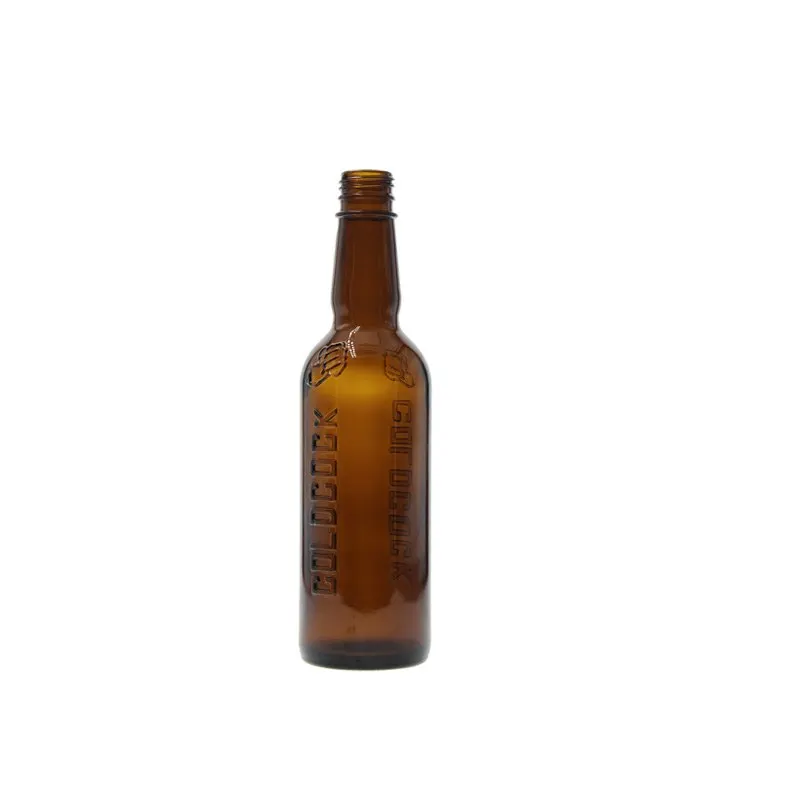
Filed under empty beer bottles; the moulds we quote for this are pictured at the foot of the page.
A swing top holds beer carbonation only when four parts agree with each other: the glass neck, the wire bail, the stopper and the gasket. The gasket is the one part that seals, and it is a consumable, so most leak complaints trace back to its compound, its hardness or its age rather than to the bottle. Before asking for a closure recommendation, fix three things: the highest pressure the pack will ever see, the washing regime if the bottle comes back, and how many closing cycles you expect between gasket changes.
How a swing top seals
The glass carries a loading ring (also called a bail ring) moulded into the neck beneath the finish, which is the shaped top of the neck. A bail of spring steel wire hooks under that ring. A stopper in porcelain or moulded plastic sits on top of the finish, and a gasket, either seated in a groove in the stopper or fitted as a flat washer, is squeezed between stopper and glass.
What makes this different from a crown is where the force comes from. A crown is crimped once by a machine at a controlled pressure and thrown away when the bottle is opened. A swing top is closed by hand or with a simple lever, and the force on the seal is whatever elastic tension the wire holds. That tension is fixed when the closure is assembled and then drifts: the wire relaxes, the gasket flattens for good, and every wash, fill and storage period moves it a little further.
Since no machine controls the closing force, seal repeatability rests mainly on the gasket. A porcelain stopper can stay in service for years while the ring of rubber behind it fails after one hot wash, and when that happens the leak is usually blamed on the glass.
What to put on the neck and bail specification
The swing finish
A crown finish is built around a crown seat and a bead for the metal skirt to grip. A swing finish is built around a seating surface, flat or lightly profiled, plus the ring that anchors the wire. Four dimensions matter on the drawing:
- the diameter of the seating surface and how flat it is;
- the outside diameter of the finish where the bail straddles it;
- the height from the seating surface to the underside of the loading ring;
- the diameter and cross-section of the loading ring.
An incorrect ring section stops the wire from seating fully, and the closure then runs below its designed tension from the very first closing.
The bail wire
Bails are often bought as a commodity accessory, which is a mistake. The wire has a diameter, a hook form that grips the loading ring, and a lever geometry that sets how much mechanical advantage the hand gets. Two bails that look the same in a photo may differ by a fraction of a millimetre in wire diameter and by more in hook radius. One outcome is a closure nobody can shut by hand at the target carbonation; the other is a closure that shuts easily and holds too little tension. Specify the bail as a spring.
The stopper
Porcelain keeps its dimensions through repeated washing, but it is rigid. It absorbs none of the variation in the glass finish, so the gasket has to take up all of it. Plastic is lighter, and it can be moulded with a deeper gasket groove that gives more predictable compression. Its limit is heat: some polymer grades soften at high wash temperatures, and the compression available to the gasket drops permanently. For a bottle that will be washed and refilled, pick stopper and gasket as a pair against the wash temperature.
Dual crown and swing necks
Some bottles are moulded with a crown finish and a swing loading ring on the same neck. The same glass can then run under a crown on a high-speed line and take a swing closure for a special release. The neck profile changes as a result, so standard swing finish dimensions cannot be assumed to carry over. Dual-closure capability has to be requested before the mould is cut; it cannot be added to an existing mould.
Choosing the gasket material
A gasket works by flowing into the microscopic unevenness of the glass seat and staying there under spring load for as long as the pack is on the shelf. Whether it manages that depends on its hardness, its compression set (how far it fails to spring back after being squeezed) and its resistance to both the beer and the cleaning chemicals.
| Material | Strengths | Weaknesses | Where it fits |
|---|---|---|---|
| EPDM | Resists water, steam and the caustic solutions of bottle washing; copes reasonably with the temperature swings of a returnable loop | Attacked by oils, solvents and some product components | The first compound to trial for beer unless the contents or the wash say otherwise |
| Silicone | Wider service temperature range; stays flexible in the cold, useful for winter storage and shipping | Lets more carbon dioxide through than EPDM | High-temperature sterilisation, or contents that attack EPDM |
| Natural rubber | Seals very well at low closing force | Ages badly under oxygen, ozone and light; can taint the product | A presentation choice for a small, fast-turning gift release, not a long-life product |
| Nitrile | Stands up to oils and solvents that would degrade EPDM | Generally less resistant to the caustic and acid chemistry of a washer | Oil- or solvent-bearing contents, once the cleaning regime has been checked |
Whatever the compound, it must suit food contact in the destination market. The frameworks buyers cite most often are Regulation (EU) No 1935/2004 and, for the United States, FDA 21 CFR Part 177. We name them as the frameworks a supplier should be able to discuss for a specific compound, not as a claim about any product. Ask for the compound designation and its supporting declaration, and read the declaration for the intended use temperature; a generic food contact statement is not enough.
Carbonation loss through the gasket
Every swing top lets carbon dioxide escape slowly through the gasket. The rate follows the material, the gasket thickness, the spring load from the bail and the storage temperature. For lightly carbonated beer, the loss across a normal shelf life rarely limits anything. As carbonation rises, the closure reaches its limit before the glass does. For that reason the target carbonation level is the most important single number to state in a closure enquiry.
Swing tops compared with crowns and corks
The pressure column below is deliberately qualitative. What a closure holds depends on the glass, the fill temperature, the headspace volume and the state of the gasket, so one figure would mislead. The final column lists what should be settled with the plant before an order is placed.
| Closure | Pressure capability | Sealing material | Reuse | Typical use | Confirm before ordering |
|---|---|---|---|---|---|
| Swing top, porcelain stopper, wire bail | Usually the highest of the swing options, as the rigid stopper does not deflect; suits well-carbonated beer | EPDM as a rule; silicone for high-temperature washing | Bottle and stopper effectively permanent; gasket replaced on a schedule | Gift packs, brewery specials, small-batch returnable programmes | Seat flatness, loading ring section, wire diameter and hook radius, gasket compound and its use temperature |
| Swing top, plastic stopper, wire bail | A little below porcelain at equal bail tension, since the stopper can flex under pressure | EPDM as a rule; stopper often moulded with an integral gasket seat | Stopper replaceable on its own; gasket remains the wear item | Large-format bottles, promotional lines, repeat releases | Stopper polymer and heat deflection temperature, groove dimensions, availability of the stopper as a spare |
| Swing top, ceramic stopper, stainless bail | Comparable to porcelain; stainless wire resists corrosion in humid or coastal storage | EPDM or silicone | Bail and stopper reused; gasket replaced | Presentation packs and export markets with humid storage | Wire grade and passivation, gasket hardness, seat surface finish |
| Crown cap, pry-off | Generally the highest among common beer closures, because every crimp is machine-controlled | Polymer liner; cork composite in some traditional markets | Single use; destroyed on opening | High-speed lines and most commercial beer | Finish code, liner compound, capping head qualified on that exact finish |
| Crown cap, twist-off | Close to pry-off on the same finish, but unreliable without a matched finish profile | Polymer liner | Single use | Markets that expect hand opening; some contract filling | That the finish is a twist-off profile, not a pry-off profile of the same nominal diameter |
| Cork with wire cage and hood | Suits high-pressure and refermented styles when cork and cage are sized correctly | Natural or agglomerated cork; sometimes a polymer closure under the hood | Single use; cannot be reseated reliably by hand | Bottle-conditioned and Belgian-style releases | Cork diameter and length, cage wire tension, neck bore, storage orientation |
Pairings that hold and pairings that leak
These describe how the system behaves. Each still needs checking against the real glass drawing and the real gasket compound.
Two that work
- Porcelain stopper, EPDM gasket of suitable hardness, bail matched to the ring. With a seating surface flat within tolerance and a ring section that fits the hook, the gasket deforms and the stopper does not. Sealing force is predictable and tolerant of how firmly someone snaps the bail shut.
- Plastic stopper at moderate carbonation. If storage temperature is controlled, the slight flex of the stopper stays inside what the gasket can absorb.
Five that fail
- Soft gasket under high bail tension. Closing harder does not seal better. The gasket is over-compressed and takes a permanent set, so the bottle is tight on filling day and leaking two weeks later, after the pallet has left. Match hardness to the intended compression.
- Rigid stopper with a gasket too thin for the finish tolerance. Porcelain cannot bend, so with no compression margin the bottles at one end of the tolerance never seal. It reads as a random defect when it is a tolerance problem.
- Hot caustic wash on an unsuitable compound. The gasket swells, hardens or cracks and the next fill leaks. In a returnable loop the wash cycle, not the filling line, selects the gasket.
- Bails and bottles from unrelated sources. A bail made for another loading ring may close and still apply the wrong tension. Spare bails need wire diameter and hook radius held as controlled dimensions.
- A closure never qualified for the real pressure. The usual case is bottle-conditioned beer where refermentation pressure was guessed, and the closure was picked for carbonation at filling. Declare the peak, not the average.
Planning reuse and gasket replacement
A returnable swing top programme needs a written replacement policy. Reusability is real, but it has a limit, and the gasket sets it.
Once an elastomer has taken a compression set it no longer recovers its thickness, and the bail delivers less sealing force even though the wire is unchanged. Hotter washes, stronger caustic, longer contact and repeated hot-cold cycling all speed this up. Gasket life is therefore a property of your process, and no supplier can state it in isolation. Establish it by running a defined number of fill, wash and storage cycles on your own equipment, measuring the seal, and setting the interval with a safety margin. A figure offered without that trial is an estimate.
The wire ages more slowly. Spring steel loses tension under repeated stress and through corrosion. In a humid warehouse or a coastal market, an unprotected bail rusts at the hook, which weakens it and alters its geometry. Specify passivation or other wire protection with the order instead of swapping bails at the customer.
The stopper normally outlasts both. Porcelain is essentially inert to wash and contents. Plastic survives while the wash stays under its softening point. If stoppers deform in service, measure the temperature at the stopper itself; the surface of the load often runs hotter than the machine set point during the hottest phase.
Dimensions to control for repeat orders
Three items on the drawing make a second order interchangeable with the first:
- loading ring diameter and section;
- bail wire diameter and hook radius;
- gasket dimensions together with the compound designation.
With these recorded, a repeat delivery is checked against numbers. Without them it is accepted on looks, and a programme ends up holding two incompatible generations of one bottle.
Closing on a small line
When a person or a plain lever does the closing, the operator becomes part of the seal. A closing station with a defined stroke, or at minimum a written closing procedure, turns that variable into a machine setting. It is worth specifying at any real volume, and it is also what makes the gasket interval measurable.
What to send for a closure recommendation
We need three inputs to assess a swing top closure, and a neck drawing if one exists.
- Peak pressure and temperature. The highest pressure the pack will reach, normally at the end of bottle conditioning and not at filling, with the maximum storage temperature.
- Nominal capacity. It fixes the headspace volume, and so how internal pressure builds for a given quantity of dissolved carbon dioxide.
- Reuse intent. For returnable bottles, the wash temperature, caustic concentration and approximate number of cycles. Those three numbers choose the gasket.
With a neck drawing or existing finish dimensions we can check the loading ring and seating surface in the same pass. If a value is unknown, mark it as unknown. Pressure and wash temperature are the two that most often change the recommendation, and both are easier to confirm before an order than after.
Tooling, price, minimum quantity and timing are not given here; they follow from a finished specification and are quoted per project, driven by the mould, any decoration, the quantity and the freight terms.
Questions this article leaves to other pages
Capacity is an input to the closure decision, not something the closure decides, so nominal and brimful capacities, fill heights and conveyor behaviour are treated as format questions elsewhere. The short, wide 330 ml shape and how it runs on a modern line is covered in our guide to stubby beer bottles. Container volume, case and pallet configuration, loading patterns, commercial terms and the production evidence to request from a supplier sit with the wholesale beer glass bottle range. If the format and the closure both have to be created, for instance a bespoke loading ring or an embossed shoulder, the project is a development job and belongs under custom beer bottle moulds.
Frequently asked questions about swing top beer bottles
What pressure can a swing top beer bottle hold?
No single figure applies, since closure, glass and fill conditions act together. A rigid stopper with a correctly sized gasket is comfortable at typical beer carbonation. Highly carbonated and bottle-conditioned beers are where the closure, not the glass, becomes the limit. Give us the pressure at the end of conditioning or at the hottest storage temperature and the system can be assessed against it.
How many times can a swing top bottle be reused?
Glass and stopper go round many times. The gasket does not, and its life depends on wash temperature, caustic strength, contact time and storage, so any count quoted without reference to your process is only an estimate. Run trial cycles on your own line, then set the interval with margin, and inspect bail hooks for corrosion at each change.
Which gasket material should I choose for beer?
Start with EPDM. Move to silicone for a wider temperature range or contents that attack EPDM, accepting higher carbon dioxide permeability. Consider nitrile only where oils or solvents are present, and check it against the washer chemistry first.
Do I need a different bottle for a swing top than for a crown cap?
Yes. The swing closure needs a moulded loading ring below the finish and a seat flat enough for a gasket, whereas a crown finish is profiled for a crimped metal skirt. A combined neck that accepts either closure exists, but only if it is designed into the mould from the start.
Why do my swing top bottles leak after a few weeks in storage?
Most often the gasket has set permanently and the bail no longer presses as hard as it did on filling day. Over-compression at closing, a soft gasket under a tight bail, an unsuitable wash and warm storage all contribute. Less commonly, a rigid stopper and a gasket with no margin meet a finish at the edge of tolerance; then only part of the batch leaks. Look at gasket condition and storage temperature before changing the bottle.
Can I replace just the gasket instead of the whole closure?
Yes, and refillable programmes are normally run that way. It works only if the gasket is a separate line item with dimensions and compound designation on the drawing; otherwise there is no reliable way to reorder it. Confirm too that the stopper is available as a spare, because a softened plastic stopper is occasionally the real fault.
Are swing top bottles suitable for gift packs and small batch releases?
They are a common choice there, as the closure signals reusability. Plan for closing that is slower than a crowner, a seal that depends on the closing procedure unless a station is used, and a gasket interval to manage if bottles are collected back. The practical controls are a defined closing procedure, a specified compound with a food contact declaration for the destination market, and packaging that protects bail and stopper in transit.