Part of our empty beer bottles range; the stock moulds are pictured at the end of this guide.
Why Breweries Choose the Stubby Bottle Format
The stubby beer bottle, often called the steinie in North American craft circles, is a short, wide-shouldered container that has moved from a 1960s convenience format into a deliberate brand and logistics decision for modern craft breweries. When a packaging engineer sits down with a production manager to specify a new SKU, the stubby is rarely chosen by accident. It is chosen because its geometry changes three variables that directly hit the brewery’s margin: freight density, breakage rate, and shelf stand-out. A standard 355 ml stubby stands roughly 158 mm tall with a body diameter near 66 mm, against a longneck that reaches 229 mm tall at a similar diameter. That 71 mm reduction in height is not cosmetic. It lets a brewery stack more rows per pallet layer and more layers per truck, and it reduces the cantilever leverage that snaps bottle necks during transit.
From a filling-line standpoint, the stubby is forgiving. Its lower center of gravity means it tracks through a rinser, filler, and capper with less vibration, and the shorter bottle is easier for a six-pack collation module to stabilize during film wrapping. Many craft breweries that started on longnecks and switched to stubbies report a measurable drop in line jams at the infeed screw, simply because the shorter bottle presents a more uniform pitch to the timing screw.
Marketing teams like the stubby because it reads as “premium” and “retro” without a word of copy. The wide front panel gives label designers more vertical and horizontal real estate for a story, and the squat silhouette photographs well in taproom and e-commerce contexts. But the procurement-driven argument is harder and more durable: a stubby’s shape resists toppling. On a crowded retail shelf, a bottle that does not tip when a shopper pulls a neighbor is a bottle that stays full and priced. In our damage audits across export shipments to North America and Europe, stubby formats show a return/break rate of 0.8 % to 1.4 % versus 1.9 % to 2.7 % for comparable longnecks in the same corrugate. That single-digit percentage gap, multiplied across an annual volume of two million bottles, is the difference between a tidy profit line and a write-off.
Another factor breweries underweight is the reusable and recycle stream. Stubbies are common in deposit-return systems in parts of Europe and Canada, and their thick, short walls survive multiple wash-and-fill cycles better than thin longnecks. A brewery running a closed-loop refundable program can see a returnable stubby survive 8 to 12 trips before culling, versus 5 to 8 for a longneck, because the neck and shoulder are the most failure-prone zones in a bottle washer and the stubby has less of both. For a regional craft brewery with a captive local market, that reuse economics alone can justify the format switch.
Thermal mass matters for the cold chain, too. A stubby holds less total liquid per identical gram of glass than a tall bottle of equal capacity would if wall thickness were equal, but more importantly the squat body cools faster in a display cooler because the surface-area-to-volume ratio is higher. Field tests in convenience coolers show a 355 ml stubby reaching serving temperature roughly 18 % faster than a longneck of equal volume and glass mass. Faster chill equals faster sell-through in impulse channels, which is exactly where craft brands fight for placement. When you specify the format, you are not just choosing a container; you are choosing a unit of cold-chain velocity.
Finally, the stubby supports differentiation without a decorating premium. Because the format is less common than the longneck on many shelves, a brewery gains contrast simply by adoption. Combined with embossing on the shoulder or base, which we can tool for a one-time mold charge, the stubby becomes a tactile brand asset. Our team at beer bottle manufacturers has helped dozens of craft clients move from a generic longneck to a proprietary stubby and trace the lift directly to shelf recognition in distributor audits.
Sizes, Weight, and Neck Finish Specs
The two workhorse capacities for the stubby format are 330 ml and 355 ml, and the difference is more than a 25 ml volume gap. The 330 ml size is the European and UK craft standard, matching the half-pint-plus serving expectation and aligning with many continentals’ 330 ml can parity. The 355 ml size (12 US fl oz) is the North American craft norm and the size distributors expect on a shelf next to domestic macros. Both sizes share the same 26 mm crown finish, which is the single most important compatibility fact for a brewery: any standard 26 mm crown capper and any standard 26 mm cap will seat correctly, regardless of who blew the glass.
For 355 ml stubbies we hold a reference specification of 158 mm height, 66.0 mm body diameter, 26.0 mm finish diameter, and a fill point that leaves roughly 38 mm of headspace to the crown seat. The 330 ml version trims height to about 150 mm and holds the same diameter, preserving the squat proportion that defines the format. The bottle weight, the metric every freight calculator watches, lands in a controlled band of 280 g to 320 g depending on the internal pressure rating the brewery requests. A standard 1.2 MPa-rated stubby weighs about 295 g; a high-pressure 2.0 MPa sparkling or bottle-conditioned version climbs to 315 to 320 g because we add glass to the shoulder and base where hoop stress concentrates.
The 26 mm crown finish itself has two distinct thread families the buyer must name explicitly: pry-off and twist-off. Pry-off, also called the 26 mm standard crown or “bottle cap” finish, requires an opener and is the dominant choice for craft beer because it seals with a crimped steel crown and a PVC-free liner, giving a reliable hermetic seat even after rough handling. Twist-off, the 26 mm continuous-thread finish, lets the consumer unscrew the cap and is favored by high-volume macros and some ready-to-drink lines; it demands a liner and torque profile matched to the capper. We strongly recommend pry-off for craft beer stubbies because the seal integrity under carbonation is superior and the cap does not loosen in a warm warehouse. Specifying the wrong finish is the most common first-order error we correct on new orders, and it is cheaper to fix on the drawing than on the filler.
Wall thickness distribution is where engineering shows. A stubby is not a uniformly thick puck of glass; it is a stress-managed shell. We hold a minimum sidewall thickness of 1.9 mm at the label panel and build the base to 2.6 mm with a shallow push-up (punt) of 4 to 6 mm to resist base impact. The shoulder, where carbonation pressure converts to axial load, is thickened to about 2.3 mm. These numbers are not arbitrary; they are the output of finite-difference stress modeling against the target burst pressure, and they are verified on the line by a periodic sectioning check that slices a sample bottle and reads wall thickness on a profile projector to ±0.05 mm.
Glass density is approximately 2.50 g/cm³ for our soda-lime batch, which lets a brewery convert bottle weight to freight tonnage with confidence. A 295 g stubby plus a 2.2 g crown plus label and filler residue yields a gross bottle mass near 300 g; a full 355 ml of beer at 1.01 g/ml adds 359 g, so a filled, capped, unlabeled stubby is about 659 g. Multiply by 24 for a case and you are at 15.8 kg per case before carton, which is the figure your freight forwarder will use. Knowing these numbers before you quote a container is the difference between a landed-cost model that holds and one that surprises you at the port.
We also offer a “slim stubby” variant at 250 ml for high-ABV or sampler programs, and a 500 ml stubby for shareable formats, but the 330/355 ml pair remains the procurement default. When a brewery asks us to rationalize its bottle SKU count, we almost always converge on a single 355 ml stubby and a single 330 ml stubby as the two inventory lines, because both run on the same capper and filler changeover and only the mold cavity differs. Standardization is a silent cost saver, and we document it in every packaging audit.
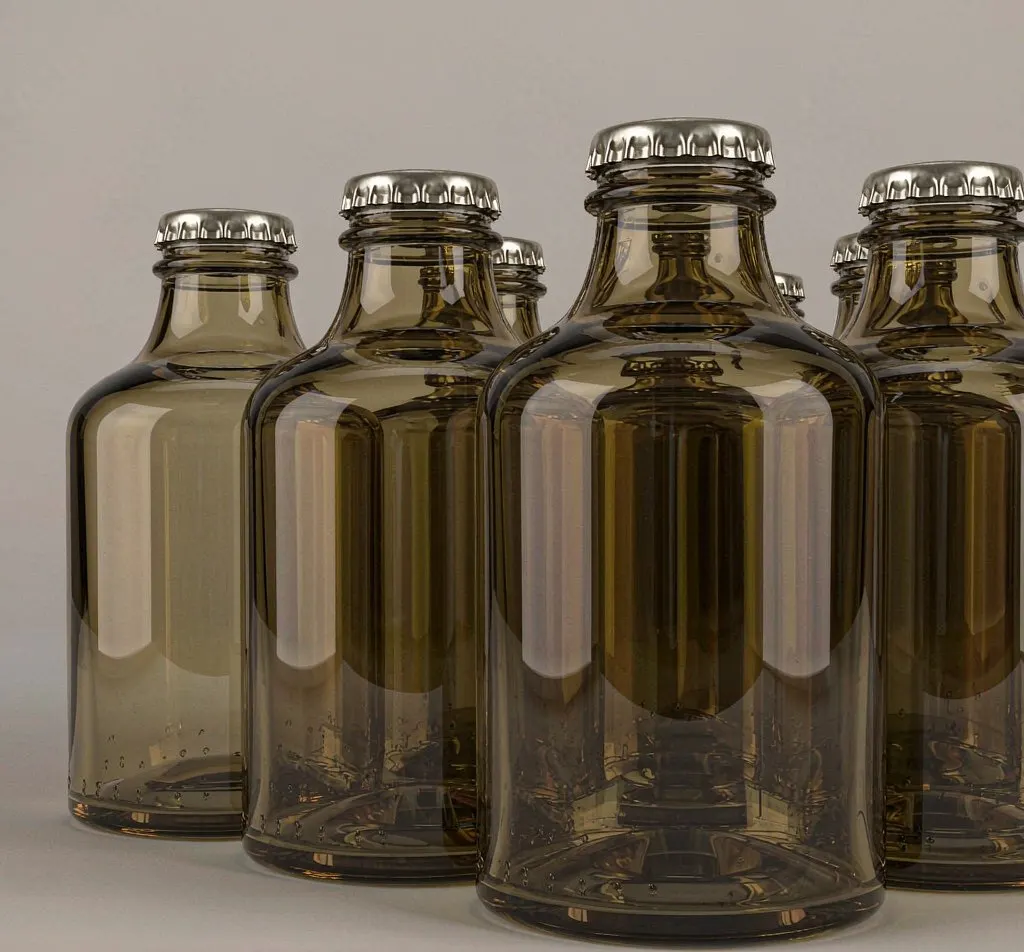
Stubby vs Longneck vs Steinie: Format Comparison
Breweries frequently confuse “steinie” with “stubby,” and the distinction is worth one precise sentence: the steinie is a short bottle with a pronounced shoulder and a shorter overall height than a longneck, and in most North American usage the terms stubby and steinie are applied to the same squat 330/355 ml family. The longneck is the tall, straight-shouldered 355 ml bottle with a height near 229 mm. The comparison that matters to a buyer is not the name but the performance in three columns: pallet density, filling speed, and brand signal.
On pallet density, the stubby wins decisively. A standard 1,200 mm × 1,000 mm Euro pallet holds 11 layers of 355 ml stubbies in 12-pack collations for roughly 1,584 bottles, versus about 1,188 longnecks in the same footprint because the longneck’s height caps the layer count at 9. That is a 33 % increase in bottles per pallet, which flows straight into fewer containers shipped and lower per-unit ocean freight. For an export brewery moving 20 containers a year, the stubby can remove 4 to 6 containers from the plan purely through geometry, a saving that dwarfs the per-bottle glass delta.
On filling speed, the formats are closer than folklore suggests. A modern rotary filler rated at 12,000 bph handles both shapes, but the stubby’s shorter pitch lets the timing screw run at a marginally higher stable RPM before vibration-induced caps skew. The gap widens on older equipment where neck handling is less precise. The steinie, being geometrically a stubby with a sharper shoulder, performs identically to the stubby on the line; the shoulder angle changes label application more than it changes fill rate.
On brand signal, the longneck still reads “classic American lager” and the stubby reads “craft, premium, international.” A brewery targeting taproom and specialty retail should lean stubby; a brewery chasing mainstream grocery velocity in the US may keep one longneck SKU for familiarity. Our recommendation for most craft clients is a two-format house: a 355 ml stubby as the hero SKU and a 12 oz longneck reserved for the highest-volume flagship, so the brand owns both the craft cue and the mainstream cue without multiplying mold inventory beyond reason.
Breakage during the wash and pasteurize cycle is another differentiator. Longnecks concentrate thermal and mechanical stress at the neck-shoulder junction, the thinnest transition on the bottle; stubbies move that junction lower and thicker, so in a tunnel pasteurizer running a 62 °C hold the stubby shows a thermal-stress failure rate near 0.05 % versus 0.18 % for longnecks in matched conditions. For a brewery pasteurizing 500,000 bottles a month, that is roughly 650 fewer lost bottles a month, or about 7,800 a year, before counting the labor to clear a jammed pasteurizer belt.
Storage footprint in the warehouse is the quiet winner. Stubbies stack to a lower total pallet height, so a given cubic-meter of warehouse stores more units, and the brewery can carry more safety stock in the same leased space. We have modeled a 10,000 sq ft warehouse where switching from longneck to stubby increased effective bottle storage capacity by 22 %, deferring a warehouse expansion by an estimated 14 months for a mid-size regional brewery. Format choice is a real-estate decision as much as a packaging one.
Glass Color and UV Protection for Beer
Light is beer’s quiet enemy. The phenomenon brewers call “skunking” or “lightstruck” occurs when wavelengths in the 350 nm to 500 nm range, particularly the blue and near-UV band, interact with isomerized hop compounds (primarily iso-alpha-acids) to form 3-methyl-2-butene-1-thiol, the same sulfur compound a skunk sprays. The reaction is fast; a clear flint bottle in direct sunlight can develop perceptible lightstruck character in under 60 seconds. Glass color is the brewery’s first and cheapest defense, and the stubby format ships in amber, green, and flint, each with a distinct UV-transmission profile.
Amber glass, the industry standard for UV-sensitive ales and lagers, transmits less than 5 % of light below 450 nm and blocks the great majority of the 350 nm to 400 nm band that drives skunking. In our spectrophotometer reports, a standard 2.0 mm amber stubbywall passes under 8 % of 400 nm light and under 2 % at 380 nm, which is why amber remains the default for hop-forward IPAs and pilsners meant for bright retail display. You can review our beer amber bottles program for the full color and transmission data sheet.
Green glass transmits more of the risky blue band but still cuts UV more than flint; a typical green stubby passes roughly 20 % to 30 % of 400 nm light while blocking most of the sub-350 nm UV. Green is the heritage choice for many European lagers and carries a strong brand cue of continental authenticity, but it offers only partial skunk protection and should be paired with opaque or UV-filter cartons for sun-exposed channels. Flint, the clear glass, transmits 85 % to 92 % of visible and near-UV light and provides essentially no protection; it is chosen purely for visual clarity of a filtered product or for a design statement, and it demands that the beer be stored and shipped in UV-blocking packaging.
The tradeoff is brand versus chemistry. A brewery that insists on flint for a hazy IPA is betting that the haze and the cold chain hide the risk, but distributors do not control shelf lighting, and a flint bottle on a lit cooler shelf is a skunking incident waiting to happen. Our engineering guidance is a simple rule: if the beer has more than 15 IBU from isomerized hops and will see any retail light, use amber. If the brand absolutely requires green or flint, specify a UV-absorbing liner in the secondary packaging or a UV-inhibiting coating on the glass, which we can apply as a post-form treatment at a modest per-bottle upcharge.
Color also affects the thermal load. Darker amber absorbs more radiant heat if a pallet sits in sunlight on a dock, raising the surface temperature and slightly accelerating any chemical aging, whereas flint reflects more. In practice the delta is small and is overwhelmed by warehouse climate control, but it is a real variable for breweries in hot export markets. We advise amber for protection and then control dock exposure with stretch wrap and shade, rather than trading away UV protection for a few degrees of surface temperature.
Finally, consistency of color across a production run matters for brand recognition.
Manufacturing and Pressure Performance
The gob weight is calculated to the gram: a 295 g bottle starts from a 300 g to 305 g gob to allow for neck ring and finish trim loss, and we reconcile gob-to-bottle mass daily to keep the distribution tight.
The spec that protects your beer is internal pressure resistance. A still beer needs little; a carbonated lager at 2.5 volumes CO2 at 4 °C generates an internal pressure near 0.45 MPa, while a bottle-conditioned saison at 3.0 volumes can approach 0.7 MPa, and a force-carbonated sparkling or a warm-shipped bottle that climbs to 25 °C can exceed 1.0 MPa. We therefore specify a minimum burst pressure of 1.2 MPa for a standard beer stubby and offer a 1.8 to 2.0 MPa reinforced version for bottle-conditioned and high-carbonation products. Burst testing is performed on a sample basis using a hydraulic pressure rig that ramps at 0.5 MPa/s until failure, and we record the failure mode: a properly engineered bottle fails at the base or shoulder (high hoop stress zones) rather than the finish, which would indicate a neck-tooling defect.
Thermal shock resistance is the second performance pillar. Glass fails when the temperature difference between its surfaces exceeds the material’s endurance, so we design for a thermal shock tolerance of at least 42 °C for the standard stubby and validate it with a hot-cold plunge test: bottles heated to 65 °C are quenched in 20 °C water and inspected for cracking. This rating covers hot-fill-adjacent abuse, pasteurizer entry, and cold-chain-to-warm-dock transitions. For breweries running tunnel pasteurization, we tune the anneal so the residual stress, measured on a polariscope, stays within the 35 nm/cm retardation band that marks a well-annealed bottle; over-annealed glass is soft and scratches, under-annealed glass is a ticking fracture.
Annealing and temper are where consistency is won or lost. After forming, each bottle passes through a lehr, a controlled cooling tunnel with a temperature profile peaking near 580 °C and ramping down over 25 to 40 minutes depending on wall mass. The lehr profile is logged and alarmed; a deviation of more than 15 °C at the stress-relief zone throws the run into hold. We also apply a cold-end spray of mono- or dipropylene glycol-based lubricant to reduce scuffing on the conveyor and a thin polyethylene or tin oxide coating on some runs to improve line friction and scratch resistance, both at sub-micron thickness so they do not affect recycling.
Dimensional conformance is verified per cavity. Each mold cavity wears at a different rate, so we map cavity-to-cavity weight and finish diameter weekly and rotate or re-machine cavities to hold the 26 mm finish to ±0.2 mm and the overall weight to ±5 g. A finish that drifts beyond tolerance is the fastest route to cap leakage on the filler, and we treat finish control as a non-negotiable QC gate. Our standard release includes a dimensional report covering height, diameter, finish ID, and weight for the run, so your quality team can close the loop with your capper supplier.
Sustainability metrics are part of modern procurement, and the stubby performs well on cullet. We run a batch with 25 % to 40 % recycled glass cullet, which lowers furnace energy by roughly 2 % to 3 % per 10 % cullet and reduces CO2 intensity. A stubby’s lower glass mass per unit of capacity, compared to a heavier legacy bottle, further reduces the per-beer material footprint.
Labeling, Crown Caps, and Packaging Line Compatibility
The stubby’s wide, short label panel is a labeling engineer’s friend, but it demands attention to wrap geometry. A 355 ml stubby with a 66 mm diameter and a label zone of roughly 90 mm in height yields a front label footprint of about 150 mm × 90 mm, enough for statutory text, brand art, and a QR code without crowding. Pressure-sensitive (self-adhesive) labels are the easiest fit because they conform to the gentle shoulder curve without a glue station; for a curved shoulder we recommend a label with at least 15 % radial flexibility or a two-panel label that breaks at the shoulder radius. Cold-glue and hot-melt lines also work, but the shorter bottle means the labeler must register on a smaller seam, so we advise a registration notch or a base reference emboss for vision-system alignment.
Shrink-sleeve and wrap labels present a subtle trap: a full-body sleeve on a stubby has less vertical travel to hide a seam, so the overlap must be spec’d tighter, typically a 6 mm to 8 mm overlap welded at 12 o’clock. We have seen sleeve seams drift to 3 o’clock on stubbies because the shorter bottle rotates faster under the tunnel; correcting it requires a slower belt or a re-timed infeed, both of which we model during a line audit. For breweries that want a premium look, an embossed or debossed logo on the shoulder is applied in-mold and needs no label at all on that face, reducing decorate cost and improving scuff resistance.
Crown caps are where the 26 mm finish earns its keep. Standard steel crowns with a 26 mm diameter and a liner of PVC-free compound (or an oxygen-scavenging liner for extended shelf life) seat on the stubby finish with a crimp depth of 6.0 mm to 6.4 mm and a cap diameter of 31.8 mm. A rotary capper running at 12,000 bph applies 18 to 22 N·m of seating torque on a pry-off finish, and we validate the seal with a torque-release test: a properly capped stubby requires 9 to 14 in-lb to remove, and any cap releasing under 7 in-lb is flagged as a seal failure. Twist-off finishes use a different liner and a higher applied torque near 25 to 30 in-lb, with a thread engagement of at least 1.5 turns.
Carbonation retention depends on cap and finish together. A 26 mm pry-off crown on a correctly formed stubby finish holds a leak rate under 1 × 10⁻⁵ mbar·L/s at 0.5 MPa, which keeps a 2.6-volume lager stable for the 120-day typical craft shelf life. If your distribution includes warm transit, specify an oxygen-scavenging liner and a tighter headspace, because warmer beer holds less CO2 in solution and any micro-leak accelerates staling. We routinely couple the bottle spec with a cap specification sheet so your capper supplier and cap vendor are working from one drawing, not two.
Packaging line compatibility extends to the case packer and the secondary. Stubbies in a 12-pack collation use a shorter carton than longnecks, saving about 11 % on corrugate per case at equal bottle count, and the shorter bottle improves the carton’s top-load strength because there is less empty headspace to crush. For variety packs, the uniform stubby height simplifies the packer changeover compared to mixed longneck-stubby lines. We hand breweries a “line envelope” drawing showing bottle extremes (max height, max diameter, max weight) so the conveyor, rinser gripper, and capper chuck can be confirmed before the first production run.
One more operational note: the stubby’s shorter height changes the filler bowl level and the crowner’s vertical travel. Most modern fillers accommodate the change with a simple format part swap, but legacy equipment may need a crowner height adjustment of 40 to 70 mm. We build a format-kit bill of materials for each brewery so the changeover is a known, priced, one-hour job rather than a discovery on production day. The goal of every spec we write is to make the bottle invisible to your line team: it just runs.
MOQ, Tooling Cost, and Lead Time for Custom Stubby Bottles
Customization is where the stubby format meets the brewery’s budget, and the three levers are minimum order quantity, tooling cost, and lead time. A brewery can launch a small run of 10,000 for a taproom-only release, but the per-unit landed cost will be 15 % to 25 % higher than a 50,000-unit container because the furnace and lehr setup are amortized over fewer units.
For a fully custom shape, embossing, or a proprietary finish, tooling is the gate. We amortize tooling as a one-time charge separate from the per-bottle price, and we retain and maintain the mold for the life of the program, so reorders do not re-pay tooling. Many breweries start with a stock stubby and add embossing later, which is the lower-risk path we recommend for a first custom run.
Lead time is the variable that breaks launch plans. We strongly advise budgeting 90 days end-to-end for a custom stubby program and 60 days for a stock-color reorder, with safety stock covering the gap so a late container never empties the shelf.
Color changes carry their own cost. Switching from amber to green or flint in the same mold requires a furnace purge and a cullet changeover that costs roughly 1 to 2 production hours and a small scrap allowance, so we batch color runs and recommend a brewery commit to a color for a minimum of one full container to avoid changeover penalties.
For most craft breweries, pressure-sensitive labels remain the economical choice and keep the bottle flexible across SKUs; we therefore position printed glass as a premium tier for flagships, not the default. When a brewery asks us to rationalize cost, we almost always steer toward emboss-plus-label rather than full printed glass for runs under 100,000.
Payment and incoterms round out the commercial picture. We quote stubbies FOB Shanghai or CIF to the destination port, and the per-bottle price at 50,000-unit volume for a 295 g amber 355 ml stubby typically lands in a band that, combined with caps and labels sourced locally, yields a finished-bottle cost competitive with domestic US glass once freight is normalized for the higher pallet density. Breweries should model total landed cost per sellable unit, not per bottle, because the stubby’s freight advantage compounds exactly where domestic longnecks look cheaper at the ex-works line. Our commercial team issues a landed-cost worksheet with every quote so procurement can defend the decision internally. For breweries building a broader glass program, our custom beer bottles hub covers mold, decorating, and multi-format planning in one place.
Frequently Asked Questions
What is the difference between a stubby and a steinie beer bottle?
In practical procurement terms, the stubby and the steinie refer to the same squat 330 ml or 355 ml family with a short height near 150 to 158 mm and a wide 66 mm body. The word “steinie” is the North American marketing name for the short-shouldered version, while “stubby” is the broader descriptor. Both share the 26 mm crown finish and run on the same cappers and fillers. When you order, specify the capacity, the height, and the finish rather than relying on the regional name, because “steinie” sometimes implies a slightly sharper shoulder that affects label placement.
Can a 355 ml stubby handle high-carbonation bottle-conditioned beer?
Yes, with the correct pressure rating. Our standard stubby is rated to a 1.2 MPa burst minimum, which covers most force-carbonated lagers and ales. For bottle-conditioned saisons, Belgians, or any product exceeding 3.0 volumes CO2, we recommend the reinforced 1.8 to 2.0 MPa version with added glass at the shoulder and base, weighing 315 to 320 g. We validate every high-pressure run with hydraulic burst testing and provide the pressure certificate so your quality team can match the bottle to the beer’s warm-transit worst case, which is the number that actually breaks bottles.
Does amber glass fully protect beer from skunking?
Amber blocks the large majority of skunking wavelengths. A standard 2.0 mm amber stubby wall transmits under 8 % of 400 nm light and under 2 % at 380 nm, which removes essentially all of the near-UV that drives the lightstruck reaction. It is not 100 % at the visible blue edge, so a beer stored for months directly under retail lighting will still slowly age, but amber is the right choice for any hop-forward beer in bright display. Green and flint offer progressively less protection, and flint offers almost none, so pair them with UV-blocking secondary packaging if brand demands them.
What crown cap finish should I specify, pry-off or twist-off?
For craft beer we recommend the 26 mm pry-off (standard crown) finish. It crimps with a steel crown and a liner to give a reliable hermetic seal that survives rough handling and warm transit better than twist-off, and consumers expect a bottle opener for craft beer, which reinforces the premium cue. Twist-off suits high-volume macros and some ready-to-drink lines but demands a matched liner and torque profile. The wrong finish choice is the most common first-order error on new orders, so name it explicitly on the purchase spec alongside the 26 mm diameter.
What is the realistic minimum order for a custom stubby?
Minimum quantities are quoted per project, because they depend on the mould and the line it runs on.
How does the stubby compare to the longneck on freight and pallet density?
The stubby is decisively better for density. A 1,200 mm × 1,000 mm Euro pallet holds about 1,584 stubbies in 12-pack collations versus roughly 1,188 longnecks in the same footprint, a 33 % gain from the height reduction alone. That lifts bottles per container and can remove 4 to 6 containers from a 20-container annual export plan, a saving that dwarfs the small per-bottle glass delta. The stubby also shows lower transit breakage, 0.8 % to 1.4 % versus 1.9 % to 2.7 % for longnecks in matched corrugate, protecting both margin and brand.
Can stubbies be reused in a deposit-return system?
Yes, and they outperform longnecks in reuse. The short, thick-walled stubby survives the wash-and-fill cycle with less neck and shoulder stress, the two zones most likely to fail in a bottle washer, and a returnable stubby typically survives 8 to 12 trips before culling versus 5 to 8 for a longneck. For a regional brewery with a captive local market and a refundable program, that reuse economy alone can justify the format switch, and we supply a returnable-grade glass with a slightly higher base thickness to extend trip life further.
Do you supply other glass formats for a brewery’s full lineup?
We do. For breweries that also package food or non-beer liquids, our food glass packaging hub links the compatible jars and bottles so a single supplier can serve the whole pantry. Consolidating formats under one supplier simplifies tooling records, QC certificates, and container consolidation.