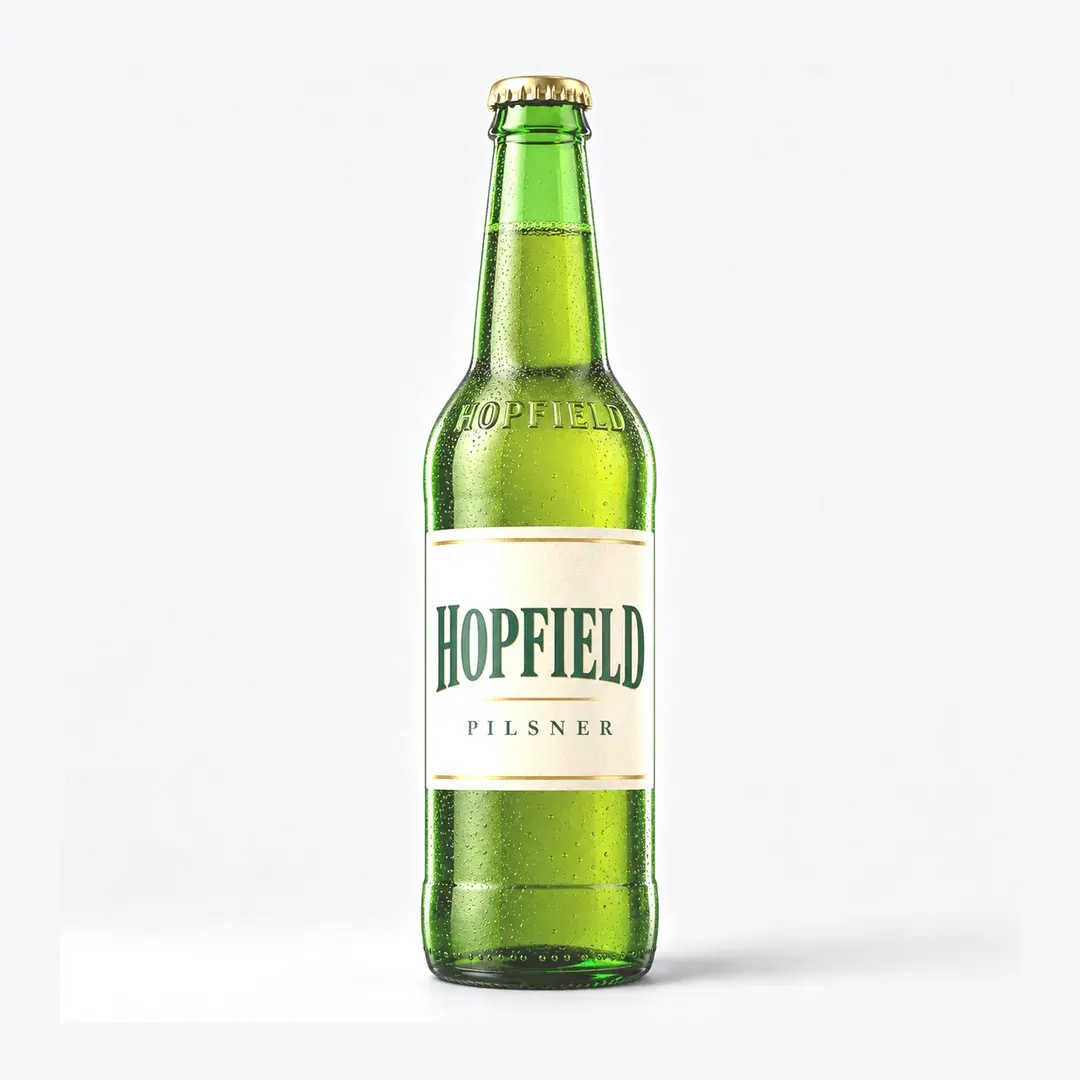
Series 8858 is a green longneck beer glass bottle with a classic proportions: a slim cylindrical body, a gently sloped shoulder carrying molded lettering, and a crown-cap finish. It is aimed at breweries, contract packers and beverage importers who want the familiar European green-bottle look for lagers, pilsners and specialty exports, produced at wholesale volumes with full export packing support. If your brand story leans on continental heritage, this is the silhouette your customer already recognizes.
Green Glass and the Lightstruck Question Every Brewer Should Ask
Green glass carries decades of brewing tradition, but it also carries a technical compromise that your quality team should price into the decision. When hop-derived compounds in beer are hit by ultraviolet and short-wavelength visible light, they break down into the same sulfur compound a skunk sprays, which is why the defect is called lightstruck or skunked. Amber glass blocks the great majority of those wavelengths. Green glass blocks some, but measurably less than amber, and clear flint blocks the least of all. That does not make green glass wrong; it makes it a choice that must be paired with the right beer and the right distribution. Lower-hop lagers, fast-rotation retail programs, and beers sold in closed six-pack carriers or full cartons live comfortably in green. Highly hopped ales sitting under open fluorescent shelf lighting do not. Many of the world’s best-selling import lagers solve this with light-stable hop extracts formulated specifically for green-bottle packaging. When you request a quotation for Series 8858, ask the factory for the spectral transmission curve of the green recipe so your brewmaster can match hop formulation and packaging to the glass with data instead of folklore.
A Heritage Silhouette With Molded Shoulder Lettering
The longneck shape of Series 8858 follows the proportions that European and Latin American lager brands have used for generations: a long, straight neck that pours cleanly, a defined shoulder transition, and a label-friendly cylindrical body. Around the shoulder, the mold carries raised lettering, the kind of permanent brand marking that predates paper labels and still signals authenticity today. Molded lettering cannot peel, scuff or wash off in a crate washer, and it keeps working for your brand even when a bar serves the bottle without its label intact. The standard mold text can be quoted as-is for immediate production, or replaced with your own brewery name and mark through a mold modification, with cost and lead time quoted against your artwork. The smooth body panel accepts wraparound paper labels, pressure-sensitive film, or neck-and-body label combinations. Capacity, glass weight and neck finish dimensions are confirmed on the technical drawing at quotation, since longneck molds are produced in several capacity variants.
Crown Finish Compatibility With Your Existing Line
The neck of Series 8858 is formed for a crown-cap closure, the global default for carbonated beer, so the bottle runs through standard rinsing, filling and crowning equipment without change parts beyond normal height adjustment. Crown finishes are defined by international glass-finish standards, and the exact finish code for this mold is confirmed with the technical drawing so your closure supplier can match liner compound and cap skirt depth precisely. If you do not already have a crown supplier, we can quote oxygen-scavenging crowns alongside the bottles, which is the pairing most export lager programs use to protect flavor through a long ocean voyage and warm warehouse storage. For breweries moving from a domestic amber bottle into a green export SKU, this continuity of closure is the quiet advantage: one capping head, one cap inventory, one seam spec, two very different shelf presences.
Pressure, Thermal Shock and Line-Speed Validation
A longneck bottle lives a hard life: high-speed depalletizing, rinser jets, filler bowl pressure, crowner impact, pasteurizer spray, labeler belts and case packer drops. Series 8858 is validated for that whole journey. Internal pressure resistance is tested per ASTM C147, the reference method for glass containers holding carbonated products, with sampling on every production lot. Thermal shock performance follows ISO 7459, which is the test that matters when a bottle moves from cold storage into a tropical filling hall or through a tunnel pasteurizer. Vertical load strength, the property that keeps stacked cases and full pallets from crushing the bottom layer, is checked against ISO 8113. Annealing is verified by polariscope on every campaign, and retained samples from each lot are kept for traceability. If your line runs at the upper end of industry speeds, tell us at quotation and we will align wall-thickness distribution targets with your filler OEM’s requirements.
Wholesale Volumes, Packing and Export Logistics
Series 8858 is produced at container-load scale. Bottles ship in export cartons with cell dividers, stacked on standard pallets, corner-boarded and shrink-wrapped for ocean transit; loading photos are provided before the container doors close. Green glass is a mainstream furnace color, so lead times are shorter and minimums friendlier than for specialty colors; the working MOQ and current campaign dates are confirmed at quotation, and our explainer on glass bottle MOQ shows how to structure a first order. First-time importers should also read our practical guide to importing glass bottles from China, which covers Incoterms, customs codes and breakage allowances.
To price Series 8858 for your lager or pilsner program, send your target capacity, annual volume and destination port through our contact form. We reply with a quotation, technical drawing and physical samples.
Frequently Asked Questions
What is the MOQ for the green longneck Series 8858 bottle?
Green is a mainstream furnace color, so minimums are lower than for specialty colors. The working MOQ depends on the capacity variant and current campaign schedule and is confirmed at quotation; most buyers structure the first order as a full container load to keep unit freight cost down.
Will green glass skunk my beer?
Green glass blocks less UV than amber, so highly hopped beers under bright retail lighting are at risk of lightstruck flavor. Many export lagers solve this with light-stable hop extracts or closed-carton distribution. Ask for the spectral transmission curve at quotation so your brewmaster can match the hop formulation to the glass.
Can the embossed lettering on the shoulder be changed to my brand name?
Yes. The standard molded lettering can be replaced with your brewery name or mark through a mold modification. Send vector artwork with your inquiry and we will quote the mold fee and the additional lead time; the embossing itself then costs nothing per bottle.
Does Series 8858 fit standard crown caps and capping machines?
Yes, the neck is formed for a standard crown-cap closure and runs on conventional crowning equipment. The exact finish code is confirmed on the technical drawing so your cap supplier can match the liner and skirt; we can also supply oxygen-scavenging crowns with the bottles.
What pressure and pasteurization tests does the bottle pass?
Each production lot is tested for internal pressure resistance per ASTM C147 and thermal shock per ISO 7459, with vertical load checked per ISO 8113. Lot test reports ship with your export documents, and retained samples are kept for traceability.
Can I order samples before committing to a container?
Yes. Stock samples of Series 8858 are available so you can test labeling, capping and shelf appearance. Sample and courier costs are confirmed on request and are normally credited against your first bulk order.
What is the typical lead time to my port?
For a standard green longneck campaign, production and export packing typically take four to six weeks after order confirmation, plus ocean transit to your destination. A firm schedule is given with the quotation once the campaign calendar and your port are known.