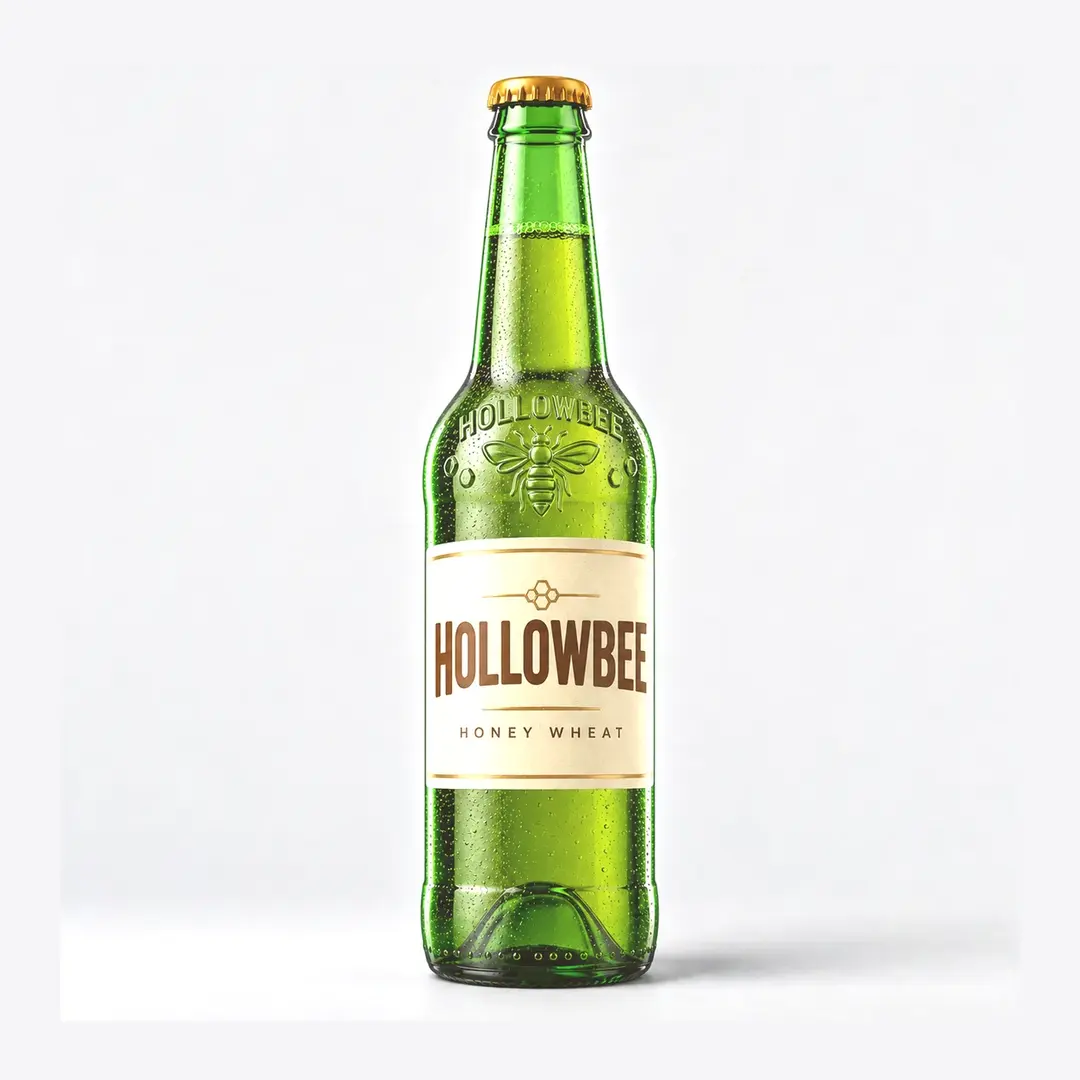
Series 8445 is a green longneck beer glass bottle with a crown-cap finish and molded lettering plus a bee-like insect motif embossed on the shoulder. It is specified for breweries, importers and distributors buying at container scale who care as much about how the bottle arrives as how it looks: export palletization, divider protection, container loading discipline and documented breakage control are part of the product we sell. If a previous supplier’s shipment reached you with a floor of broken glass, this page explains how we prevent that.
Designed for the Journey, Not Just the Shelf
A beer bottle exported across an ocean lives through more mechanical abuse in transit than it ever will in a bar. It is dropped into cartons at speed, vibrated for weeks inside a steel container, craned on and off vessels, and hauled over roads of wildly variable quality before it ever sees your depalletizer. The longneck geometry of Series 8445 is well suited to that journey: the straight body packs tightly into cell-divider cartons with minimal void space, the defined shoulder prevents nesting and point-contact between neighboring bottles, and the controlled wall-thickness distribution keeps impact strength consistent from unit to unit so a carton fails predictably rarely rather than randomly. The molded shoulder marks, lettering and a small winged-insect motif, are pressed into the glass itself, so even in the rough-and-tumble of a returnable-bottle market the package keeps its identity after the label is long gone. Capacity, glass weight and finish dimensions are confirmed on the technical drawing at quotation, and the factory can supply the full case and pallet configuration data, bottles per carton, cartons per layer, layers per pallet, before you commit, so your warehouse and freight planning work from real numbers.
Export Packing: Divider Cartons, Pallets and Shrink Wrap
Our standard export packing for Series 8445 is engineered in layers, each solving a specific failure mode. Individual bottles sit in corrugated cartons with full-height cell dividers, which stop glass-to-glass contact, the root cause of most transit breakage. Cartons are stacked in an interlocked pattern on standard export pallets, corner boards stabilize the columns, and the whole cube is shrink-wrapped under tension so the load moves as one unit instead of a thousand independent pieces. Strapping and top sheets are added for long or multi-modal routes. At the container, pallets are loaded with the weight distributed over the container floor’s strong points, braced against longitudinal movement, and photographed before the doors close; those photos go to you with the shipping documents as evidence of load condition at origin. For buyers who want an additional verification layer, third-party loading supervision can be arranged at cost. This system is why our breakage claims rate stays low, and it is also why we ask about your destination’s last-mile conditions at quotation: a container that finishes its journey on smooth European motorways and one that ends on unpaved highland roads deserve different packing decisions.
Breakage Allowances and How We Handle Claims
No honest glass exporter promises zero breakage; what distinguishes suppliers is how the risk is priced and how claims are handled. Our standard practice includes an agreed breakage allowance written into the contract, a clear photographic claims process, and replacement or credit terms that do not require you to ship broken glass back across an ocean. Because every lot is traceable to its furnace campaign and packing date, claims can be investigated against loading photos and packing records rather than argued from memory. For first-time buyers, our practical guide to importing glass bottles from China explains how Incoterms allocate transit risk between seller, carrier and buyer, and why the cheapest EXW quote often becomes the most expensive shipment once breakage, insurance and handling are counted honestly.
Container Loading Math That Protects Your Margin
Freight is a fixed cost per container, so how many sellable bottles arrive inside that container decides your real landed unit cost. Because Series 8445 follows standard longneck proportions, it packs efficiently: the factory provides the exact carton dimensions, bottles per carton, cartons per pallet layer and total pallet count per 20-foot and 40-foot container at quotation, before you commit to anything. Those figures let you model three scenarios honestly, a full container of one SKU, a mixed container shared with another bottle from our range, or a shared campaign slot if your volume is still growing, and choose whichever lands cheapest per delivered bottle. Buyers are often surprised that moving from a partially filled container to a properly planned full one cuts freight cost per bottle by a third or more, which usually dwarfs any per-unit price negotiation. If your warehouse has racking height limits or your forklift has a pallet weight ceiling, tell us at quotation and the pallet configuration will be adjusted to match your handling reality rather than a theoretical optimum.
Pressure and Strength Testing Behind the Packing
Packing protects bottles from the outside; manufacturing quality protects them from the inside. Every lot of Series 8445 is tested for internal pressure resistance per ASTM C147, the standard method for carbonated-beverage glass, because a bottle weakened at origin fails later on your line or in your warehouse. Thermal shock resistance per ISO 7459 covers pasteurization and cold-chain transitions. Vertical load per ISO 8113 is the test that matters most for this page’s subject: it confirms the bottle survives the sustained static load of a fully stacked export pallet without the bottom layer crushing weeks into the voyage. Annealing is verified by polariscope every campaign, and per-lot test reports ship with your documents.
Ordering, MOQ and What to Send Us
Green longnecks are a mainstream furnace product with regular campaigns and moderate minimums; the working MOQ is confirmed at quotation, and our explainer on glass bottle MOQs shows how to size a first order against your storage and cash flow. The most useful inquiry includes your target capacity, annual volume, destination port and any special last-mile conditions.
Send those details through our contact form and we will reply with a quotation, packing specification and samples of Series 8445.
Frequently Asked Questions
How are Series 8445 bottles packed for ocean export?
Bottles are packed in corrugated cartons with full-height cell dividers to prevent glass-to-glass contact, stacked in interlocked layers on standard export pallets with corner boards, then shrink-wrapped under tension and strapped. Pallets are braced inside the container and photographed before the doors close, with photos sent to you with the shipping documents.
What happens if bottles arrive broken?
Our contracts include an agreed breakage allowance and a photographic claims process; valid claims are settled by replacement or credit without returning broken glass. Every lot is traceable to its furnace campaign and packing date, so claims are checked against loading photos and packing records.
Can the embossed lettering and insect motif be changed to my brand?
Yes. The standard shoulder embossing can be replaced with your brewery name or mark through a mold modification quoted against your vector artwork. After the mold exists, embossing adds no per-unit cost and survives washing and reconditioning.
What is the MOQ for this green longneck?
Green is a mainstream furnace color with regular campaigns, so minimums are moderate and confirmed at quotation based on the capacity variant. Most export buyers order full container loads to keep unit freight cost low.
Does the bottle meet pressure standards for carbonated beer?
Yes. Each lot is tested for internal pressure per ASTM C147, thermal shock per ISO 7459 and vertical load per ISO 8113, which confirms bottles survive full-pallet stacking during the voyage. Test reports ship with your export documents.
Can I get samples before placing a container order?
Yes. Stock samples are available for capping, labeling and line trials. Sample and courier costs are confirmed on request and normally credited against your first bulk order.
What information do you need for an accurate quotation?
Target bottle capacity, annual volume, destination port, preferred Incoterm and any special last-mile conditions. With those details we return a quotation including the packing specification, pallet configuration and current campaign lead time.