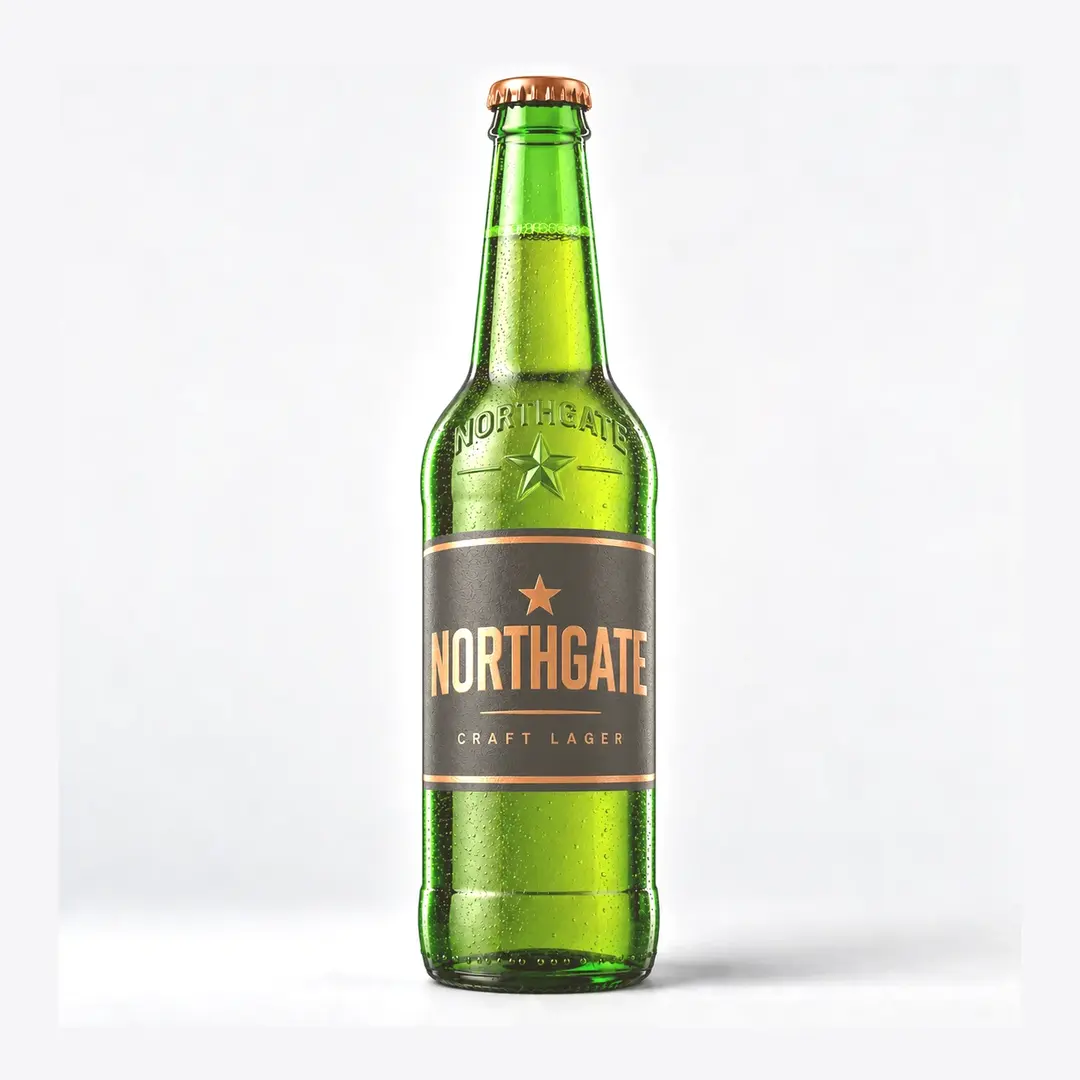
The Series 2572 is a green longneck beer bottle with a crown-cap finish and embossed lettering at the shoulder, produced for craft breweries and growing beverage brands that want their packaging to carry permanent brand identity without committing to a fully proprietary mould at day one. The photo shows the raised characters and star detail formed into the shoulder, the kind of moulded-in branding that survives ice buckets, condensation and crate washing long after paper labels have scuffed. For small and mid-size producers buying at wholesale volumes, this series offers a practical route to a branded bottle.
Embossed Identity for Craft Brands
Craft beer buyers make judgments with their hands before their eyes, and embossing works on exactly that instinct. A raised wordmark or crest at the shoulder tells the drinker this bottle belongs to a real brand with roots, not a contract-packed commodity. The embossed lettering and star motif visible on this series show the level of detail mould engraving can hold at production speed, and the effect costs nothing per bottle once the mould exists. Buyers at sufficient volume can commission their own emboss, with the tooling investment amortized across the run, while smaller buyers start from the stock design and build identity through labels and crowns. Either path ends with a bottle that feels intentional in the hand.
Right-Sized for Small-Batch Production
Craft producers rarely buy glass the way industrial lager plants do, and this series is quoted with that reality in mind. Orders can be planned around seasonal releases and rotating specialties rather than a single year-round SKU, and repeat runs on a proven design move faster because moulds and line settings are established. Minimum order quantities follow furnace economics rather than arbitrary thresholds, and our article on glass bottle MOQ explained lays out those mechanics so you can plan cash flow before talking to us. Buyers who share a twelve-month release calendar at inquiry get the most useful pricing, because we can schedule their runs against furnace slots instead of quoting each order in isolation.
The Green Longneck in Craft Context
Green longnecks carry decades of lager heritage, and craft brands use that familiarity deliberately: a pilsner, helles or export-style lager in green glass reads as traditional craftsmanship rather than a trend-chasing experiment. The color filters part of the light spectrum but less UV than amber, so it suits hop-forward recipes only when distribution keeps bottles in closed cartons and cold chain. For malt-forward lagers, cream ales and quick-turning specialties, green delivers exactly the look the style promises. The glass here is furnace-colored through the full wall thickness, so the presentation holds through pasteurization and repeated handling.
Crown Finish and Filling Line Practicalities
The bottle is formed for the standard 26 mm crown closure, the closure nearly every craft filler and mobile canning-and-bottling line already runs. A uniform crown lip gives the liner a consistent sealing surface, which is what holds carbonation through warm storage and distribution. Dimensional checks at the cold end confirm the bottles will run through starwheels, guide rails and labelers without jams, and the finish dimensions appear on the technical drawing issued with your quotation. Capacity, weight, height and body diameter are confirmed with the factory on that same drawing, and we supply physical samples for line trials before mass production as a standard step, because a bottle that jams your filler on release day is an expensive lesson.
From Stock Bottle to Signature Packaging
Many successful craft brands follow a three-step path with us: launch on the stock bottle with strong label design, add custom crowns and neck foils as volumes grow, then invest in a proprietary emboss once a flagship SKU proves itself. That sequence keeps early cash in brewing and marketing where it belongs, while building toward packaging that competitors cannot imitate. Our team maps that path with you at the first quotation, so each stage’s minimums and lead times are known before you need them. Importers and overseas breweries will find the logistics side covered in our guide to importing glass bottles from China.
Quality Control Standards Behind Every Pallet
Production is monitored under a documented QC plan referencing ASTM C148 for annealing quality of glass containers, ISO 7459 for thermal shock endurance and ISO 7458 for internal pressure resistance. Embossed areas receive particular inspection attention, since lettering detail must form cleanly without thin spots or checks, and cold-end screening catches seeds, stones, blisters and finish defects on every bottle. Statistical samples from each shift pass pressure and thermal shock testing before pallets are released, and dimensional gauges verify the crown finish against the drawing. Buyers with a specific AQL level or third-party inspection requirement can state it in the purchase specification and it becomes part of the routine.
Packing, Shipping and Getting a Quote
Bottles ship on export pallets, shrink-wrapped and corner-protected as shown below, with container loading plans prepared per order so your landed cost per bottle is visible before you commit. Fumigation-free packaging is available for markets that require it, and partial-container options can be discussed for first orders. For craft buyers warehousing their own glass, we recommend storing pallets indoors on level floors and keeping the shrink wrap intact until the bottles move to the line, since dust and moisture inside the wrap complicate bottle rinsing. Lead times are quoted per order and depend on the production schedule at inquiry, so the earlier your release calendar reaches us, the more scheduling options we can offer. Every quotation includes the technical drawing, packing specification, loading plan and current lead time in one document, which makes internal approval and import paperwork straightforward.
To price the Series 2572 for your next release, send your target volume, destination port and any embossing plans through our contact page and a packaging specialist will respond with a complete offer including the technical drawing.
Frequently Asked Questions
Can a small craft brewery order the Series 2572, or is it only for large volumes?
The Series 2572 is quoted for small and mid-size producers as well as large buyers. Orders can be planned around seasonal releases and rotating specialties rather than one year-round SKU, and buyers who share a twelve-month release calendar get the most useful pricing because runs can be scheduled against furnace slots. Send your target volumes and we will quote the exact MOQ and tiers.
Can I get my own logo embossed at the shoulder like the lettering in the photo?
Yes, at sufficient volume. A proprietary emboss is engraved into the mould so every bottle carries your wordmark or crest permanently at no per-unit cost; the tooling investment is amortized across the run. Many craft brands start on the stock design with labels and custom crowns, then invest in embossing once a flagship SKU proves itself.
What closure does this bottle take?
The Series 2572 is formed for the standard 26 mm crown closure used by nearly every craft filler and mobile bottling line. Finish dimensions appear on the technical drawing with your quotation, and a uniform crown lip provides the consistent sealing surface that holds carbonation through storage and distribution.
Is green glass suitable for hop-forward craft styles?
Green filters part of the light spectrum but less UV than amber, so hop-forward recipes in green glass need distribution that keeps bottles in closed cartons and cold chain. Malt-forward lagers, cream ales and quick-turning specialties suit green without restriction. For aggressively hopped beers in open display, we recommend amber.
Can I get samples before committing to a full order?
Yes. Physical samples for line trials and label application tests are supplied before mass production as a standard step, alongside the technical drawing for dimensional confirmation. Production is scheduled only after your written approval of samples and drawing.
What quality tests back each shipment?
Production follows a documented QC plan referencing ASTM C148 for annealing quality, ISO 7459 for thermal shock endurance and ISO 7458 for internal pressure resistance. Embossed areas receive dedicated inspection so lettering forms cleanly without thin spots, and every bottle passes cold-end screening before pallets are released.