Judge a glass bottle supplier on evidence you can measure: defects on real samples, dimensions against a drawing, thermal shock results, weight spread across a shipment, and fit with your own closures. Then check that certificates and production records back up what the samples show. A quick test of process control is to weigh at least 30 bottles from one shipment; a coefficient of variation above 0.5% points to an unstable process.
What to test on samples
A structured sample review has five parts. Record every result, because the record becomes the baseline you compare later deliveries against.
| Check | How to do it | What a bad result tells you |
|---|---|---|
| Visual defects | Bright, direct light from several angles, scored on a defined defect scale | Weak furnace control, raw-material handling or packing |
| Dimensions | Measure height, body diameter and neck finish against the specification sheet | Bottles that will not run on filling and capping equipment |
| Thermal shock | Heated bottle moved into ambient-temperature water | Risk of failure in hot filling or pasteurisation |
| Weight consistency | Weigh at least 30 bottles and calculate the coefficient of variation | Unstable forming, later seen as filling inaccuracy |
| Closure fit | Trial with the caps your line will actually use | Poor seating, stripped threads, leaking seals |
Surface defects
Any plant can send flawless samples, so the real question is how much of a normal production run reaches that level. Look for bubbles in the wall first. They concentrate stress and can cause a bottle to crack by itself during filling or thermal processing.
Scratches that go beyond what you can see at arm's length mean rough handling during production or packing, and they predict more breakage in your warehouse. Stones are particles of raw material that never melted, and streaks are zones where the glass composition is uneven. Both suggest the supplier's furnace temperature or raw-material handling is not consistent.
Colour and clarity
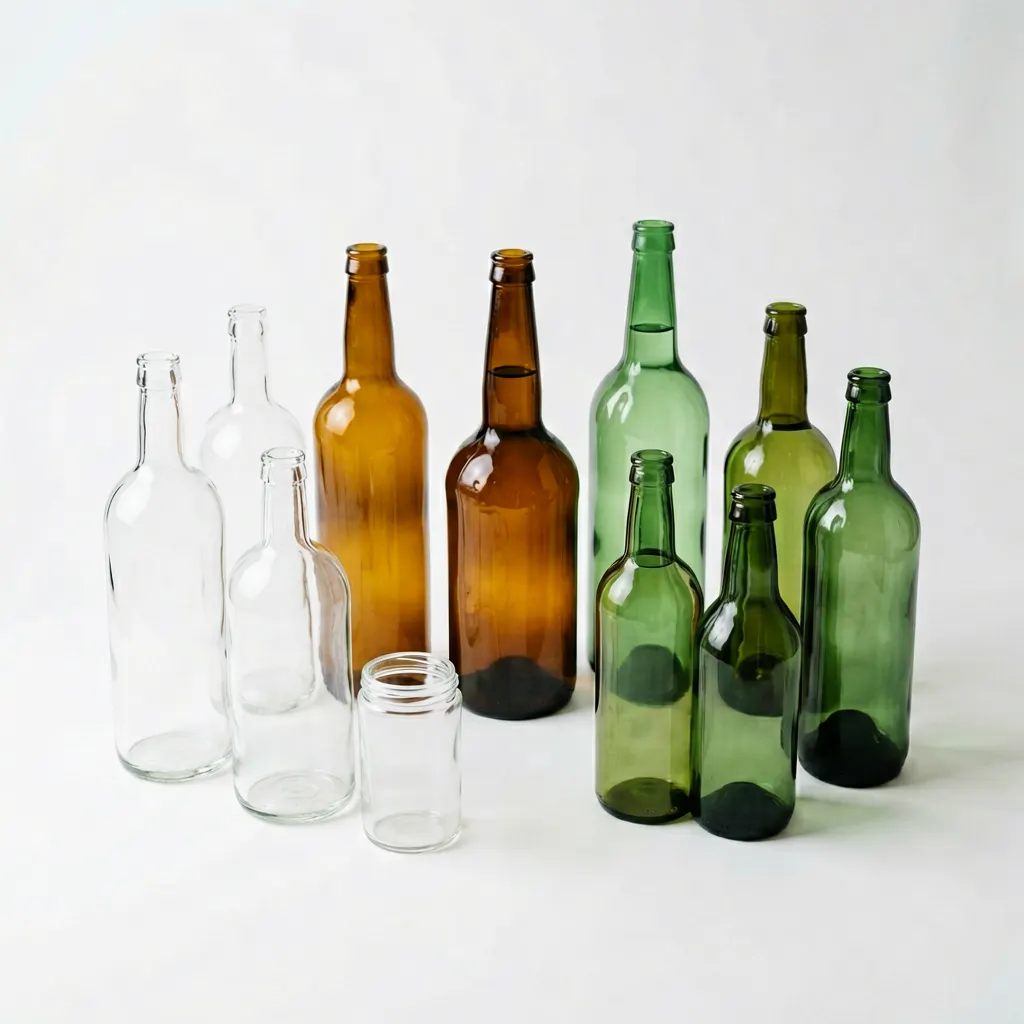
In clear glass, a green or amber tint is a sign of iron contamination or furnace chemistry that is off. In coloured glass such as amber, cobalt blue, amethyst or olive green, the concern is whether the shade repeats from one batch to the next. A green wine bottle that changes tone between orders is something your marketing team and your customers will both notice.
Ask what colour tolerance the supplier works to, and whether colour is matched batch by batch or taken from a generic formulation.
Dimensions and neck finish
A bottle that looks right is still unusable if it does not fit the line. The outer diameter of the neck finish is the measurement that matters most, since caps will not seal unless it matches the thread pitch and tolerance of the closure. Careful suppliers keep calibrated gauges and check each production run against the specification.
Request the specification sheet and compare it with your own measurements. A supplier unable to state tolerances in millimetres for height, body diameter and neck finish should be dropped from the list.

Wall thickness
Wall thickness is meant to differ by zone: more glass in the base for stability, a controlled shoulder for strength under pressure, and a neck sized for sealing without excess stress. What should not vary is the thickness inside one zone. A bottle noticeably heavier on one side than the other shows an inconsistent parison, the preform made during press-and-blow or blow-and-blow forming (our overview of how glass bottles are made explains both). The result is uneven cooling, internal stress and breakage that is hard to predict.
Good suppliers measure walls with ultrasonic gauges or by cutting cross-sections, and they hand over the results on request.
Thermal shock
This test matters for anything filled hot, such as spirits filled above 60°C, and for any product that is pasteurised. Glass expands and contracts as its temperature changes. A bottle that cannot take the step from hot fill to ambient cooling develops microfractures that may be invisible until the bottle is stressed and fails.
The usual method heats the bottle, typically to 90°C for a set period, and then immerses it in ambient-temperature water to see whether cracks or chips appear. Suppliers serving spirits and hot-fill drinks should have these results on file.
Weight consistency
Even weight means an even volume of glass in each bottle, and so consistent walls and strength through the batch. Wide variation indicates a process that is not under control, and it will surface later as filling accuracy problems. Lightweighting is a genuine trend in glass packaging, but a lighter bottle still has to hold its weight from piece to piece.
Closure fit
Most packaging failures happen where the glass finish meets the closure liner. Before committing, run the supplier's bottles with your production caps and look at seating, thread stripping and seal integrity. A supplier that already tests and documents compatibility with common systems such as crown caps, screw caps and cork is more mature than a typical commodity vendor. The closure also depends on the bottle style, which our guide to alcohol bottle types covers.
Certificates worth asking for
A certificate shows that a third party has verified the supplier's quality system. Ask for the documents that apply to your product and market.
- ISO 9001. The baseline quality management standard. It does not prove product quality by itself, but it shows documented processes for managing quality, tracking defects and catching problems before shipment.
- FDA compliance. Required for glass in contact with food or drink. It covers limits on heavy metal leaching among other safety requirements, and suppliers should supply the documentation when asked.
- LFGB. The German food safety standard, relevant if you sell in Europe, with particular attention to heavy metal migration testing.
- Chain-of-custody certification. Programmes such as SCS Recycled Content confirm that recycled-glass claims are genuine, which matters to brands that market on sustainability.
Signs of reliability beyond the bottle
How the supplier communicates
Behaviour during sampling predicts behaviour when something goes wrong in your peak production period. Note whether the technical staff know the product or simply forward you from one person to another, and whether test data is handed over willingly or held back behind paperwork.
Suppliers who are open about their capabilities, limits and defect rates early on tend to stay open when problems appear. Polished but evasive answers at the sample stage usually mean slow answers later.
Production record
Ask for references from brands with the same fill temperature, closure system and production speed as yours, and for a documented history of delivery performance and defect tracking. A direct request is the monthly production volume and defect rate for the past 24 months. Stable or improving numbers support a long-term relationship; erratic output or a rising defect rate is a production risk whatever the first quote looks like. Our glass bottle supplier guide sets out the wider comparison.
Repeat the evaluation on a schedule
Supplier evaluation is not a single event. Processes drift, raw-material sources change, and quality can slip without anyone at the supplier noticing until complaints arrive. Even with a supplier you already use, request fresh samples every 12 to 18 months and put them through the same five checks.
Comparing the new results with your original baseline makes any decline easy to see. For background on why the material rewards this effort, see our article on the functions and advantages of glass bottles.