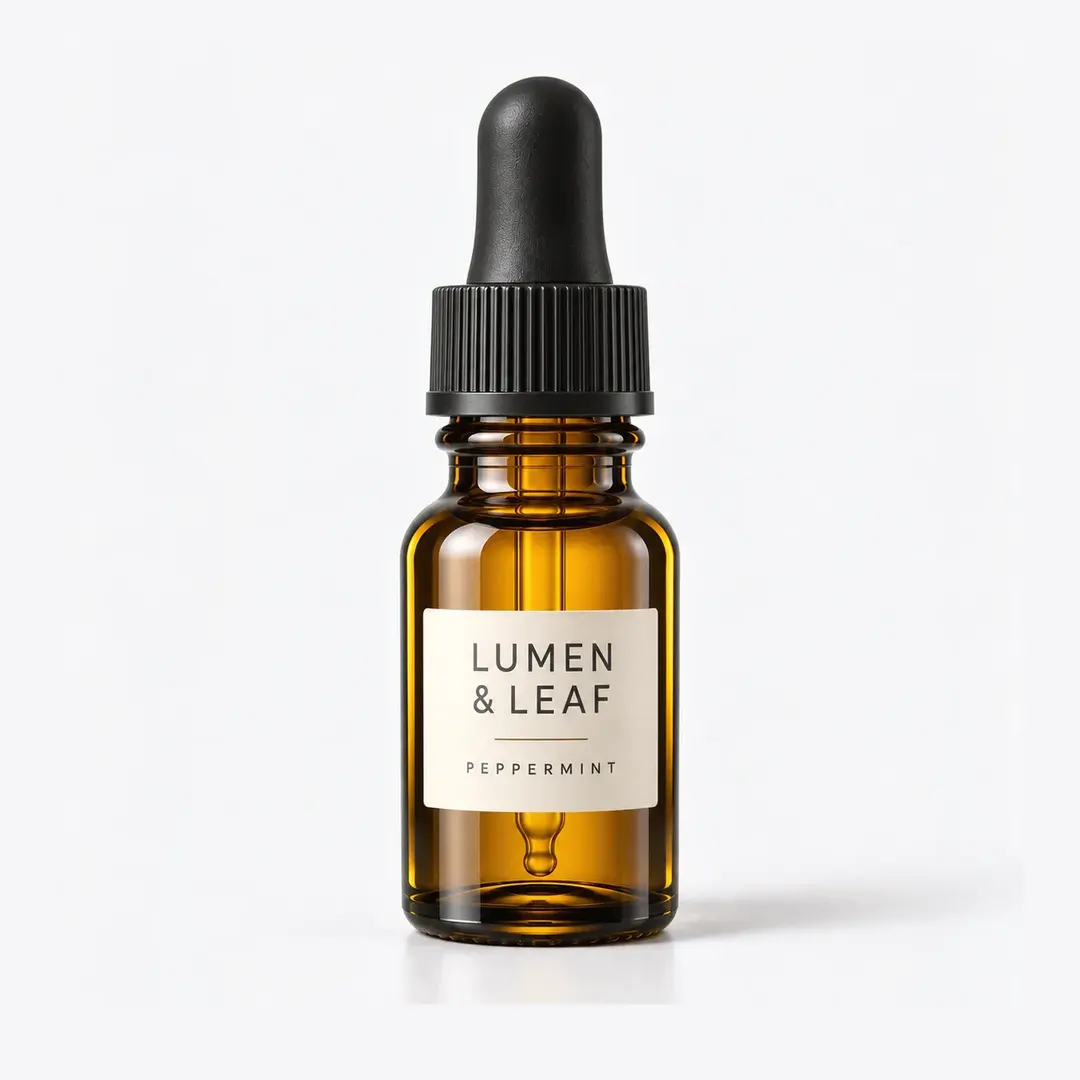
Amber Glass Dropper Bottle Series 5562 centers on the small-format amber vial shown in close-up here: a compact Boston round essential oil bottle with a sharply defined screw-thread neck and the molded ring that seats dropper fitments. This is the size class that essential oil, tincture, and serum brands use for their highest-value, most concentrated products, which makes one question dominate the buying decision: how precisely can the end user dose the contents? This page examines that question from the bottle side of the assembly, for brand founders and packaging buyers who specify dropper systems.
Dosing Precision Starts at the Neck Finish
Buyers often treat the dropper cap as the only variable in dosing, but consistent drops begin with the bottle. The neck in the photo shows a continuous, evenly pitched thread and a clean horizontal transfer ring below it. That ring is where an orifice reducer or dropper fitment seats; if the ring is wavy or off-level, the reducer tilts, the orifice goes off-center, and drop size varies. Tight dimensional control on the neck bore matters just as much: a reducer pressed into an oversize bore weeps, while one forced into an undersize bore can crack the neck or pop out in transit. Neck dimensions for this series are held to the tolerances stated on the technical drawing, which we share at quotation so you can cross-check against your chosen closure supplier’s specification.
Dropper Assemblies: Bulb, Pipette, and Drop Formation
Three components decide the user’s dosing experience. The bulb sets suction volume per squeeze; the pipette’s tip diameter and cut set drop size; and the liquid’s viscosity and surface tension do the rest. Glass pipettes with a straight-cut tip deliver the classic apothecary drop that essential oil users expect, while tapered tips slow the flow for thick carrier blends. For products where dose accuracy is a selling point, such as CBD tinctures or children’s aromatherapy blends, graduated pipettes with printed milliliter marks are worth the small cost premium. Tell us your formula’s viscosity and target dose, and we will propose a pipette geometry rather than leaving it to chance.
Orifice Reducers as a Low-Cost Alternative
Not every SKU needs a pipette. For splash-style products such as diffuser refills, massage oil bases, and fragrance oils, an orifice reducer paired with a plain screw cap dispenses clean single drops when the bottle is inverted, at a fraction of a dropper assembly’s cost. The molded ring visible on the neck of the Series 5562 vial is designed to accept standard press-in reducers. Reducers also travel better than droppers: there is no rubber bulb to perish in hot containers and no pipette to bend. Many brands run both configurations, dropper for the retail hero SKU and reducer for refills and professional sizes.
Why Small Vials Punish Closure Mistakes
In a 5 ml or 10 ml bottle, a weeping closure loses a commercially meaningful share of the fill in weeks, and a single leaking unit can oil-stain an entire retail carton. Small vials also concentrate the consequences of a bad seal because their contents are usually the most potent and most expensive per milliliter in the range. This is why we recommend that small-format SKUs always specify a lined cap with a liner material matched to the formula, and why torque control at capping deserves attention: under-torqued caps back off in vibration during sea freight, while over-torqued caps on small necks can distort the thread. Your filler should validate a torque window on actual samples before the production run.
Tamper Evidence and Child Resistance on Small Vials
Retail channels increasingly expect visible tamper evidence on ingestible or topical liquids, and small essential oil vials are no exception. Tamper-evident dropper caps carry a breakaway band that separates from the cap skirt on first opening, giving the customer instant visual confirmation of an untouched product. Where formulas are hazardous to children, push-and-turn child-resistant dropper closures are available for the common neck finishes in this series; these require a certification file from the closure maker, which we can help you collect for your market. Plan these requirements early, because child-resistant and tamper-evident variants have their own minimums and slightly longer lead times than plain caps, and switching closure platforms after bottles are tooled is far more painful than specifying correctly at quotation.
Amber Protection for Concentrated Formulas
Small-format vials are typically where brands put their most light-sensitive actives, so the amber glass in this series does real work here. The tint absorbs the UV band that drives oxidation of citrus terpenes and degradation of photolabile botanicals, keeping the fill stable through warehousing and shelf life. Exact light-transmission values for your wall thickness can be confirmed with the factory.
Quality Control and Standards
Neck-finish dimensions are gauged against drawing tolerances lot by lot, annealing is checked under polarized light, and amber tint is matched to master color plates. Packaging documentation supports Regulation (EC) No 1223/2009 for cosmetic products sold in the EU, and lot test reports are available on request.
Ordering Small-Format Vials
Small vials pack densely, so carton counts are high and per-unit freight cost is low, but their minimum order quantities are correspondingly larger than mid-size bottles; our glass bottle MOQ explained guide breaks down how that trade-off works. Vials ship in partitioned export cartons, palletized and shrink-wrapped, with droppers or reducers packed separately to protect bulbs and pipettes. First-time importers can follow our guide to importing glass bottles from China for sampling and lead-time planning. To specify Series 5562 with the right dropper or reducer for your formula, send your viscosity range, target dose, and annual volume through the contact page and we will return a matched proposal with drawings.
Frequently Asked Questions
What size is the bottle in the Series 5562 photo?
The image shows the small-format vial of the series, in the 5 ml to 10 ml class used for concentrated essential oils, tinctures, and serums. Exact brimful capacity, height, and neck dimensions are confirmed on the technical drawing at quotation.
How do I make sure my customers get a consistent drop size?
Consistent drops need three things working together: a dimensionally accurate neck bore and seating ring on the bottle, a pipette tip geometry matched to your formula’s viscosity, and a good bulb. Tell us your viscosity range and target dose and we will propose a pipette design rather than leaving drop size to chance.
Should I choose a dropper assembly or an orifice reducer?
Choose a bulb dropper with pipette when users count drops, such as tinctures and facial oils; choose a press-in orifice reducer with a plain cap for splash dispensing, diffuser refills, and cost-sensitive SKUs. Many brands use droppers on retail sizes and reducers on refills. Both seat on the same molded neck ring.
Why do small vials leak more often than large bottles?
They do not inherently leak more, but failures hurt more: a weeping seal loses a large share of a 5 ml fill quickly, and small necks are easier to over-torque. Specify a liner matched to your formula and have your filler validate a torque window on real samples before the production run.
Can I get graduated pipettes for measured dosing?
Yes, glass pipettes with printed milliliter graduations are available for the common sizes of this series and are popular for CBD tinctures and dosed aromatherapy blends. They add a modest cost premium over plain pipettes; ask for both options when you request a quotation.
What quality checks and export packing apply to small vials?
Vials ship in partitioned export cartons, palletized and shrink-wrapped, with closures packed separately to protect bulbs and pipettes.


