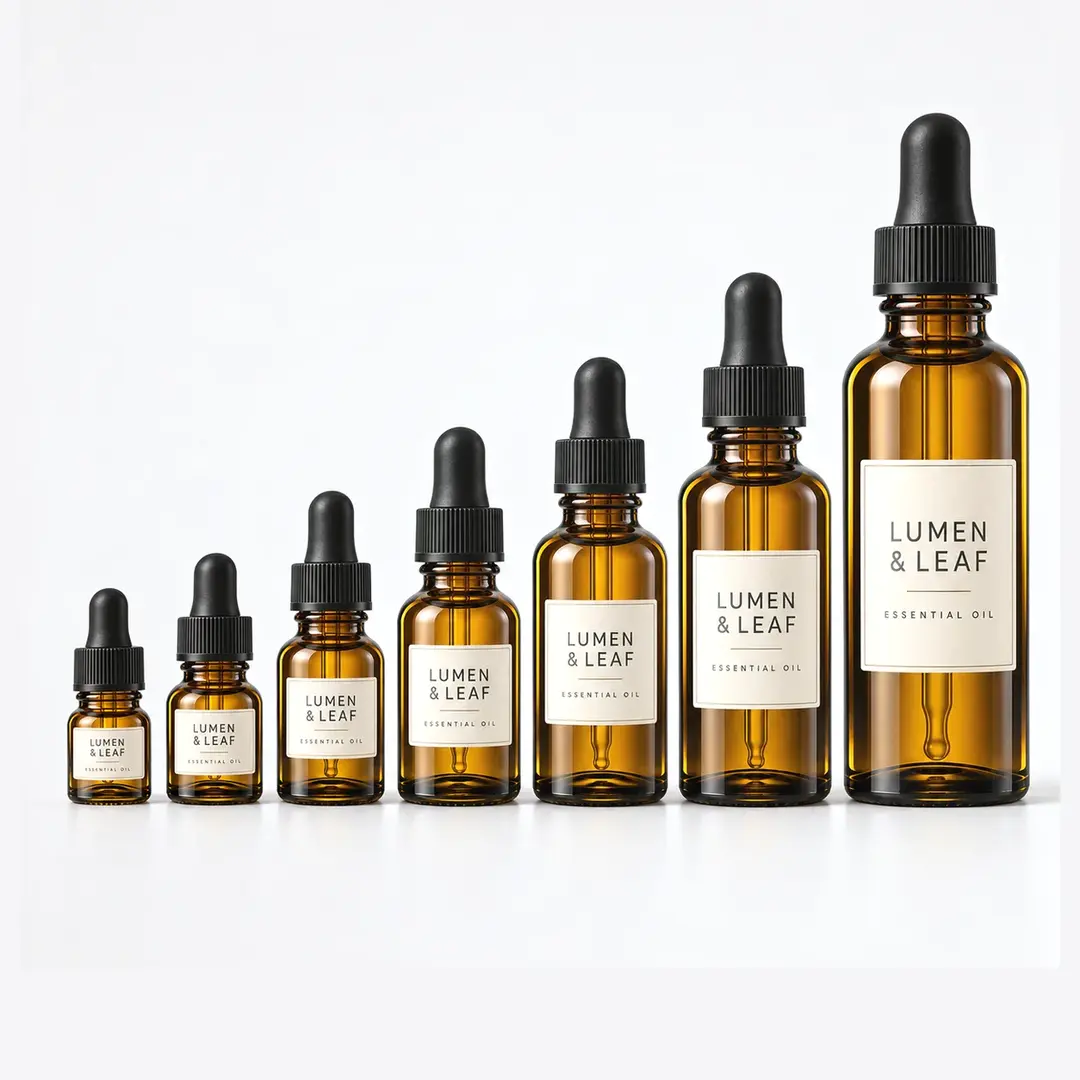
Amber Glass Dropper Bottle Series 5564 is a coordinated family of seven amber Boston round bottles, photographed here from the smallest sampler to the largest refill format. For essential oil and aromatherapy brands, the commercial value of this series is not any single bottle but the ladder itself: one design language that lets a product line climb from a discovery vial through the standard retail size to a salon or refill format without changing suppliers, closures, or visual identity. This page is for brand owners and purchasing managers planning exactly that kind of tiered assortment.
Designing a Sample-to-Refill Product Ladder
Mature essential oil brands rarely sell one size. A typical ladder starts with a small vial used for discovery sets, gift boxes, and subscription samplers; steps up to the 10 ml and 30 ml formats that dominate online retail; and tops out with 50 ml or 100 ml bottles sold to spas, practitioners, and refill stations. Series 5564 maps onto this structure directly. Because every step shares the same amber tint, shoulder radius, and neck proportions, customers recognize the brand instantly whether they hold the sampler or the refill, and marketing photography can shoot the whole range as one family.
The ladder also serves pricing strategy. Small sizes carry a high price per milliliter and recruit new customers; mid sizes carry the volume; large sizes reward loyalty and reduce packaging cost per milliliter. Having all three tiers from one mold family keeps the economics clean.
How a Unified Neck Finish Simplifies Procurement
Look along the row in the photo and notice that the screw-thread necks belong to one finish family across the sizes. That consistency is a purchasing asset. A single dropper cap platform, one orifice reducer design, and one tamper-evident closure line can serve most of the ladder, so closure inventory shrinks from many SKUs to a few. Contract fillers benefit too: one capping chuck and one torque setting cover most changeovers, which shortens setup time when a production day switches between sizes. The smallest and largest bottles in a ladder sometimes step to an adjacent thread standard, so confirm each capacity’s neck specification on the technical drawing at quotation.
Labeling Real Estate Across the Sizes
Cylindrical Boston round bodies give a continuous labeling surface, but usable label height shrinks fast on the small vials. When planning the ladder, design the label system once: a full-wrap label for mid and large sizes, and a condensed front-and-back panel layout for the samplers, keeping the same typography and hierarchy. Doing this at the start avoids the common trap of a beautiful 30 ml label that becomes illegible when compressed onto a 5 ml vial. Our team can share dimensioned drawings so your designer works from real measurements rather than estimates.
Matching Closures to Each Tier of the Ladder
Different rungs of the ladder usually want different dispensing hardware, even when the neck finish is shared. Sampler vials are commonly paired with simple orifice reducers and plain screw caps, because the goal is low unit cost and leak-proof transit rather than measured dosing. Mid-range retail bottles earn the full bulb dropper assembly with a calibrated glass pipette, since end users count drops at this size. Refill formats often ship with a plain cap plus a separate reducer in the carton, because spas and refill stations decant rather than dose. Planning closures tier by tier like this keeps the sampler cheap, the retail bottle premium, and the refill practical, all on the same neck platform.
Stocking Strategy and Inventory Economics
Buying the whole ladder at once is rarely optimal. A practical approach is to anchor inventory on the one or two sizes that carry most of your volume, order samplers in campaign-sized batches tied to promotions, and treat refill sizes as a lower-velocity line reviewed quarterly. Each capacity carries its own minimum order quantity; our glass bottle MOQ explained guide shows how MOQs typically scale with size and decoration so you can phase purchases sensibly.
Amber Protection Across the Whole Range
Every tier of the ladder carries the same amber glass, so light-sensitive formulas stay protected whether the customer buys a sampler or a refill. This matters more than it first appears: samplers often travel in clear cosmetic bags and sit on bright vanities, while refill bottles live under salon lighting for months. Because the tint is matched across all seven sizes, the protection story in your marketing holds for every SKU, and you never face the awkward question of why the small bottle is amber but the large one is not. Light-transmission specifics for your chosen wall thickness can be confirmed with the factory at quotation.
Quality Control and Standards
Every capacity in Series 5564 is produced and inspected to recognized international methods: thermal shock resistance per ASTM C149, internal pressure strength per ISO 7458, and vertical load resistance per ISO 8113. Annealing is verified by polarized-light inspection, and amber tint is matched against master color plates so the sampler and the refill read as the same product on the shelf. For brands selling into the European Union, packaging documentation supports Regulation (EC) No 1223/2009 compliance. Lot-level test reports are available on request.
Export Packing and Getting a Quotation
Bottles leave our facility in partitioned export cartons, palletized and shrink-wrapped as shown above, with closures optionally packed separately to protect dropper bulbs. If this is your first time sourcing packaging from China, our step-by-step guide to importing glass bottles from China covers sampling, production lead times, and sea-freight planning. To price a ladder built on Series 5564, send us your target capacities, annual volumes per size, and closure preferences via the contact page; we will reply with a quotation and the technical drawings for each step of the range.
Frequently Asked Questions
What capacities does Series 5564 cover?
The series is a seven-step ladder from small sampler vials up to refill-format bottles, spanning the standard essential-oil sizes in the 5 ml to 100 ml class. Exact brimful capacities, heights, and diameters for each step are provided on the technical drawings at quotation.
Why buy a whole size ladder instead of just my best-selling bottle?
A ladder lets one product line serve discovery, retail, and refill occasions with a single visual identity. Samplers recruit customers at high price per milliliter, mid sizes carry volume, and large formats reward loyalty. Sourcing all tiers from one mold family also keeps closures, labels, and photography consistent.
Do all sizes in the series take the same dropper cap?
The necks belong to one finish family, so a single dropper cap and reducer platform generally serves most of the ladder, with pipette length adjusted per size. The smallest and largest capacities sometimes use an adjacent thread standard; confirm each neck finish on the drawing before committing to closure stock.
How should I plan inventory across seven sizes?
Anchor stock on your one or two highest-velocity sizes, order samplers in campaign batches tied to promotions, and review refill sizes quarterly. Each capacity has its own MOQ, which typically scales with size; our MOQ guide on the site explains the structure so you can phase purchases.
Can labels be designed to work on both tiny and large bottles?
Yes, if the label system is planned once: a full-wrap layout for mid and large sizes and a condensed front-and-back panel for samplers, sharing typography and hierarchy. We supply dimensioned drawings so your designer works from real measurements.
How are these bottles tested and packed for export?
Production lots are checked per ASTM C149 (thermal shock), ISO 7458 (internal pressure), and ISO 8113 (vertical load), with annealing inspection and amber tint matching against master plates. Bottles ship in partitioned export cartons, palletized and shrink-wrapped, and documentation supports EU Regulation (EC) No 1223/2009.


