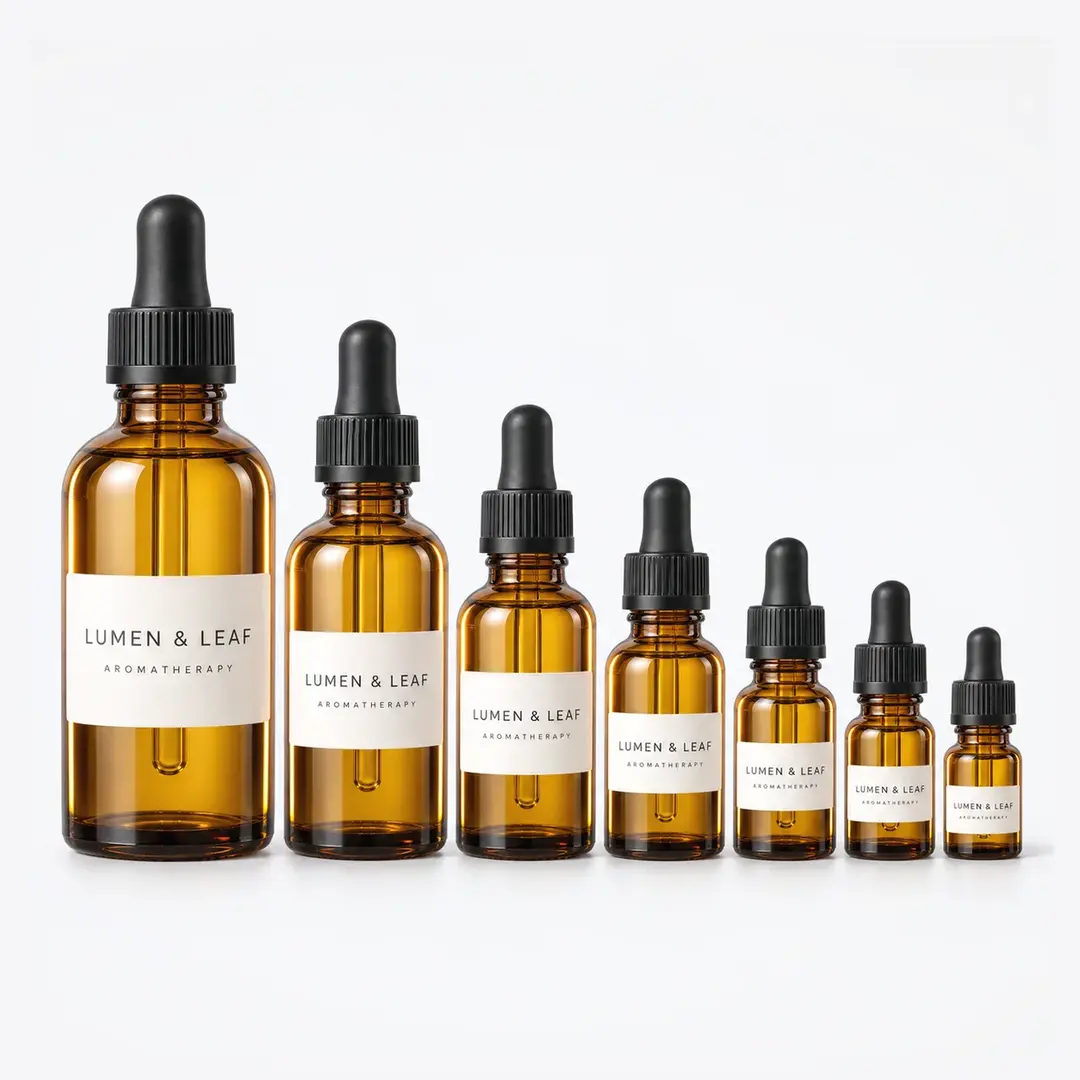
Amber Glass Dropper Bottle Series 5565 is a seven-size ladder of Boston round amber glass bottles built for essential oil, aromatherapy, and apothecary brands that sell light-sensitive liquids. The series runs from small sampler vials up to bulk refill sizes, and every bottle in the photo shares the same warm amber tint and screw-thread neck finish, so a brand can carry one visual identity from a discovery vial to a studio refill. This page is written for brand founders, contract fillers, and wholesale buyers who need to know why amber glass is the default answer for photosensitive formulas and what to check before placing an order.
Why Amber Glass Protects Light-Sensitive Formulas
Essential oils, fragrance concentrates, CBD tinctures, and many active serums degrade under ultraviolet and short-wave visible light. Citrus oils oxidize and lose their top notes; photolabile actives such as retinol alternatives and certain botanical extracts break down measurably after weeks on a bright shelf. Amber glass addresses this at the material level: iron, sulfur, and carbon compounds in the melt absorb the majority of UV radiation and a large share of visible blue light before it reaches the fill. Compared with flint (clear) glass, amber typically cuts transmission in the damaging 300-450 nm band to a small fraction, which is why pharmacopoeias have specified amber containers for light-sensitive preparations for decades.
For a buyer, the practical takeaway is simple: if your formula carries a “protect from light” instruction in its stability file, amber is not a styling choice but a shelf-life decision. The Series 5565 tint is consistent across all seven sizes in the image, which matters when the same SKU is sold in 10 ml retail and 100 ml refill formats. Exact light-transmission data for your required wall thickness can be confirmed on the technical drawing at quotation.
Amber Glass Versus UV Coatings and Secondary Packaging
Brands sometimes ask whether a clear bottle with a UV-blocking spray coating, or a clear bottle inside an opaque carton, can replace amber glass. Coatings can work, but they add a process step, raise per-unit cost, and can scratch or haze in transit, which undermines both protection and appearance. Opaque cartons protect the product only while the box stays closed; once the bottle sits on a bathroom shelf or a retail display, the fill is exposed again. Amber glass builds the protection into the container itself, works for the life of the product, and signals apothecary authenticity that consumers in the essential oil aisle actively look for. For most light-sensitive formulas it remains the lowest-risk, lowest-friction choice.
The Boston Round Shape and What It Means on the Shelf
Every bottle in the series uses the classic Boston round silhouette: cylindrical body, rounded shoulder, and a short neck. This shape has stayed dominant in the essential oil trade for functional reasons. The rounded shoulder sheds liquid cleanly when the bottle is tilted, so pipettes and reducers evacuate almost the entire fill. The cylindrical body maximizes label area relative to volume, which helps when regulatory text, ingredient lists, and barcodes must all fit on a 10 ml bottle. And the form nests efficiently in standard cartons and dividers, reducing freight damage per unit.
The heavy base visible in the photo also gives the smaller sizes a low center of gravity, a quiet but real advantage on retail shelves where 5 ml vials tip easily.
One Neck Finish Across Seven Sizes
A detail worth pausing on: although capacities step from sampler to refill, the neck finish family stays consistent across the ladder. In practice this means one dropper assembly design, one reducer insert, and one tamper-evident cap platform can serve the entire series, with pipette length being the main size-specific variable. For a growing brand this collapses procurement complexity: fewer closure SKUs, fewer minimum orders, and one capping chuck setup at the filler. Confirm the exact thread specification for each capacity with the factory, since the smallest and largest sizes sometimes step to adjacent neck standards.
Closures and Fitments for Series 5565
The bottles are shown open, which is how they ship: closures are matched at order time. Typical pairings include bulb dropper caps with glass or plastic pipettes, orifice reducers with screw caps for splash dispensing, and tamper-evident dropper assemblies for retail channels that demand visible seal integrity. For child-resistant requirements, push-and-turn dropper caps are available on the common sizes. Gasket and liner material should be chosen against your formula’s solvent load; high-limonene citrus blends, for example, call for liners rated for aggressive essential oils.
Quality Control and Standards
Production lots for this series are checked against internationally recognized glass container methods. Thermal shock resistance is verified per ASTM C149, internal pressure strength per ISO 7458, and resistance to vertical load per ISO 8113. Annealing quality is checked with polarized light inspection, and amber color consistency is compared against master tint plates lot by lot. For cosmetic fills sold in the European Union, packaging is documented to support compliance with Regulation (EC) No 1223/2009 packaging-material requirements. Test reports for the current production lot are available on request.
Ordering, MOQ, and Export Packing
Each capacity in the series carries its own minimum order quantity, with the popular mid-range sizes typically offering the lowest entry point; see our glass bottle MOQ explained guide for how MOQs are structured by size and decoration. Bottles are packed in partitioned export cartons, palletized, and shrink-wrapped as shown above; dropper assemblies can be packed separately to protect bulbs in transit. Buyers new to sourcing from China can walk through the full process in our guide to importing glass bottles from China, covering sampling, lead times, and sea-freight planning. To get pricing on specific sizes from Series 5565, send your target capacities and closure preferences through our contact page and we will return a quotation with the technical drawings.
Frequently Asked Questions
Which sizes are available in Amber Glass Dropper Bottle Series 5565?
The series is a seven-capacity ladder running from small sampler vials up to bulk refill bottles, covering the standard essential-oil sizes in the 5 ml to 100 ml class. The exact capacity of each step, together with brimful volume and neck-finish data, is confirmed on the technical drawing at quotation.
Is amber glass really necessary for essential oils, or is it just for looks?
It is functional, not cosmetic. Amber glass absorbs most UV and much short-wave visible light, which slows oxidation of citrus terpenes and protects photolabile actives. If your stability file says “protect from light”, amber is the correct default; clear glass would need a secondary opaque carton to deliver equivalent protection.
Can I use the same dropper cap across all seven sizes in the series?
The neck-finish family is consistent across the ladder, so one dropper assembly platform generally fits the whole series, with pipette length adjusted per capacity. The smallest and largest sizes sometimes step to an adjacent thread standard, so confirm the exact neck finish for each capacity with the factory before ordering closures in bulk.
What closure options can be supplied with these bottles?
Typical pairings include bulb dropper caps with glass or plastic pipettes, orifice reducers with screw caps, tamper-evident dropper assemblies, and child-resistant push-and-turn caps on common sizes. For high-limonene citrus formulas we recommend liners rated for aggressive essential oils; tell us your formula type and we will propose the liner.
How are the bottles tested before shipment?
Lots are checked for thermal shock per ASTM C149, internal pressure per ISO 7458, vertical load per ISO 8113, plus annealing inspection and amber tint comparison against master plates. Documentation supports EU Regulation (EC) No 1223/2009 packaging requirements, and lot test reports are available on request.
What is the MOQ and how are the bottles packed for export?
MOQ varies by capacity, with mid-range sizes usually offering the lowest entry; our MOQ guide on the site explains the structure. Bottles ship in partitioned export cartons, palletized and shrink-wrapped, and dropper assemblies can be packed separately to protect the bulbs. Sea-freight lead times and sampling steps are covered in our importing-from-China guide.


